P49956
Gene name |
CTF18 (CHL12, YMR078C, YM9582.03C) |
Protein name |
Chromosome transmission fidelity protein 18 |
Names |
|
Species |
Saccharomyces cerevisiae (strain ATCC 204508 / S288c) (Baker's yeast) |
KEGG Pathway |
sce:YMR078C |
EC number |
|
Protein Class |
|
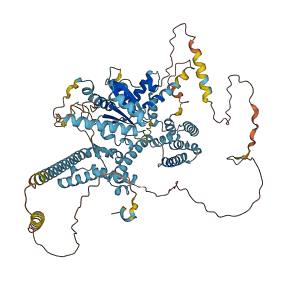
Descriptions
The autoinhibited protein was predicted that may have potential autoinhibitory elements via cis-regPred.
Autoinhibitory domains (AIDs)
Target domain |
|
Relief mechanism |
|
Assay |
cis-regPred |
Accessory elements
No accessory elements
Autoinhibited structure

Activated structure
12 variants for P49956
| Variant ID(s) | Position | Change | Description | Diseaes Association | Provenance |
|---|---|---|---|---|---|
| s13-424655 | 25 | A>T | No | SGRP | |
| s13-424309 | 140 | G>A | No | SGRP | |
| s13-423887 | 281 | R>S | No | SGRP | |
| s13-423602 | 376 | S>T | No | SGRP | |
| s13-423569 | 387 | T>A | No | SGRP | |
| s13-423533 | 399 | W>R | No | SGRP | |
| s13-423202 | 509 | S>N | No | SGRP | |
| s13-423155 | 525 | S>G | No | SGRP | |
| s13-423113 | 539 | A>T | No | SGRP | |
| s13-422926 | 601 | R>T | No | SGRP | |
| s13-422713 | 672 | N>S | No | SGRP | |
| s13-422591 | 713 | N>D | No | SGRP |
No associated diseases with P49956
4 GO annotations of cellular component
| Name | Definition |
|---|---|
| Ctf18 RFC-like complex | A heptameric complex related to replication factor C, which loads the DNA polymerase processivity factor proliferating cell nuclear antigen (PCNA) onto DNA and plays a vital role in chromosome cohesion. In Saccharomyces the subunits are known as Ctf18p, Rfc2p, Rfc3p, Rfc4p, Rfc5p, Dcc1p, and Ctf8p. |
| mitochondrion | A semiautonomous, self replicating organelle that occurs in varying numbers, shapes, and sizes in the cytoplasm of virtually all eukaryotic cells. It is notably the site of tissue respiration. |
| nuclear replication fork | The Y-shaped region of a nuclear replicating DNA molecule, resulting from the separation of the DNA strands and in which the synthesis of new strands takes place. Also includes associated protein complexes. |
| nucleus | A membrane-bounded organelle of eukaryotic cells in which chromosomes are housed and replicated. In most cells, the nucleus contains all of the cell's chromosomes except the organellar chromosomes, and is the site of RNA synthesis and processing. In some species, or in specialized cell types, RNA metabolism or DNA replication may be absent. |
3 GO annotations of molecular function
| Name | Definition |
|---|---|
| ATP binding | Binding to ATP, adenosine 5'-triphosphate, a universally important coenzyme and enzyme regulator. |
| ATP hydrolysis activity | Catalysis of the reaction: ATP + H2O = ADP + H+ phosphate. ATP hydrolysis is used in some reactions as an energy source, for example to catalyze a reaction or drive transport against a concentration gradient. |
| DNA binding | Any molecular function by which a gene product interacts selectively and non-covalently with DNA (deoxyribonucleic acid). |
4 GO annotations of biological process
| Name | Definition |
|---|---|
| DNA replication initiation | The process in which DNA-dependent DNA replication is started; this begins with the ATP dependent loading of an initiator complex onto the DNA, this is followed by DNA melting and helicase activity. In bacteria, the gene products that enable the helicase activity are loaded after the initial melting and in archaea and eukaryotes, the gene products that enable the helicase activity are inactive when they are loaded and subsequently activate. |
| double-strand break repair via homologous recombination | The error-free repair of a double-strand break in DNA in which the broken DNA molecule is repaired using homologous sequences. A strand in the broken DNA searches for a homologous region in an intact chromosome to serve as the template for DNA synthesis. The restoration of two intact DNA molecules results in the exchange, reciprocal or nonreciprocal, of genetic material between the intact DNA molecule and the broken DNA molecule. |
| maintenance of DNA trinucleotide repeats | Any process involved in sustaining the fidelity and copy number of DNA trinucleotide repeats. DNA trinucleotide repeats are naturally occurring runs of three base-pairs. |
| mitotic sister chromatid cohesion | The cell cycle process in which the sister chromatids of a replicated chromosome are joined along the entire length of the chromosome, from their formation in S phase through metaphase during a mitotic cell cycle. This cohesion cycle is critical for high fidelity chromosome transmission. |
| 10 | 20 | 30 | 40 | 50 | 60 |
| MVDTAPYIGS | LGRSSLFDTG | DIEQAPGNNA | IGINEEDIHA | FVSSTGETVQ | LKKKPAKLAT |
| 70 | 80 | 90 | 100 | 110 | 120 |
| GNISLYTNPD | TVWRSDDTYG | ININYLLDKI | EASGDDRTNA | QKTSPITGKI | GSDTLWVEKW |
| 130 | 140 | 150 | 160 | 170 | 180 |
| RPKKFLDLVG | NEKTNRRMLG | WLRQWTPAVF | KEQLPKLPTE | KEVSDMELDP | LKRPPKKILL |
| 190 | 200 | 210 | 220 | 230 | 240 |
| LHGPPGIGKT | SVAHVIAKQS | GFSVSEINAS | DERAGPMVKE | KIYNLLFNHT | FDTNPVCLVA |
| 250 | 260 | 270 | 280 | 290 | 300 |
| DEIDGSIESG | FIRILVDIMQ | SDIKATNKLL | YGQPDKKDKK | RKKKRSKLLT | RPIICICNNL |
| 310 | 320 | 330 | 340 | 350 | 360 |
| YAPSLEKLKP | FCEIIAVKRP | SDTTLLERLN | LICHKENMNI | PIKAINDLID | LAQGDVRNCI |
| 370 | 380 | 390 | 400 | 410 | 420 |
| NNLQFLASNV | DSRDSSASDK | PACAKNTWAS | SNKDSPISWF | KIVNQLFRKD | PHRDIKEQFY |
| 430 | 440 | 450 | 460 | 470 | 480 |
| ELLNQVELNG | NSDRILQGCF | NIFPYVKYSD | NGIRKPANIS | DWLFFHDLMY | QSMYAHNGEL |
| 490 | 500 | 510 | 520 | 530 | 540 |
| LRYSALVPLV | FFQTFGDIAN | KDDIRMKNSE | YEQRELKRAN | SDIVSLIMRH | ISVQSPLMAS |
| 550 | 560 | 570 | 580 | 590 | 600 |
| FTDRKSLIFE | ILPYLDSMIS | SDFNKIRNLK | LKQAIMEELV | QLLKSFQLNL | IQNRSEGFDV |
| 610 | 620 | 630 | 640 | 650 | 660 |
| RGGLTIDPPI | DEVVLLNPKH | INEVQHKRAN | NLSSLLAKIE | ENRAKKRHID | QVTEDRLQSQ |
| 670 | 680 | 690 | 700 | 710 | 720 |
| EMHSKKVKTG | LNSSSSTIDF | FKNQYGLLKQ | TQELEETQKT | IGSDETNQAD | DCNQTVKIWV |
| 730 | 740 | ||||
| KYNEGFSNAV | RKNVTWNNLW | E |