P47937
Gene name |
Tacr3 (Tac3r) |
Protein name |
Neuromedin-K receptor |
Names |
NKR, NK-3 receptor, NK-3R, Neurokinin B receptor, Tachykinin receptor 3 |
Species |
Mus musculus (Mouse) |
KEGG Pathway |
mmu:21338 |
EC number |
|
Protein Class |
|
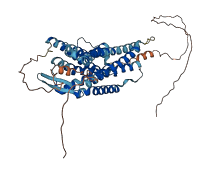
Descriptions
The autoinhibited protein was predicted that may have potential autoinhibitory elements via cis-regPred.
Autoinhibitory domains (AIDs)
Target domain |
|
Relief mechanism |
|
Assay |
cis-regPred |
Accessory elements
No accessory elements
Autoinhibited structure

Activated structure
1 structures for P47937
| Entry ID | Method | Resolution | Chain | Position | Source |
|---|---|---|---|---|---|
| AF-P47937-F1 | Predicted | AlphaFoldDB |
31 variants for P47937
| Variant ID(s) | Position | Change | Description | Diseaes Association | Provenance |
|---|---|---|---|---|---|
| rs223229396 | 3 | S>W | No | EVA | |
| rs3388665680 | 7 | G>V | No | EVA | |
| rs3388666296 | 13 | G>R | No | EVA | |
| rs213445345 | 22 | G>V | No | EVA | |
| rs47793185 | 26 | A>T | No | EVA | |
| rs3388666580 | 30 | I>N | No | EVA | |
| rs3388662669 | 36 | L>F | No | EVA | |
| rs256956451 | 44 | A>V | No | EVA | |
| rs256282123 | 66 | V>L | No | EVA | |
| rs3388659391 | 71 | R>Q | No | EVA | |
| rs45864971 | 87 | V>I | No | EVA | |
| rs3388666287 | 114 | L>V | No | EVA | |
| rs3393615189 | 121 | V>E | No | EVA | |
| rs3388665660 | 121 | V>L | No | EVA | |
| rs3388660857 | 133 | G>D | No | EVA | |
| rs31379347 | 134 | V>L | No | EVA | |
| rs3388667895 | 153 | I>F | No | EVA | |
| rs3388666275 | 168 | V>A | No | EVA | |
| rs3388669877 | 189 | I>T | No | EVA | |
| rs3388665694 | 210 | K>Q | No | EVA | |
| rs3388665688 | 250 | M>I | No | EVA | |
| rs3388663867 | 310 | A>G | No | EVA | |
| rs3393692337 | 327 | A>G | No | EVA | |
| rs3388666215 | 330 | W>* | No | EVA | |
| rs3388669950 | 331 | L>R | No | EVA | |
| rs3388665658 | 401 | D>Y | No | EVA | |
| rs36689332 | 404 | E>D | No | EVA | |
| rs3388665655 | 406 | D>N | No | EVA | |
| rs13477425 | 431 | F>S | No | EVA | |
| rs3388663875 | 434 | A>T | No | EVA | |
| rs3388669905 | 435 | S>Y | No | EVA |
No associated diseases with P47937
8 GO annotations of cellular component
| Name | Definition |
|---|---|
| cytoplasm | The contents of a cell excluding the plasma membrane and nucleus, but including other subcellular structures. |
| dendrite membrane | The portion of the plasma membrane surrounding a dendrite. |
| integral component of membrane | The component of a membrane consisting of the gene products and protein complexes having at least some part of their peptide sequence embedded in the hydrophobic region of the membrane. |
| membrane | A lipid bilayer along with all the proteins and protein complexes embedded in it an attached to it. |
| neuronal cell body membrane | The plasma membrane of a neuron cell body - excludes the plasma membrane of cell projections such as axons and dendrites. |
| nucleus | A membrane-bounded organelle of eukaryotic cells in which chromosomes are housed and replicated. In most cells, the nucleus contains all of the cell's chromosomes except the organellar chromosomes, and is the site of RNA synthesis and processing. In some species, or in specialized cell types, RNA metabolism or DNA replication may be absent. |
| plasma membrane | The membrane surrounding a cell that separates the cell from its external environment. It consists of a phospholipid bilayer and associated proteins. |
| sperm midpiece | The highly organized segment of the sperm flagellum which begins at the connecting piece and is characterized by the presence of 9 outer dense fibers (ODFs) that lie outside each of the 9 outer axonemal microtubule doublets and by a sheath of mitochondria that encloses the ODFs and the axoneme; the midpiece terminates about one-fourth of the way down the sperm flagellum at the annulus, which marks the beginning of the principal piece. |
1 GO annotations of molecular function
| Name | Definition |
|---|---|
| tachykinin receptor activity | Combining with a tachykinin neuropeptide and transmitting the signal across the membrane by activating an associated G-protein. |
11 GO annotations of biological process
| Name | Definition |
|---|---|
| aging | A developmental process that is a deterioration and loss of function over time. Aging includes loss of functions such as resistance to disease, homeostasis, and fertility, as well as wear and tear. Aging includes cellular senescence, but is more inclusive. May precede death and may succeed developmental maturation (GO:0021700). |
| hyperosmotic salinity response | Any process that results in a change in state or activity of a cell or an organism (in terms of movement, secretion, enzyme production, gene expression, etc.) as a result of detection of, or exposure to, an increase in the concentration of salt (particularly but not exclusively sodium and chloride ions) in the environment. |
| positive regulation of blood pressure | Any process in which the force of blood traveling through the circulatory system is increased. |
| positive regulation of flagellated sperm motility | Any process that activates or increases the frequency, rate or extent of flagellated sperm motility. |
| positive regulation of heart rate | Any process that activates or increases the frequency or rate of heart contraction. |
| positive regulation of uterine smooth muscle contraction | Any process that increases the frequency, rate or extent of uterine smooth muscle contraction. |
| regulation of dopamine metabolic process | Any process that modulates the frequency, rate or extent of the chemical reactions and pathways involving dopamine. |
| regulation of feeding behavior | Any process that modulates the rate, frequency or extent of the behavior associated with the intake of food. |
| response to cocaine | Any process that results in a change in state or activity of a cell or an organism (in terms of movement, secretion, enzyme production, gene expression, etc.) as a result of a cocaine stimulus. Cocaine is a crystalline alkaloid obtained from the leaves of the coca plant. |
| response to estradiol | Any process that results in a change in state or activity of a cell or an organism (in terms of movement, secretion, enzyme production, gene expression, etc.) as a result of stimulus by estradiol, a C18 steroid hormone hydroxylated at C3 and C17 that acts as a potent estrogen. |
| response to morphine | Any process that results in a change in state or activity of a cell or an organism (in terms of movement, secretion, enzyme production, gene expression, etc.) as a result of a morphine stimulus. Morphine is an opioid alkaloid, isolated from opium, with a complex ring structure. |
| 10 | 20 | 30 | 40 | 50 | 60 |
| MASVPTGENW | TDGTAGVGSH | TGNLSAALGI | TEWLALQAGN | FSSALGLPVT | SQAPSQVRAN |
| 70 | 80 | 90 | 100 | 110 | 120 |
| LTNQFVQPSW | RIALWSLAYG | LVVAVAVFGN | LIVIWIILAH | KRMRTVTNYF | LVNLAFSDAS |
| 130 | 140 | 150 | 160 | 170 | 180 |
| VAAFNTLVNF | IYGVHSEWYF | GANYCRFQNF | FPITAVFASI | YSMTAIAVDR | YMAIIDPLKP |
| 190 | 200 | 210 | 220 | 230 | 240 |
| RLSATATKIV | IGSIWILAFL | LAFPQCLYSK | IKVMPGRTLC | YVQWPEGPKQ | HFTYHIIVII |
| 250 | 260 | 270 | 280 | 290 | 300 |
| LVYCFPLLIM | GVTYTIVGIT | LWGGEIPGDT | CDKYHEQLKA | KRKVVKMMII | VVVTFAICWL |
| 310 | 320 | 330 | 340 | 350 | 360 |
| PYHVYFILTA | IYQQLNRWKY | IQQVYLASFW | LAMSSTMYNP | IIYCCLNKRF | RAGFKRAFRW |
| 370 | 380 | 390 | 400 | 410 | 420 |
| CPFIQVSSYD | ELELKTTRFH | PTRQSSLYTV | SRMESVTVLY | DPSEGDPAKS | SRKKRAVPRD |
| 430 | 440 | 450 | |||
| PSANGCSHRE | FKSASTTSSF | ISSPYTSVDE | YS |