P47757
Gene name |
Capzb (Cappb1) |
Protein name |
F-actin-capping protein subunit beta |
Names |
CapZ beta |
Species |
Mus musculus (Mouse) |
KEGG Pathway |
mmu:12345 |
EC number |
|
Protein Class |
|
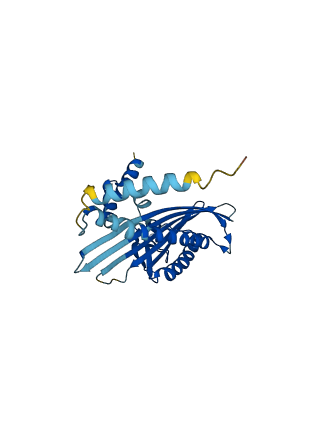
Descriptions
The autoinhibited protein was predicted that may have potential autoinhibitory elements via cis-regPred.
Autoinhibitory domains (AIDs)
Target domain |
|
Relief mechanism |
|
Assay |
cis-regPred |
Accessory elements
No accessory elements
Autoinhibited structure

Activated structure
3 structures for P47757
| Entry ID | Method | Resolution | Chain | Position | Source |
|---|---|---|---|---|---|
| 7PDZ | EM | 380 A | E | 1-270 | PDB |
| 8P94 | EM | 330 A | V | 1-270 | PDB |
| AF-P47757-F1 | Predicted | AlphaFoldDB |
6 variants for P47757
| Variant ID(s) | Position | Change | Description | Diseaes Association | Provenance |
|---|---|---|---|---|---|
| rs3388728440 | 66 | R>* | No | EVA | |
| rs3388716503 | 69 | D>N | No | EVA | |
| rs3388720903 | 148 | W>R | No | EVA | |
| rs3388701463 | 216 | L>Q | No | EVA | |
| rs3388701413 | 238 | D>E | No | EVA | |
| rs3388718707 | 246 | L>I | No | EVA |
No associated diseases with P47757
1 regional properties for P47757
| Type | Name | Position | InterPro Accession |
|---|---|---|---|
| conserved_site | F-actin capping protein, beta subunit, conserved site | 62 - 67 | IPR019771 |
16 GO annotations of cellular component
| Name | Definition |
|---|---|
| asymmetric synapse | A type of synapse occurring between an axon and a dendritic spine or dendritic shaft. Asymmetric synapses, the most abundant synapse type in the central nervous system, involve axons that contain predominantly spherical vesicles and contain a thickened postsynaptic density. Most or all synapses of this type are excitatory. |
| brush border | The dense covering of microvilli on the apical surface of an epithelial cell in tissues such as the intestine, kidney, and choroid plexus; the microvilli aid absorption by increasing the surface area of the cell. |
| cortical cytoskeleton | The portion of the cytoskeleton that lies just beneath the plasma membrane. |
| cytoskeletal calyx | A large cytoskeletal structure located at the posterior end of the perinuclear theca of a mammalian sperm head. The nucleus is tightly associated with the calyx, which contains calicin and basic cylicin proteins. |
| cytosol | The part of the cytoplasm that does not contain organelles but which does contain other particulate matter, such as protein complexes. |
| dendritic spine | A small, membranous protrusion from a dendrite that forms a postsynaptic compartment, typically receiving input from a single presynapse. They function as partially isolated biochemical and an electrical compartments. Spine morphology is variable:they can be thin, stubby, mushroom, or branched, with a continuum of intermediate morphologies. They typically terminate in a bulb shape, linked to the dendritic shaft by a restriction. Spine remodeling is though to be involved in synaptic plasticity. |
| F-actin capping protein complex | A heterodimer consisting of alpha and beta subunits that binds to and caps the barbed ends of actin filaments, thereby regulating the polymerization of actin monomers but not severing actin filaments. |
| hippocampal mossy fiber to CA3 synapse | One of the giant synapses that form between the mossy fiber axons of dentate gyrus granule cells and the large complex spines of CA3 pyramidal cells. It consists of a giant bouton known as the mossy fiber expansion, synapsed to the complex, multiheaded spine (thorny excresence) of a CA3 pyramidal cell. |
| lamellipodium | A thin sheetlike process extended by the leading edge of a migrating cell or extending cell process; contains a dense meshwork of actin filaments. |
| membrane | A lipid bilayer along with all the proteins and protein complexes embedded in it an attached to it. |
| neuronal cell body | The portion of a neuron that includes the nucleus, but excludes cell projections such as axons and dendrites. |
| postsynaptic density | An electron dense network of proteins within and adjacent to the postsynaptic membrane of an asymmetric, neuron-neuron synapse. Its major components include neurotransmitter receptors and the proteins that spatially and functionally organize them such as anchoring and scaffolding molecules, signaling enzymes and cytoskeletal components. |
| Schaffer collateral - CA1 synapse | A synapse between the Schaffer collateral axon of a CA3 pyramidal cell and a CA1 pyramidal cell. |
| sperm connecting piece | The segment of the sperm flagellum that attaches to the implantation fossa of the nucleus in the sperm head; from the remnant of the centriole at this point, the axoneme extends throughout the length of the flagellum. |
| WASH complex | A protein complex that localizes at the surface of endosomes, where it recruits and activates the Arp2/3 complex to induce actin polymerization. In human, the WASH complex is composed of F-actin-capping protein subunits alpha and beta, WASH1, FAM21, KIAA1033, KIAA0196 and CCDC53. |
| Z disc | Platelike region of a muscle sarcomere to which the plus ends of actin filaments are attached. |
1 GO annotations of molecular function
| Name | Definition |
|---|---|
| actin binding | Binding to monomeric or multimeric forms of actin, including actin filaments. |
9 GO annotations of biological process
| Name | Definition |
|---|---|
| actin polymerization or depolymerization | Assembly or disassembly of actin filaments by the addition or removal of actin monomers from a filament. |
| barbed-end actin filament capping | The binding of a protein or protein complex to the barbed (or plus) end of an actin filament, thus preventing the addition, exchange or removal of further actin subunits. |
| cell morphogenesis | The developmental process in which the size or shape of a cell is generated and organized. |
| cell projection organization | A process that is carried out at the cellular level which results in the assembly, arrangement of constituent parts, or disassembly of a prolongation or process extending from a cell, e.g. a flagellum or axon. |
| cytoskeleton organization | A process that is carried out at the cellular level which results in the assembly, arrangement of constituent parts, or disassembly of cytoskeletal structures. |
| lamellipodium assembly | Formation of a lamellipodium, a thin sheetlike extension of the surface of a migrating cell. |
| negative regulation of filopodium assembly | Any process that stops, prevents, or reduces the frequency, rate or extent of the assembly of a filopodium, a thin, stiff protrusion extended by the leading edge of a motile cell such as a crawling fibroblast or amoeba, or an axonal growth cone. |
| regulation of cell morphogenesis | Any process that modulates the frequency, rate or extent of cell morphogenesis. Cell morphogenesis is the developmental process in which the shape of a cell is generated and organized. |
| regulation of lamellipodium assembly | Any process that modulates the rate, frequency or extent of the formation of a lamellipodium, a thin sheetlike extension of the surface of a migrating cell. |
| 10 | 20 | 30 | 40 | 50 | 60 |
| MSDQQLDCAL | DLMRRLPPQQ | IEKNLSDLID | LVPSLCEDLL | SSVDQPLKIA | RDKVVGKDYL |
| 70 | 80 | 90 | 100 | 110 | 120 |
| LCDYNRDGDS | YRSPWSNKYD | PPLEDGAMPS | ARLRKLEVEA | NNAFDQYRDL | YFEGGVSSVY |
| 130 | 140 | 150 | 160 | 170 | 180 |
| LWDLDHGFAG | VILIKKAGDG | SKKIKGCWDS | IHVVEVQEKS | SGRTAHYKLT | STVMLWLQTN |
| 190 | 200 | 210 | 220 | 230 | 240 |
| KSGSGTMNLG | GSLTRQMEKD | ETVSDCSPHI | ANIGRLVEDM | ENKIRSTLNE | IYFGKTKDIV |
| 250 | 260 | 270 | |||
| NGLRSLDAIP | DNHKFKQLQR | ELSQVLTQRQ | VYIQPDN |