P47756
Gene name |
CAPZB |
Protein name |
F-actin-capping protein subunit beta |
Names |
CapZ beta |
Species |
Homo sapiens (Human) |
KEGG Pathway |
hsa:832 |
EC number |
|
Protein Class |
|
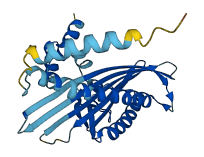
Descriptions
The autoinhibited protein was predicted that may have potential autoinhibitory elements via cis-regPred.
Autoinhibitory domains (AIDs)
Target domain |
|
Relief mechanism |
|
Assay |
cis-regPred |
Accessory elements
No accessory elements
Autoinhibited structure

Activated structure
2 structures for P47756
| Entry ID | Method | Resolution | Chain | Position | Source |
|---|---|---|---|---|---|
| 8F8Q | EM | 279 A | H | 2-270 | PDB |
| AF-P47756-F1 | Predicted | AlphaFoldDB |
80 variants for P47756
| Variant ID(s) | Position | Change | Description | Diseaes Association | Provenance |
|---|---|---|---|---|---|
|
CA19147684 rs868018192 |
3 | D>Y | No |
ClinGen Ensembl |
|
|
CA339249094 rs1285180944 |
19 | Q>* | No |
ClinGen gnomAD |
|
|
CA339249089 rs1210953883 |
19 | Q>R | No |
ClinGen TOPMed |
|
|
CA339249081 rs1174855778 |
20 | Q>K | No |
ClinGen gnomAD |
|
|
CA339249049 rs1467668376 |
22 | E>K | Variant assessed as Somatic; impact. [NCI-TCGA] | No |
ClinGen NCI-TCGA gnomAD |
|
rs185128330 CA655443 |
23 | K>T | No |
ClinGen 1000Genomes ExAC TOPMed gnomAD |
|
|
CA19147673 rs371700600 |
25 | L>V | No |
ClinGen ESP TOPMed |
|
|
CA655441 rs368022261 |
27 | D>N | No |
ClinGen 1000Genomes ESP ExAC TOPMed gnomAD |
|
|
rs1322067694 CA339248931 |
30 | D>N | No |
ClinGen gnomAD |
|
|
CA339248929 rs1322067694 |
30 | D>Y | No |
ClinGen gnomAD |
|
|
rs375068236 CA19147668 |
31 | L>V | No |
ClinGen ESP ExAC TOPMed gnomAD |
|
|
rs993754632 CA18862509 |
32 | V>A | No |
ClinGen Ensembl |
|
|
rs532876346 CA655402 |
34 | S>C | No |
ClinGen 1000Genomes ExAC TOPMed gnomAD |
|
|
CA338785426 rs532876346 |
34 | S>G | No |
ClinGen 1000Genomes ExAC TOPMed gnomAD |
|
|
CA338785436 rs532876346 |
34 | S>R | No |
ClinGen 1000Genomes ExAC TOPMed gnomAD |
|
|
CA338785417 rs1168451697 |
34 | S>T | No |
ClinGen TOPMed |
|
|
rs11555671 CA18862479 |
43 | V>A | No |
ClinGen Ensembl |
|
|
rs775385399 CA655399 |
44 | D>A | No |
ClinGen ExAC gnomAD |
|
|
rs1181167004 CA338785191 |
44 | D>H | No |
ClinGen gnomAD |
|
|
rs1178705380 CA338785027 |
53 | K>R | No |
ClinGen gnomAD |
|
|
CA338785006 rs1570074362 |
54 | V>G | No |
ClinGen Ensembl |
|
|
rs1457096979 CA338785003 |
55 | V>M | No |
ClinGen gnomAD |
|
|
rs1164984231 CA338784994 |
56 | G>R | No |
ClinGen gnomAD |
|
|
CA338784883 rs1558210195 |
65 | N>D | No |
ClinGen Ensembl |
|
|
CA338782455 rs1423990074 |
76 | S>G | No |
ClinGen gnomAD |
|
|
rs775970180 CA655372 |
77 | N>K | No |
ClinGen ExAC TOPMed gnomAD |
|
|
rs1570040709 CA338782268 |
80 | D>A | No |
ClinGen Ensembl |
|
|
rs866090505 CA18855994 |
82 | P>S | No |
ClinGen Ensembl |
|
|
CA655370 rs746198763 |
87 | A>T | Variant assessed as Somatic; impact. [NCI-TCGA] | No |
ClinGen ExAC NCI-TCGA gnomAD |
|
CA338782011 rs1488009114 |
88 | M>L | No |
ClinGen gnomAD |
|
|
CA338781961 rs1212334949 |
89 | P>L | No |
ClinGen gnomAD |
|
|
CA655369 rs779361762 |
89 | P>S | No |
ClinGen ExAC gnomAD |
|
|
rs1287229316 CA338781882 |
91 | A>P | No |
ClinGen TOPMed |
|
|
rs1300824082 CA338781856 |
92 | R>W | No |
ClinGen gnomAD |
|
|
rs1342100350 CA338781708 |
95 | K>R | No |
ClinGen gnomAD |
|
|
CA338781530 rs1570040313 |
98 | V>G | No |
ClinGen Ensembl |
|
|
CA338781337 rs1468395067 |
103 | A>T | No |
ClinGen TOPMed |
|
|
rs1358541641 CA338781281 |
104 | F>C | No |
ClinGen gnomAD |
|
|
rs943114234 CA338781255 |
105 | D>E | No |
ClinGen TOPMed gnomAD |
|
|
CA338781136 rs1259572563 |
109 | D>E | No |
ClinGen TOPMed |
|
|
rs1489427449 CA338773540 |
112 | F>Y | No |
ClinGen TOPMed |
|
|
CA655347 rs770183245 |
116 | V>I | Variant assessed as Somatic; 0.0 impact. [NCI-TCGA] | No |
ClinGen ExAC NCI-TCGA gnomAD |
|
CA655344 rs754804408 |
132 | I>M | No |
ClinGen ExAC gnomAD |
|
|
CA338772844 rs1310957804 |
141 | S>L | No |
ClinGen TOPMed |
|
|
CA338772832 rs1237566703 |
142 | K>E | No |
ClinGen TOPMed |
|
|
CA338772692 rs1312359053 |
145 | K>R | No |
ClinGen gnomAD |
|
|
CA338772349 rs1209091291 |
153 | V>L | No |
ClinGen gnomAD |
|
|
CA655339 rs750255932 |
154 | V>I | No |
ClinGen ExAC TOPMed gnomAD |
|
|
rs1569936021 CA338772304 |
155 | E>K | No |
ClinGen Ensembl |
|
|
CA338772235 rs1558182245 |
157 | Q>L | No |
ClinGen Ensembl |
|
|
CA655320 rs745616037 |
159 | K>R | No |
ClinGen ExAC gnomAD |
|
|
CA655319 rs778714039 |
162 | G>S | No |
ClinGen ExAC gnomAD |
|
|
CA655318 rs377121153 |
163 | R>C | Variant assessed as Somatic; 0.0 impact. [NCI-TCGA] | No |
ClinGen ESP ExAC NCI-TCGA gnomAD |
|
CA338771685 rs1266726751 |
163 | R>H | Variant assessed as Somatic; impact. [NCI-TCGA] | No |
ClinGen NCI-TCGA TOPMed gnomAD |
|
rs1266726751 CA338771683 |
163 | R>L | No |
ClinGen TOPMed gnomAD |
|
|
CA655316 rs532731972 |
164 | T>I | No |
ClinGen 1000Genomes ExAC gnomAD |
|
|
CA338771617 rs1302402418 |
166 | H>R | No |
ClinGen gnomAD |
|
|
CA338771525 rs1275024781 |
168 | K>R | No |
ClinGen gnomAD |
|
|
rs370957079 CA655312 |
172 | T>M | No |
ClinGen ESP ExAC gnomAD |
|
|
rs1012732497 CA18845491 |
182 | S>T | No |
ClinGen TOPMed |
|
|
CA655310 rs765706838 |
183 | G>S | No |
ClinGen ExAC gnomAD |
|
|
CA655309 rs762321251 |
186 | T>A | No |
ClinGen ExAC |
|
|
CA338771093 rs1317767416 |
188 | N>S | No |
ClinGen TOPMed gnomAD |
|
|
CA338771092 rs1317767416 |
188 | N>T | No |
ClinGen TOPMed gnomAD |
|
|
CA338771067 rs1404652678 |
190 | G>R | Variant assessed as Somatic; 0.0 impact. [NCI-TCGA] | No |
ClinGen NCI-TCGA gnomAD |
|
CA655294 rs750948747 |
197 | M>T | No |
ClinGen ExAC gnomAD |
|
|
rs1217360518 CA338766708 |
198 | E>K | No |
ClinGen TOPMed |
|
|
CA338766669 rs1172609400 |
199 | K>N | No |
ClinGen gnomAD |
|
|
rs549370964 CA655291 |
207 | S>F | No |
ClinGen 1000Genomes ExAC gnomAD |
|
|
rs775574370 CA655289 |
213 | I>F | No |
ClinGen ExAC gnomAD |
|
|
rs775574370 CA655288 |
213 | I>V | No |
ClinGen ExAC gnomAD |
|
|
CA18839525 rs1018612131 |
215 | R>H | No |
ClinGen TOPMed gnomAD |
|
|
rs1311754922 CA338765403 |
227 | T>M | Variant assessed as Somatic; 0.0 impact. [NCI-TCGA] | No |
ClinGen NCI-TCGA gnomAD |
|
CA655264 rs762802330 |
229 | N>D | No |
ClinGen ExAC gnomAD |
|
|
CA655262 rs769458863 |
231 | I>N | No |
ClinGen ExAC gnomAD |
|
|
CA338765049 rs1302429895 |
239 | I>V | No |
ClinGen gnomAD |
|
|
CA338765032 rs1361836900 |
240 | V>I | Variant assessed as Somatic; 0.0 impact. [NCI-TCGA] | No |
ClinGen NCI-TCGA TOPMed gnomAD |
|
rs1361836900 CA338765036 |
240 | V>L | No |
ClinGen TOPMed gnomAD |
|
|
CA655259 rs181908306 |
241 | N>S | No |
ClinGen 1000Genomes ESP ExAC TOPMed gnomAD |
|
|
rs181908306 CA18838886 |
241 | N>T | No |
ClinGen 1000Genomes ESP ExAC TOPMed gnomAD |
No associated diseases with P47756
1 regional properties for P47756
| Type | Name | Position | InterPro Accession |
|---|---|---|---|
| conserved_site | F-actin capping protein, beta subunit, conserved site | 62 - 67 | IPR019771 |
15 GO annotations of cellular component
| Name | Definition |
|---|---|
| actin cytoskeleton | The part of the cytoskeleton (the internal framework of a cell) composed of actin and associated proteins. Includes actin cytoskeleton-associated complexes. |
| brush border | The dense covering of microvilli on the apical surface of an epithelial cell in tissues such as the intestine, kidney, and choroid plexus; the microvilli aid absorption by increasing the surface area of the cell. |
| cortical cytoskeleton | The portion of the cytoskeleton that lies just beneath the plasma membrane. |
| cytoskeleton | A cellular structure that forms the internal framework of eukaryotic and prokaryotic cells. The cytoskeleton includes intermediate filaments, microfilaments, microtubules, the microtrabecular lattice, and other structures characterized by a polymeric filamentous nature and long-range order within the cell. The various elements of the cytoskeleton not only serve in the maintenance of cellular shape but also have roles in other cellular functions, including cellular movement, cell division, endocytosis, and movement of organelles. |
| cytosol | The part of the cytoplasm that does not contain organelles but which does contain other particulate matter, such as protein complexes. |
| extracellular exosome | A vesicle that is released into the extracellular region by fusion of the limiting endosomal membrane of a multivesicular body with the plasma membrane. Extracellular exosomes, also simply called exosomes, have a diameter of about 40-100 nm. |
| F-actin capping protein complex | A heterodimer consisting of alpha and beta subunits that binds to and caps the barbed ends of actin filaments, thereby regulating the polymerization of actin monomers but not severing actin filaments. |
| hippocampal mossy fiber to CA3 synapse | One of the giant synapses that form between the mossy fiber axons of dentate gyrus granule cells and the large complex spines of CA3 pyramidal cells. It consists of a giant bouton known as the mossy fiber expansion, synapsed to the complex, multiheaded spine (thorny excresence) of a CA3 pyramidal cell. |
| lamellipodium | A thin sheetlike process extended by the leading edge of a migrating cell or extending cell process; contains a dense meshwork of actin filaments. |
| membrane | A lipid bilayer along with all the proteins and protein complexes embedded in it an attached to it. |
| postsynaptic density | An electron dense network of proteins within and adjacent to the postsynaptic membrane of an asymmetric, neuron-neuron synapse. Its major components include neurotransmitter receptors and the proteins that spatially and functionally organize them such as anchoring and scaffolding molecules, signaling enzymes and cytoskeletal components. |
| sarcomere | The repeating unit of a myofibril in a muscle cell, composed of an array of overlapping thick and thin filaments between two adjacent Z discs. |
| Schaffer collateral - CA1 synapse | A synapse between the Schaffer collateral axon of a CA3 pyramidal cell and a CA1 pyramidal cell. |
| sperm connecting piece | The segment of the sperm flagellum that attaches to the implantation fossa of the nucleus in the sperm head; from the remnant of the centriole at this point, the axoneme extends throughout the length of the flagellum. |
| WASH complex | A protein complex that localizes at the surface of endosomes, where it recruits and activates the Arp2/3 complex to induce actin polymerization. In human, the WASH complex is composed of F-actin-capping protein subunits alpha and beta, WASH1, FAM21, KIAA1033, KIAA0196 and CCDC53. |
3 GO annotations of molecular function
| Name | Definition |
|---|---|
| actin binding | Binding to monomeric or multimeric forms of actin, including actin filaments. |
| actin filament binding | Binding to an actin filament, also known as F-actin, a helical filamentous polymer of globular G-actin subunits. |
| cadherin binding | Binding to cadherin, a type I membrane protein involved in cell adhesion. |
8 GO annotations of biological process
| Name | Definition |
|---|---|
| actin polymerization or depolymerization | Assembly or disassembly of actin filaments by the addition or removal of actin monomers from a filament. |
| barbed-end actin filament capping | The binding of a protein or protein complex to the barbed (or plus) end of an actin filament, thus preventing the addition, exchange or removal of further actin subunits. |
| cell morphogenesis | The developmental process in which the size or shape of a cell is generated and organized. |
| cytoskeleton organization | A process that is carried out at the cellular level which results in the assembly, arrangement of constituent parts, or disassembly of cytoskeletal structures. |
| lamellipodium assembly | Formation of a lamellipodium, a thin sheetlike extension of the surface of a migrating cell. |
| negative regulation of filopodium assembly | Any process that stops, prevents, or reduces the frequency, rate or extent of the assembly of a filopodium, a thin, stiff protrusion extended by the leading edge of a motile cell such as a crawling fibroblast or amoeba, or an axonal growth cone. |
| regulation of cell morphogenesis | Any process that modulates the frequency, rate or extent of cell morphogenesis. Cell morphogenesis is the developmental process in which the shape of a cell is generated and organized. |
| regulation of lamellipodium assembly | Any process that modulates the rate, frequency or extent of the formation of a lamellipodium, a thin sheetlike extension of the surface of a migrating cell. |
| 10 | 20 | 30 | 40 | 50 | 60 |
| MSDQQLDCAL | DLMRRLPPQQ | IEKNLSDLID | LVPSLCEDLL | SSVDQPLKIA | RDKVVGKDYL |
| 70 | 80 | 90 | 100 | 110 | 120 |
| LCDYNRDGDS | YRSPWSNKYD | PPLEDGAMPS | ARLRKLEVEA | NNAFDQYRDL | YFEGGVSSVY |
| 130 | 140 | 150 | 160 | 170 | 180 |
| LWDLDHGFAG | VILIKKAGDG | SKKIKGCWDS | IHVVEVQEKS | SGRTAHYKLT | STVMLWLQTN |
| 190 | 200 | 210 | 220 | 230 | 240 |
| KSGSGTMNLG | GSLTRQMEKD | ETVSDCSPHI | ANIGRLVEDM | ENKIRSTLNE | IYFGKTKDIV |
| 250 | 260 | 270 | |||
| NGLRSVQTFA | DKSKQEALKN | DLVEALKRKQ | QC |