P46580
Gene name |
prmt-5 |
Protein name |
Protein arginine N-methyltransferase 5 |
Names |
|
Species |
Caenorhabditis elegans |
KEGG Pathway |
cel:CELE_C34E10.5 |
EC number |
2.1.1.320: Methyltransferases |
Protein Class |
|
Descriptions
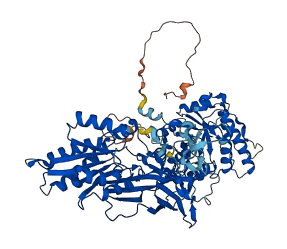
The autoinhibited protein was predicted that may have potential autoinhibitory elements via cis-regPred.
Autoinhibitory domains (AIDs)
Target domain |
|
Relief mechanism |
|
Assay |
cis-regPred |
Accessory elements
No accessory elements
Autoinhibited structure

Activated structure
3 structures for P46580
| Entry ID | Method | Resolution | Chain | Position | Source |
|---|---|---|---|---|---|
| 3UA3 | X-ray | 300 A | A/B | 1-734 | PDB |
| 3UA4 | X-ray | 300 A | A/B | 1-734 | PDB |
| AF-P46580-F1 | Predicted | AlphaFoldDB |
No variants for P46580
| Variant ID(s) | Position | Change | Description | Diseaes Association | Provenance |
|---|---|---|---|---|---|
| No variants for P46580 | |||||
No associated diseases with P46580
Functions
| Description | ||
|---|---|---|
| EC Number | 2.1.1.320 | Methyltransferases |
| Subcellular Localization |
|
|
| PANTHER Family | ||
| PANTHER Subfamily | ||
| PANTHER Protein Class | ||
| PANTHER Pathway Category | No pathway information available | |
3 GO annotations of cellular component
| Name | Definition |
|---|---|
| cytosol | The part of the cytoplasm that does not contain organelles but which does contain other particulate matter, such as protein complexes. |
| nucleus | A membrane-bounded organelle of eukaryotic cells in which chromosomes are housed and replicated. In most cells, the nucleus contains all of the cell's chromosomes except the organellar chromosomes, and is the site of RNA synthesis and processing. In some species, or in specialized cell types, RNA metabolism or DNA replication may be absent. |
| transcription repressor complex | A protein complex that possesses activity that prevents or downregulates transcription. |
8 GO annotations of molecular function
| Name | Definition |
|---|---|
| [myelin basic protein]-arginine N-methyltransferase activity | Catalysis of the reaction: S-adenosyl-L-methionine + (myelin basic protein)-arginine = S-adenosyl-L-homocysteine + (myelin basic protein)-N(omega)-methyl-arginine. |
| DNA-binding transcription factor binding | Binding to a DNA-binding transcription factor, a protein that interacts with a specific DNA sequence (sometimes referred to as a motif) within the regulatory region of a gene to modulate transcription. |
| histone methyltransferase activity (H4-R3 specific) | Catalysis of the reaction: S-adenosyl-L-methionine + (histone H4)-arginine (position 3) = S-adenosyl-L-homocysteine + (histone H4)-N-methyl-arginine (position 3). This reaction is the addition of a methyl group to arginine at position 3 of histone H4. |
| histone-arginine N-methyltransferase activity | Catalysis of the reaction: S-adenosyl-L-methionine + (histone)-arginine = S-adenosyl-L-homocysteine + (histone)-N-methyl-arginine. |
| p53 binding | Binding to one of the p53 family of proteins. |
| protein-arginine N-methyltransferase activity | Catalysis of the reaction: S-adenosyl-L-methionine + (protein)-arginine = S-adenosyl-L-homocysteine + (protein)-N-methyl-arginine. |
| protein-arginine omega-N monomethyltransferase activity | Catalysis of the addition of a methyl group to either of the unmethylated terminal nitrogen atoms (also called omega nitrogen) in peptidyl-arginine to form an omega-N-G-monomethylated arginine residue. The reaction is S-adenosyl-L-methionine |
| protein-arginine omega-N symmetric methyltransferase activity | +Catalysis of the addition of a second methyl group to methylated peptidyl-arginine. Methylation is on the terminal nitrogen (omega nitrogen) residue that is not already methylated, resulting in symmetrical peptidyl-N(omega),N'(omega)-dimethyled arginine residues. |
11 GO annotations of biological process
| Name | Definition |
|---|---|
| chromatin organization | The assembly or remodeling of chromatin composed of DNA complexed with histones, other associated proteins, and sometimes RNA. |
| histone arginine methylation | The modification of a histone by addition of a methyl group to an arginine residue. |
| histone H4-R3 methylation | The modification of histone H4 by addition of a methyl group to arginine at position 3 of the histone. |
| intrinsic apoptotic signaling pathway in response to DNA damage | The series of molecular signals in which an intracellular signal is conveyed to trigger the apoptotic death of a cell. The pathway is induced by the detection of DNA damage, and ends when the execution phase of apoptosis is triggered. |
| locomotory behavior | The specific movement from place to place of an organism in response to external or internal stimuli. Locomotion of a whole organism in a manner dependent upon some combination of that organism's internal state and external conditions. |
| negative regulation of DNA damage response, signal transduction by p53 class mediator | Any process that stops, prevents, or reduces the frequency, rate or extent of the cascade of processes induced by the cell cycle regulator phosphoprotein p53, or an equivalent protein, in response to the detection of DNA damage. |
| negative regulation of DNA-templated transcription | Any process that stops, prevents, or reduces the frequency, rate or extent of cellular DNA-templated transcription. |
| peptidyl-arginine methylation, to symmetrical-dimethyl arginine | The process of methylation of peptidyl-arginine to form peptidyl-N(omega),N'(omega)-dimethyl-L-arginine. |
| peptidyl-arginine N-methylation | The addition of a methyl group onto a nitrogen atom of an arginine residue in a protein. |
| regulation of DNA-templated transcription | Any process that modulates the frequency, rate or extent of cellular DNA-templated transcription. |
| response to odorant | Any process that results in a change in state or activity of a cell or an organism (in terms of movement, secretion, enzyme production, gene expression, etc.) as a result of an odorant stimulus. An odorant is any substance capable of stimulating the sense of smell. |
1 homologous proteins in AiPD
| UniProt AC | Gene Name | Protein Name | Species | Evidence Code |
|---|---|---|---|---|
| P38274 | HSL7 | Protein arginine N-methyltransferase HSL7 | Saccharomyces cerevisiae (strain ATCC 204508 / S288c) (Baker's yeast) | PR |
| 10 | 20 | 30 | 40 | 50 | 60 |
| MSNRTYADNL | FPQQVAEQHE | EQMSSGSSPK | SNSPSRSISS | VEAANSRIHI | GWMATTLDVA |
| 70 | 80 | 90 | 100 | 110 | 120 |
| ENLDRHVATF | CTRLGEFKYN | FVVYPIGGVV | RAFWTPNGSA | ENHPPVIDLP | DVQLRNDLWE |
| 130 | 140 | 150 | 160 | 170 | 180 |
| SYVVGKISPW | IDCDSSDPAF | ASLSEEHLLK | ELSYICYLGL | QTMAIELTRI | SSPRTAAILK |
| 190 | 200 | 210 | 220 | 230 | 240 |
| KWIWTRNSRF | TVWVQLPSAI | EKCKDYDAFT | IEHVDLWTIW | ADFRKNCGNF | SGVYFQVALT |
| 250 | 260 | 270 | 280 | 290 | 300 |
| ISSELPDELT | ELKLVDRWKA | EPLAAFVIES | GLFISGRNGE | ASIPSAHINL | LKHLWTTDAL |
| 310 | 320 | 330 | 340 | 350 | 360 |
| RIVLRATTDT | FKYNTSIKSE | YSQALRHAVR | NVNYRSRPDV | GEGSNDSTHY | LNVIEYKDVL |
| 370 | 380 | 390 | 400 | 410 | 420 |
| QAPLQPLSEN | LDSGVYNTFE | QDQIKYDVYG | EAVVGALKDL | GADGRKTVVI | YLLGGGRGPI |
| 430 | 440 | 450 | 460 | 470 | 480 |
| GTKILKSERE | YNNTFRQGQE | SLKVKLYIVE | KNPNAIVTLK | YMNVRTWKRR | VTIIESDMRS |
| 490 | 500 | 510 | 520 | 530 | 540 |
| LPGIAKDRGF | EQPDIIVSEL | LGSFGDNELS | PECLDGVTGF | LKPTTISIPQ | KYTSYVKPIM |
| 550 | 560 | 570 | 580 | 590 | 600 |
| STHIHQTIKA | QSIPYLSRAI | PSHGRGEPEL | DEDEMWIQKY | PQGHVRNNMD | QIYVVYLSKY |
| 610 | 620 | 630 | 640 | 650 | 660 |
| IPLAETTKPV | FTFEHPNFMN | SSNERSDSIE | FVMDRNADLM | GFAGYFDLQL | YKTVMLSIEP |
| 670 | 680 | 690 | 700 | 710 | 720 |
| STHTPGMVSW | FPAVIPLRDQ | LRVGEGDRIS | LKIDRKVDNT | GVWYEWHVEK | KKTNGESVST |
| 730 | |||||
| PIQNPNGESY | YMRM |