P38274
Gene name |
HSL7 |
Protein name |
Protein arginine N-methyltransferase HSL7 |
Names |
Histone synthetic lethal protein 7, Type II protein arginine N-methyltransferase, Type II PRMT |
Species |
Saccharomyces cerevisiae (strain ATCC 204508 / S288c) (Baker's yeast) |
KEGG Pathway |
sce:YBR133C |
EC number |
2.1.1.320: Methyltransferases |
Protein Class |
|
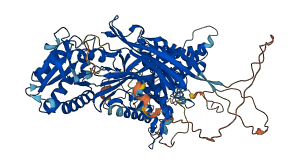
Descriptions
The autoinhibited protein was predicted that may have potential autoinhibitory elements via cis-regPred.
Autoinhibitory domains (AIDs)
Target domain |
|
Relief mechanism |
|
Assay |
cis-regPred |
Accessory elements
No accessory elements
Autoinhibited structure

Activated structure
1 structures for P38274
| Entry ID | Method | Resolution | Chain | Position | Source |
|---|---|---|---|---|---|
| AF-P38274-F1 | Predicted | AlphaFoldDB |
11 variants for P38274
| Variant ID(s) | Position | Change | Description | Diseaes Association | Provenance |
|---|---|---|---|---|---|
| s02-503396 | 296 | S>P | No | SGRP | |
| s02-503345 | 313 | L>V | No | SGRP | |
| s02-503304 | 326 | D>E | No | SGRP | |
| s02-503158 | 375 | A>V | No | SGRP | |
| s02-502670 | 538 | V>I | No | SGRP | |
| s02-502621 | 554 | V>A | No | SGRP | |
| s02-502417 | 622 | E>G | No | SGRP | |
| s02-502396 | 629 | D>V | No | SGRP | |
| s02-502286 | 666 | D>N | No | SGRP | |
| s02-502015 | 756 | D>G | No | SGRP | |
| s02-501968 | 772 | I>V | No | SGRP |
No associated diseases with P38274
Functions
| Description | ||
|---|---|---|
| EC Number | 2.1.1.320 | Methyltransferases |
| Subcellular Localization |
|
|
| PANTHER Family | ||
| PANTHER Subfamily | ||
| PANTHER Protein Class | ||
| PANTHER Pathway Category | No pathway information available | |
7 GO annotations of cellular component
| Name | Definition |
|---|---|
| cellular bud neck | The constriction between the mother cell and daughter cell (bud) in an organism that reproduces by budding. |
| cellular bud neck septin collar | A tubular structure with flared ends, shaped like an hourglass and composed of highly ordered arrays of septin filaments, that forms at the bud neck of a dividing cell. In S. cerevisiae, this structure is located at the bud neck throughout most of the cell cycle and the septins are fixed within the structure, not exchanging with soluble septins. This septin structure acts as a scaffold for other proteins that function at the bud neck. |
| cellular bud neck septin ring | A ring-shaped structure that forms at the site of cytokinesis in the bud neck of a budding cell; composed of members of the conserved family of filament forming proteins called septins as well as septin-associated proteins. In S. cerevisiae, this structure forms at the time of bud emergence and the septins show a high rate of exchange. |
| cytoplasm | The contents of a cell excluding the plasma membrane and nucleus, but including other subcellular structures. |
| cytosol | The part of the cytoplasm that does not contain organelles but which does contain other particulate matter, such as protein complexes. |
| nucleus | A membrane-bounded organelle of eukaryotic cells in which chromosomes are housed and replicated. In most cells, the nucleus contains all of the cell's chromosomes except the organellar chromosomes, and is the site of RNA synthesis and processing. In some species, or in specialized cell types, RNA metabolism or DNA replication may be absent. |
| outer plaque of spindle pole body | One of three laminate structures that form the spindle pole body; the outer plaque is in the cytoplasm. |
4 GO annotations of molecular function
| Name | Definition |
|---|---|
| histone methyltransferase activity | Catalysis of the reaction: S-adenosyl-L-methionine + histone = S-adenosyl-L-homocysteine + methyl-histone. Histone methylation generally occurs on either an arginine or lysine residue. |
| histone-arginine N-methyltransferase activity | Catalysis of the reaction: S-adenosyl-L-methionine + (histone)-arginine = S-adenosyl-L-homocysteine + (histone)-N-methyl-arginine. |
| protein-arginine omega-N monomethyltransferase activity | Catalysis of the addition of a methyl group to either of the unmethylated terminal nitrogen atoms (also called omega nitrogen) in peptidyl-arginine to form an omega-N-G-monomethylated arginine residue. The reaction is S-adenosyl-L-methionine |
| protein-arginine omega-N symmetric methyltransferase activity | +Catalysis of the addition of a second methyl group to methylated peptidyl-arginine. Methylation is on the terminal nitrogen (omega nitrogen) residue that is not already methylated, resulting in symmetrical peptidyl-N(omega),N'(omega)-dimethyled arginine residues. |
9 GO annotations of biological process
| Name | Definition |
|---|---|
| cell division | The process resulting in division and partitioning of components of a cell to form more cells; may or may not be accompanied by the physical separation of a cell into distinct, individually membrane-bounded daughter cells. |
| cell morphogenesis | The developmental process in which the size or shape of a cell is generated and organized. |
| G2/M transition of mitotic cell cycle | The mitotic cell cycle transition by which a cell in G2 commits to M phase. The process begins when the kinase activity of M cyclin/CDK complex reaches a threshold high enough for the cell cycle to proceed. This is accomplished by activating a positive feedback loop that results in the accumulation of unphosphorylated and active M cyclin/CDK complex. |
| histone arginine methylation | The modification of a histone by addition of a methyl group to an arginine residue. |
| peptidyl-arginine N-methylation | The addition of a methyl group onto a nitrogen atom of an arginine residue in a protein. |
| positive regulation of mitotic nuclear division | Any process that activates or increases the frequency, rate or extent of mitosis. |
| protein catabolic process | The chemical reactions and pathways resulting in the breakdown of a protein by the destruction of the native, active configuration, with or without the hydrolysis of peptide bonds. |
| regulation of cell cycle | Any process that modulates the rate or extent of progression through the cell cycle. |
| regulation of DNA-templated transcription | Any process that modulates the frequency, rate or extent of cellular DNA-templated transcription. |
1 homologous proteins in AiPD
| UniProt AC | Gene Name | Protein Name | Species | Evidence Code |
|---|---|---|---|---|
| P46580 | prmt-5 | Protein arginine N-methyltransferase 5 | Caenorhabditis elegans | PR |
| 10 | 20 | 30 | 40 | 50 | 60 |
| MHSNVFVGVK | PGFNHKQHSK | KSRFLENVSS | HSPELPSNYD | YVLLPITTPR | YKEIVGQVFK |
| 70 | 80 | 90 | 100 | 110 | 120 |
| DFQRQSIQNW | KPLQIPEPQL | QDICIPPFNV | KKLDNDDTPS | YIGLLSSWLE | LESRDPNVRD |
| 130 | 140 | 150 | 160 | 170 | 180 |
| LGLKVLLNEC | KYARFVGINK | LILAPPRDLS | NLQLYGQMIY | RLLQNRIVFA | APALTISISL |
| 190 | 200 | 210 | 220 | 230 | 240 |
| PLYEDSDPLA | TWELWNTVRK | QCEYHPSLTI | SLALPRTRTP | SYVLNRWLAE | PVSCLLVSSS |
| 250 | 260 | 270 | 280 | 290 | 300 |
| IFASNQYDYP | VLHKFNQNLI | LKFQKVNGDS | QILGNELCVI | LHGMEKYANN | VKGGESAYLE |
| 310 | 320 | 330 | 340 | 350 | 360 |
| YINYLLKKGD | KVLNSNSNHQ | FLLQEDSRIM | PPLKPHSDNL | LNSTYLTFEK | DLVKYDLYES |
| 370 | 380 | 390 | 400 | 410 | 420 |
| AILEALQDLA | PRASAKRPLV | ILVAGAGRGP | LVDRTFKIIS | MLFMDSKVSI | IAIEKNPQAY |
| 430 | 440 | 450 | 460 | 470 | 480 |
| LYLQKRNFDC | WDNRVKLIKE | DMTKWQINEP | SEKRIQIDLC | ISELLGSFGC | NELSPECLWS |
| 490 | 500 | 510 | 520 | 530 | 540 |
| IEKYHSHNDT | IFIPRSYSSY | IAPISSPLFY | QKLSQTNRSL | EAPWIVHRVP | YCILSSRVNE |
| 550 | 560 | 570 | 580 | 590 | 600 |
| VWRFEHPMAQ | KDTVQDEDDF | TVEFSQSSLN | EFKIKHRGEI | HGFIGFFSAN | LYNNIFLSTL |
| 610 | 620 | 630 | 640 | 650 | 660 |
| PNDSTVRLKF | SEETLMNTRR | EENLIKKCDH | TPNMTSWSPI | IFPLKQPISF | IDDSELSVLM |
| 670 | 680 | 690 | 700 | 710 | 720 |
| SRIHSDTEQK | VWYEWSLESF | IYLMLSNYTS | AVTAASMTIP | RSIVTDDTKT | LAHNRHYSAT |
| 730 | 740 | 750 | 760 | 770 | 780 |
| TNQKLDNQID | LDQDIENEEE | QGFLSNLETG | WQSVQDIHGL | SETAKPDHLD | SINKPMFDLK |
| 790 | 800 | 810 | 820 | ||
| STKALEPSNE | LPRHEDLEED | VPEVHVRVKT | SVSTLHNVCG | RAFSLPL |