P39531
Gene name |
RCY1 (YJL204C, J0318, J0320) |
Protein name |
Recyclin-1 |
Names |
|
Species |
Saccharomyces cerevisiae (strain ATCC 204508 / S288c) (Baker's yeast) |
KEGG Pathway |
sce:YJL204C |
EC number |
|
Protein Class |
|
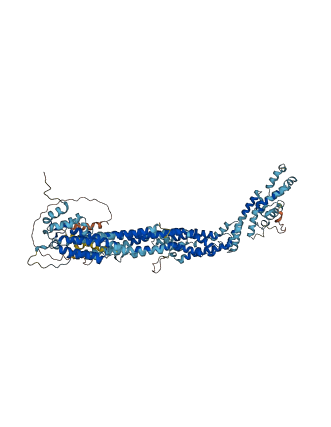
Descriptions
The autoinhibited protein was predicted that may have potential autoinhibitory elements via cis-regPred.
Autoinhibitory domains (AIDs)
Target domain |
|
Relief mechanism |
|
Assay |
cis-regPred |
Accessory elements
No accessory elements
Autoinhibited structure

Activated structure
1 structures for P39531
| Entry ID | Method | Resolution | Chain | Position | Source |
|---|---|---|---|---|---|
| AF-P39531-F1 | Predicted | AlphaFoldDB |
14 variants for P39531
| Variant ID(s) | Position | Change | Description | Diseaes Association | Provenance |
|---|---|---|---|---|---|
| s10-52932 | 74 | N>D | No | SGRP | |
| s10-52931 | 74 | N>S | No | SGRP | |
| s10-52905 | 83 | I>L | No | SGRP | |
| s10-52905 | 83 | I>V | No | SGRP | |
| s10-52870 | 94 | K>N | No | SGRP | |
| s10-52869 | 95 | I>V | No | SGRP | |
| s10-52757 | 132 | R>K | No | SGRP | |
| s10-52454 | 233 | E>G | No | SGRP | |
| s10-52127 | 342 | F>Y | No | SGRP | |
| s10-52036 | 372 | L>F | No | SGRP | |
| s10-51927 | 409 | S>G | No | SGRP | |
| s10-51798 | 452 | D>N | No | SGRP | |
| s10-51599 | 518 | H>R | No | SGRP | |
| s10-51509 | 548 | K>R | No | SGRP |
No associated diseases with P39531
No regional properties for P39531
| Type | Name | Position | InterPro Accession |
|---|---|---|---|
| No domain, repeats, and functional sites for P39531 | |||
Functions
8 GO annotations of cellular component
| Name | Definition |
|---|---|
| cell tip | The region at the end of the longest axis of a cylindrical or elongated cell. |
| cellular bud | A protuberance from a cell of an organism that reproduces by budding, which will grow larger and become a separate daughter cell after nuclear division, cytokinesis, and cell wall formation (when appropriate). The daughter cell may completely separate from the mother cell, or the mother and daughter cells may remain associated. |
| cellular bud neck | The constriction between the mother cell and daughter cell (bud) in an organism that reproduces by budding. |
| cytosol | The part of the cytoplasm that does not contain organelles but which does contain other particulate matter, such as protein complexes. |
| endosome | A vacuole to which materials ingested by endocytosis are delivered. |
| exocyst | A protein complex peripherally associated with the plasma membrane that determines where vesicles dock and fuse. At least eight complex components are conserved between yeast and mammals. |
| Golgi apparatus | A membrane-bound cytoplasmic organelle of the endomembrane system that further processes the core oligosaccharides (e.g. N-glycans) added to proteins in the endoplasmic reticulum and packages them into membrane-bound vesicles. The Golgi apparatus operates at the intersection of the secretory, lysosomal, and endocytic pathways. |
| site of polarized growth | Any part of a cell where non-isotropic growth takes place. |
1 GO annotations of molecular function
| Name | Definition |
|---|---|
| SNARE binding | Binding to a SNARE (soluble N-ethylmaleimide-sensitive factor attached protein receptor) protein. |
6 GO annotations of biological process
| Name | Definition |
|---|---|
| early endosome to Golgi transport | The directed movement of substances from early endosomes to the Golgi. |
| endocytic recycling | The directed movement of membrane-bounded vesicles from endosomes back to the plasma membrane, a trafficking pathway that promotes the recycling of internalized transmembrane proteins. |
| endocytosis | A vesicle-mediated transport process in which cells take up external materials or membrane constituents by the invagination of a small region of the plasma membrane to form a new membrane-bounded vesicle. |
| exocytosis | A process of secretion by a cell that results in the release of intracellular molecules (e.g. hormones, matrix proteins) contained within a membrane-bounded vesicle. Exocytosis can occur either by full fusion, when the vesicle collapses into the plasma membrane, or by a kiss-and-run mechanism that involves the formation of a transient contact, a pore, between a granule (for exemple of chromaffin cells) and the plasma membrane. The latter process most of the time leads to only partial secretion of the granule content. Exocytosis begins with steps that prepare vesicles for fusion with the membrane (tethering and docking) and ends when molecules are secreted from the cell. |
| Golgi to plasma membrane transport | The directed movement of substances from the Golgi to the plasma membrane in transport vesicles that move from the trans-Golgi network to the plasma membrane, where they fuse and release their contents by exocytosis. |
| protein transport | The directed movement of proteins into, out of or within a cell, or between cells, by means of some agent such as a transporter or pore. |
1 homologous proteins in AiPD
| UniProt AC | Gene Name | Protein Name | Species | Evidence Code |
|---|---|---|---|---|
| P97878 | Exoc5 | Exocyst complex component 5 | Rattus norvegicus (Rat) | PR |
| 10 | 20 | 30 | 40 | 50 | 60 |
| MDDLLKVPEI | VTNIASYLST | VDYLSFQQVN | KRVYAIINGK | NDSKYWSLKL | TRMGLQQVHS |
| 70 | 80 | 90 | 100 | 110 | 120 |
| NEEEEITLLD | ENDNQNSLRI | FEIYKSFTAQ | NSKKIFVKFY | RCYNSYARKL | YNNNLANFFP |
| 130 | 140 | 150 | 160 | 170 | 180 |
| TSYSNDPLKQ | TRILNFIKKY | NFSNKNDIET | FTRIETNFNI | LREIFINSVL | KESELNYQSN |
| 190 | 200 | 210 | 220 | 230 | 240 |
| NLAAVARFMK | ILLISNEESN | AIEFFKSKAD | LPPSLTVLPS | NDELFWAEQP | REEDSGGSTV |
| 250 | 260 | 270 | 280 | 290 | 300 |
| IFNSKNLDTF | LNQLRDFLNE | KIKLADILFK | DEFPVILQFI | ESFIQDILLD | ILNNILLSYS |
| 310 | 320 | 330 | 340 | 350 | 360 |
| EFLKENGKDS | KANYECVPEL | YFTFIKKFDT | ELNDSVNAGA | NFRKVVRDLL | NLYLEPFVVN |
| 370 | 380 | 390 | 400 | 410 | 420 |
| YMNQTTRVFE | SLINSQLANY | DTQVQDKQRE | QNAKIYNTLK | DQTDASSASN | NELPNDLSII |
| 430 | 440 | 450 | 460 | 470 | 480 |
| TETSKTVPEA | DSKPSTIHQS | VHSTDISNDK | LDFLSSFTKI | FKFSNNENQR | LKQQLQLAYN |
| 490 | 500 | 510 | 520 | 530 | 540 |
| LNLISNNLQN | IKSLISLDLC | YKILQETSEK | TDQIYKFHTI | ESLLPLIKLR | CQEIFKILIT |
| 550 | 560 | 570 | 580 | 590 | 600 |
| QLNKNHVKPA | FEKAILLLQK | YNPNEIEQIE | IKFNSLSPAN | TQVEPLVQFT | ELINIGDIIL |
| 610 | 620 | 630 | 640 | 650 | 660 |
| QMISIFYKNE | LIPKKIIDKN | KDFLNDVIQL | KKNFETSIDD | FVAEGLNIGI | NKLMDEISFV |
| 670 | 680 | 690 | 700 | 710 | 720 |
| FKTLQLPDDY | NPPPPSRNSP | IRDIKPTKCA | IRVVELLSNH | CFLLTGATDK | GTIDVYQQEI |
| 730 | 740 | 750 | 760 | 770 | 780 |
| GERFFNEIVK | HLKKCFISTE | GAIWLICDLN | YFYDFIANKL | KQKNVVPYFV | GLKSIGQLYI |
| 790 | 800 | 810 | 820 | 830 | |
| ISGKDSKELG | KLISDLGKFN | GIFTQEEIYE | FVQRRSDWVR | VRKDVEKVMY | GLGIRDCCIM |