P38959
Gene name |
VPS41 (FET2, VAM2, YDR080W, D446, YD8554.13) |
Protein name |
Vacuolar protein sorting-associated protein 41 |
Names |
Vacuolar morphogenesis protein 2 |
Species |
Saccharomyces cerevisiae (strain ATCC 204508 / S288c) (Baker's yeast) |
KEGG Pathway |
sce:YDR080W |
EC number |
|
Protein Class |
|
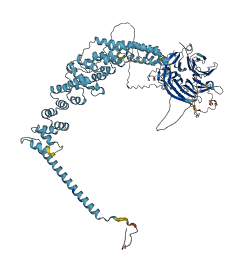
Descriptions
The autoinhibited protein was predicted that may have potential autoinhibitory elements via cis-regPred.
Autoinhibitory domains (AIDs)
Target domain |
|
Relief mechanism |
|
Assay |
cis-regPred |
Accessory elements
No accessory elements
Autoinhibited structure

Activated structure
2 structures for P38959
| Entry ID | Method | Resolution | Chain | Position | Source |
|---|---|---|---|---|---|
| 7ZU0 | EM | 440 A | F | 1-992 | PDB |
| AF-P38959-F1 | Predicted | AlphaFoldDB |
25 variants for P38959
| Variant ID(s) | Position | Change | Description | Diseaes Association | Provenance |
|---|---|---|---|---|---|
| s04-604040 | 12 | L>F | No | SGRP | |
| s04-604102 | 33 | V>A | No | SGRP | |
| s04-604153 | 50 | S>N | No | SGRP | |
| s04-604183 | 60 | A>V | No | SGRP | |
| s04-604251 | 83 | D>N | No | SGRP | |
| s04-604323 | 107 | S>G | No | SGRP | |
| s04-604642 | 213 | V>A | No | SGRP | |
| s04-605030 | 342 | K>N | No | SGRP | |
| s04-605063 | 353 | M>I | No | SGRP | |
| s04-605184 | 394 | T>A | No | SGRP | |
| s04-605538 | 512 | E>K | No | SGRP | |
| s04-605638 | 545 | T>I | No | SGRP | |
| s04-605638 | 545 | T>S | No | SGRP | |
| s04-605772 | 590 | I>V | No | SGRP | |
| s04-605793 | 597 | E>K | No | SGRP | |
| s04-605970 | 656 | A>T | No | SGRP | |
| s04-605977 | 658 | S>T | No | SGRP | |
| s04-605991 | 663 | S>P | No | SGRP | |
| s04-606171 | 723 | I>V | No | SGRP | |
| s04-606297 | 765 | I>L | No | SGRP | |
| s04-606412 | 803 | Q>R | No | SGRP | |
| s04-606723 | 907 | D>N | No | SGRP | |
| s04-606819 | 939 | E>K | No | SGRP | |
| s04-606932 | 976 | Q>H | No | SGRP | |
| s04-606949 | 982 | I>S | No | SGRP |
No associated diseases with P38959
3 regional properties for P38959
| Type | Name | Position | InterPro Accession |
|---|---|---|---|
| repeat | Clathrin, heavy chain/VPS, 7-fold repeat | 753 - 901 | IPR000547 |
| repeat | WD40 repeat | 144 - 181 | IPR001680-1 |
| repeat | WD40 repeat | 184 - 225 | IPR001680-2 |
4 GO annotations of cellular component
| Name | Definition |
|---|---|
| endosome | A vacuole to which materials ingested by endocytosis are delivered. |
| fungal-type vacuole membrane | The lipid bilayer surrounding a vacuole, the shape of which correlates with cell cycle phase. The membrane separates its contents from the cytoplasm of the cell. An example of this structure is found in Saccharomyces cerevisiae. |
| HOPS complex | A multimeric protein complex that associates with the vacuolar membrane, late endosomal (multivesicular body) and lysosomal membranes. HOPS is a tethering complex involved in vesicle fusion. |
| late endosome | A prelysosomal endocytic organelle differentiated from early endosomes by lower lumenal pH and different protein composition. Late endosomes are more spherical than early endosomes and are mostly juxtanuclear, being concentrated near the microtubule organizing center. |
1 GO annotations of molecular function
| Name | Definition |
|---|---|
| small GTPase binding | Binding to a small monomeric GTPase. |
13 GO annotations of biological process
| Name | Definition |
|---|---|
| cellular response to starvation | Any process that results in a change in state or activity of a cell (in terms of movement, secretion, enzyme production, gene expression, etc.) as a result of deprivation of nourishment. |
| cytoplasm to vacuole transport by the Cvt pathway | A cytoplasm to vacuole targeting pathway that uses machinery common with autophagy. The Cvt vesicle is formed when the receptor protein, Atg19, binds to the complexes of the target protein (aminopeptidase or alpha-mannosidase homododecamers), forming the Cvt complex. Atg11 binds to Atg9 and transports the Cvt complex to the pre-autophagosome (PAS). The phagophore membrane expands around the Cvt complex (excluding bulk cytoplasm) forming the Cvt vesicle. This pathway is mostly observed in yeast. |
| endosomal vesicle fusion | The homotypic fusion of endocytic vesicles to form or add to an early endosome. |
| macroautophagy | The major inducible pathway for the general turnover of cytoplasmic constituents in eukaryotic cells, it is also responsible for the degradation of active cytoplasmic enzymes and organelles during nutrient starvation. Macroautophagy involves the formation of double-membrane-bounded autophagosomes which enclose the cytoplasmic constituent targeted for degradation in a membrane-bounded structure. Autophagosomes then fuse with a lysosome (or vacuole) releasing single-membrane-bounded autophagic bodies that are then degraded within the lysosome (or vacuole). Some types of macroautophagy, e.g. pexophagy, mitophagy, involve selective targeting of the targets to be degraded. |
| piecemeal microautophagy of the nucleus | Degradation of a cell nucleus by lysosomal microautophagy. |
| protein targeting to vacuole | The process of directing proteins towards the vacuole, usually using signals contained within the protein. |
| protein transport | The directed movement of proteins into, out of or within a cell, or between cells, by means of some agent such as a transporter or pore. |
| regulation of SNARE complex assembly | Any process that modulates the frequency, rate or extent of assembly of the SNARE complex. The SNARE complex is a protein complex involved in membrane fusion; a stable ternary complex consisting of a four-helix bundle, usually formed from one R-SNARE and three Q-SNAREs with an ionic layer sandwiched between hydrophobic layers. |
| vacuolar protein processing | Protein processing that takes place in the vacuole. Most protein processing in the vacuole represents proteolytic cleavage of precursors to form active enzymes. |
| vacuole fusion, non-autophagic | The fusion of two vacuole membranes to form a single vacuole. |
| vacuole organization | A process that is carried out at the cellular level which results in the assembly, arrangement of constituent parts, or disassembly of a vacuole. |
| vesicle tethering | The initial, indirect interaction between a vesicle membrane and a membrane to which it is targeted for fusion. This interaction is mediated by tethering factors (or complexes), which interact with both membranes. Interaction can occur via direct binding to membrane phospholipids or membrane proteins, or via binding to vesicle coat proteins. This process is distinct from and prior to interaction between factors involved in fusion. |
| vesicle-mediated transport | A cellular transport process in which transported substances are moved in membrane-bounded vesicles; transported substances are enclosed in the vesicle lumen or located in the vesicle membrane. The process begins with a step that directs a substance to the forming vesicle, and includes vesicle budding and coating. Vesicles are then targeted to, and fuse with, an acceptor membrane. |
1 homologous proteins in AiPD
| UniProt AC | Gene Name | Protein Name | Species | Evidence Code |
|---|---|---|---|---|
| Q19954 | vps-41 | Vacuolar protein sorting-associated protein 41 homolog | Caenorhabditis elegans | PR |
| 10 | 20 | 30 | 40 | 50 | 60 |
| MTTDNHQNDS | VLDQQSGERT | IDESNSISDE | NNVDNKREDV | NVTSPTKSVS | CISQAENGVA |
| 70 | 80 | 90 | 100 | 110 | 120 |
| SRTDESTITG | SATDAETGDD | DDDDDDDDDE | DEDDEDEPPL | LKYTRISQLP | KNFFQRDSIS |
| 130 | 140 | 150 | 160 | 170 | 180 |
| SCLFGDTFFA | FGTHSGILHL | TTCAFEPIKT | IKCHRSSILC | INTDGKYFAT | GSIDGTVIIG |
| 190 | 200 | 210 | 220 | 230 | 240 |
| SMDDPQNITQ | YDFKRPINSV | ALHSNFQASR | MFVSGGMAGD | VVLSQRNWLG | NRIDIVLNKK |
| 250 | 260 | 270 | 280 | 290 | 300 |
| KKKKTRKDDL | SSDMKGPIMG | IYTMGDLILW | MDDDGITFCD | VPTRSQLLNI | PFPSRIFNVQ |
| 310 | 320 | 330 | 340 | 350 | 360 |
| DVRPDLFRPH | VHFLESDRVV | IGWGSNIWLF | KVSFTKDSNS | IKSGDSNSQS | NNMSHFNPTT |
| 370 | 380 | 390 | 400 | 410 | 420 |
| NIGSLLSSAA | SSFRGTPDKK | VELECHFTVS | MLITGLASFK | DDQLLCLGFD | IDIEEEATID |
| 430 | 440 | 450 | 460 | 470 | 480 |
| EDMKEGKNFS | KRPENLLAKG | NAPELKIVDL | FNGDEIYNDE | VIMKNYEKLS | INDYHLGKHI |
| 490 | 500 | 510 | 520 | 530 | 540 |
| DKTTPEYYLI | SSNDAIRVQE | LSLKDHFDWF | MERKQYYKAW | KIGKYVIGSE | ERFSIGLKFL |
| 550 | 560 | 570 | 580 | 590 | 600 |
| NSLVTKKDWG | TLVDHLNIIF | EETLNSLDSN | SYDVTQNVLK | EWADIIEILI | TSGNIVEIAP |
| 610 | 620 | 630 | 640 | 650 | 660 |
| LIPKKPALRK | SVYDDVLHYF | LANDMINKFH | EYITKWDLKL | FSVEDFEEEL | ETRIEAASEP |
| 670 | 680 | 690 | 700 | 710 | 720 |
| TASSKEEGSN | ITYRTELVHL | YLKENKYTKA | IPHLLKAKDL | RALTIIKIQN | LLPQYLDQIV |
| 730 | 740 | 750 | 760 | 770 | 780 |
| DIILLPYKGE | ISHISKLSIF | EIQTIFNKPI | DLLFENRHTI | SVARIYEIFE | HDCPKSFKKI |
| 790 | 800 | 810 | 820 | 830 | 840 |
| LFCYLIKFLD | TDDSFMISPY | ENQLIELYSE | YDRQSLLPFL | QKHNNYNVES | AIEVCSSKLG |
| 850 | 860 | 870 | 880 | 890 | 900 |
| LYNELIYLWG | KIGETKKALS | LIIDELKNPQ | LAIDFVKNWG | DSELWEFMIN | YSLDKPNFTK |
| 910 | 920 | 930 | 940 | 950 | 960 |
| AILTCSDETS | EIYLKVIRGM | SDDLQIDNLQ | DIIKHIVQEN | SLSLEVRDNI | LVIINDETKK |
| 970 | 980 | 990 | |||
| FANEFLKIRS | QGKLFQVDES | DIEINDDLNG | VL |