P38273
Gene name |
CCZ1 (AUT11, CVT16, YBR131W, YBR1006) |
Protein name |
Vacuolar fusion protein CCZ1 |
Names |
Autophagy-related protein 11, Calcium-caffeine-zinc sensitivity protein 1, Cytoplasm to vacuole targeting protein 16 |
Species |
Saccharomyces cerevisiae (strain ATCC 204508 / S288c) (Baker's yeast) |
KEGG Pathway |
sce:YBR131W |
EC number |
|
Protein Class |
|
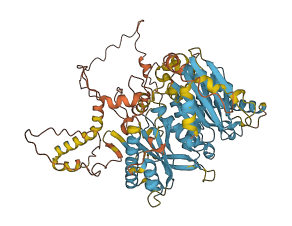
Descriptions
The autoinhibited protein was predicted that may have potential autoinhibitory elements via cis-regPred.
Autoinhibitory domains (AIDs)
Target domain |
|
Relief mechanism |
|
Assay |
cis-regPred |
Accessory elements
No accessory elements
Autoinhibited structure

Activated structure
1 structures for P38273
| Entry ID | Method | Resolution | Chain | Position | Source |
|---|---|---|---|---|---|
| AF-P38273-F1 | Predicted | AlphaFoldDB |
27 variants for P38273
| Variant ID(s) | Position | Change | Description | Diseaes Association | Provenance |
|---|---|---|---|---|---|
| s02-497334 | 60 | V>I | No | SGRP | |
| s02-497365 | 70 | I>N | No | SGRP | |
| s02-497443 | 96 | I>T | No | SGRP | |
| s02-497471 | 105 | L>F | No | SGRP | |
| s02-497529 | 125 | S>P | No | SGRP | |
| s02-497538 | 128 | G>R | No | SGRP | |
| s02-497709 | 185 | E>Q | No | SGRP | |
| s02-497727 | 191 | E>K | No | SGRP | |
| s02-497940 | 262 | T>S | No | SGRP | |
| s02-497985 | 277 | F>L | No | SGRP | |
| s02-498127 | 324 | E>A | No | SGRP | |
| s02-498126 | 324 | E>K | No | SGRP | |
| s02-498301 | 382 | S>L | No | SGRP | |
| s02-498309 | 385 | N>Y | No | SGRP | |
| s02-498342 | 396 | A>T | No | SGRP | |
| s02-498691 | 512 | V>A | No | SGRP | |
| s02-498706 | 517 | D>G | No | SGRP | |
| s02-498705 | 517 | D>N | No | SGRP | |
| s02-498883 | 576 | T>N | No | SGRP | |
| s02-498917 | 587 | K>N | No | SGRP | |
| s02-498962 | 602 | M>I | No | SGRP | |
| s02-499011 | 619 | T>A | No | SGRP | |
| s02-499043 | 629 | D>E | No | SGRP | |
| s02-499125 | 657 | I>L | No | SGRP | |
| s02-499172 | 672 | K>N | No | SGRP | |
| s02-499188 | 678 | S>R | No | SGRP | |
| s02-499260 | 702 | R>G | No | SGRP |
No associated diseases with P38273
1 regional properties for P38273
| Type | Name | Position | InterPro Accession |
|---|---|---|---|
| domain | Cationic amino acid transporter, C-terminal | 558 - 608 | IPR029485 |
Functions
7 GO annotations of cellular component
| Name | Definition |
|---|---|
| cytosol | The part of the cytoplasm that does not contain organelles but which does contain other particulate matter, such as protein complexes. |
| endosome | A vacuole to which materials ingested by endocytosis are delivered. |
| intracellular membrane-bounded organelle | Organized structure of distinctive morphology and function, bounded by a single or double lipid bilayer membrane and occurring within the cell. Includes the nucleus, mitochondria, plastids, vacuoles, and vesicles. Excludes the plasma membrane. |
| late endosome | A prelysosomal endocytic organelle differentiated from early endosomes by lower lumenal pH and different protein composition. Late endosomes are more spherical than early endosomes and are mostly juxtanuclear, being concentrated near the microtubule organizing center. |
| Mon1-Ccz1 complex | A protein complex that functions as a guanine nucleotide exchange factor (GEF) and converts Rab-GDP to Rab-GTP. In S. cerevisiae, this complex consists of at least Mon1 and Ccz1, and serves as a GEF for the Rab Ypt7p. |
| multivesicular body membrane | The lipid bilayer surrounding a multivesicular body. |
| vacuolar membrane | The lipid bilayer surrounding the vacuole and separating its contents from the cytoplasm of the cell. |
4 GO annotations of molecular function
| Name | Definition |
|---|---|
| guanyl-nucleotide exchange factor activity | Stimulates the exchange of GDP to GTP on a signaling GTPase, changing its conformation to its active form. Guanine nucleotide exchange factors (GEFs) act by stimulating the release of guanosine diphosphate (GDP) to allow binding of guanosine triphosphate (GTP), which is more abundant in the cell under normal cellular physiological conditions. |
| phosphatidylinositol-3-phosphate binding | Binding to phosphatidylinositol-3-phosphate, a derivative of phosphatidylinositol in which the inositol ring is phosphorylated at the 3' position. |
| phosphatidylinositol-5-phosphate binding | Binding to phosphatidylinositol-5-phosphate, a derivative of phosphatidylinositol in which the inositol ring is phosphorylated at the 5' position. |
| phosphatidylserine binding | Binding to phosphatidylserine, a class of glycophospholipids in which a phosphatidyl group is esterified to the hydroxyl group of L-serine. |
11 GO annotations of biological process
| Name | Definition |
|---|---|
| autophagosome maturation | Removal of PI3P and Atg8/LC3 after the closure of the phagophore and before the fusion with the endosome/lysosome (e.g. mammals and insects) or vacuole (yeast), and that very likely destabilizes other Atg proteins and thus enables their efficient dissociation and recycling. |
| autophagy | The cellular catabolic process in which cells digest parts of their own cytoplasm; allows for both recycling of macromolecular constituents under conditions of cellular stress and remodeling the intracellular structure for cell differentiation. |
| cytoplasm to vacuole transport by the Cvt pathway | A cytoplasm to vacuole targeting pathway that uses machinery common with autophagy. The Cvt vesicle is formed when the receptor protein, Atg19, binds to the complexes of the target protein (aminopeptidase or alpha-mannosidase homododecamers), forming the Cvt complex. Atg11 binds to Atg9 and transports the Cvt complex to the pre-autophagosome (PAS). The phagophore membrane expands around the Cvt complex (excluding bulk cytoplasm) forming the Cvt vesicle. This pathway is mostly observed in yeast. |
| late endosome to vacuole transport via multivesicular body sorting pathway | The directed movement of substances from endosomes to vacuoles by a pathway in which molecules are sorted into multivesicular bodies, which then fuse with the vacuole. |
| macroautophagy | The major inducible pathway for the general turnover of cytoplasmic constituents in eukaryotic cells, it is also responsible for the degradation of active cytoplasmic enzymes and organelles during nutrient starvation. Macroautophagy involves the formation of double-membrane-bounded autophagosomes which enclose the cytoplasmic constituent targeted for degradation in a membrane-bounded structure. Autophagosomes then fuse with a lysosome (or vacuole) releasing single-membrane-bounded autophagic bodies that are then degraded within the lysosome (or vacuole). Some types of macroautophagy, e.g. pexophagy, mitophagy, involve selective targeting of the targets to be degraded. |
| positive regulation of GTPase activity | Any process that activates or increases the activity of a GTPase. |
| protein targeting to vacuolar membrane | The process of directing proteins towards the vacuolar membrane; usually uses signals contained within the protein. |
| protein targeting to vacuole | The process of directing proteins towards the vacuole, usually using signals contained within the protein. |
| vacuolar transport | The directed movement of substances into, out of or within a vacuole. |
| vesicle docking | The initial attachment of a transport vesicle membrane to the target membrane, mediated by proteins protruding from the membrane of the vesicle and the target membrane. Docking requires only that the two membranes come close enough for these proteins to interact and adhere. |
| vesicle-mediated transport | A cellular transport process in which transported substances are moved in membrane-bounded vesicles; transported substances are enclosed in the vesicle lumen or located in the vesicle membrane. The process begins with a step that directs a substance to the forming vesicle, and includes vesicle budding and coating. Vesicles are then targeted to, and fuse with, an acceptor membrane. |
1 homologous proteins in AiPD
| UniProt AC | Gene Name | Protein Name | Species | Evidence Code |
|---|---|---|---|---|
| Q28HU2 | ccz1 | Vacuolar fusion protein CCZ1 homolog | Xenopus tropicalis (Western clawed frog) (Silurana tropicalis) | PR |
| 10 | 20 | 30 | 40 | 50 | 60 |
| MRLHYITVFD | PSRSTNENDT | FKQLLLFHYF | GTTDSIPSLN | EKLSIIGVIQ | GIWSLTSSCV |
| 70 | 80 | 90 | 100 | 110 | 120 |
| NKDGEDLEKI | IELNNDIIFC | IKVESRFFIS | LAISNISDDQ | SAIPLQYLSA | YLWLSYRFFK |
| 130 | 140 | 150 | 160 | 170 | 180 |
| LLNGSFSGFN | KDFRKLTDLL | NEFVIPFWND | IYLNLETVTN | RSFTVMWPGF | YKRANFQHSS |
| 190 | 200 | 210 | 220 | 230 | 240 |
| YNPGEKNNVE | ESWDAIILQN | ILLDKKSYLG | LKDILVYHLP | KRTKAANRES | MGTKTYGLVR |
| 250 | 260 | 270 | 280 | 290 | 300 |
| NFTSDLNTLP | DISNWLYHLH | CTYGEISSHI | LTGNVHFKEE | LQVEEEQERS | RDTNGRDEEE |
| 310 | 320 | 330 | 340 | 350 | 360 |
| SQEQQRREHQ | ETTQNNTSEL | SLSERVIHNV | TLPISFAYDA | IHEVSTTTGV | SGSLSMIMDY |
| 370 | 380 | 390 | 400 | 410 | 420 |
| VPKPHWPFIS | SSNKSADKNN | YSNSNDNANS | NAPLMAQSEA | VGGTIGNSRF | GFLISPLNSD |
| 430 | 440 | 450 | 460 | 470 | 480 |
| LLPSSYQALK | LNLNFENSKD | KEDFYNCLFW | YFDDFLIVIV | CDPDFNKICE | RDYLKDLSFQ |
| 490 | 500 | 510 | 520 | 530 | 540 |
| LCQSMECLNN | EILNSQNCDN | VESFAYVIRD | NVTKEIDSSV | PFGSPKFTSD | ESISTLQLAI |
| 550 | 560 | 570 | 580 | 590 | 600 |
| NGIDQFINDN | SNSLSLANWN | PITIMGGSNA | ISKKNTTEGF | GNGVNDKTQK | FKRKYLNFLN |
| 610 | 620 | 630 | 640 | 650 | 660 |
| LMSAEKLWDL | QVDVLQFLTS | LQNSKRDPDY | FQEERLLKLN | NGVLCYIKEN | NSNLIIIIKN |
| 670 | 680 | 690 | 700 | ||
| WFQNNGTSKA | AKQRNRFSSD | SSKGSSLFQS | LGRDVTDWWE | SREI |