P37913
Gene name |
Lig1 (Lig-1) |
Protein name |
DNA ligase 1 |
Names |
DNA ligase I, Polydeoxyribonucleotide synthase [ATP] 1 |
Species |
Mus musculus (Mouse) |
KEGG Pathway |
mmu:16881 |
EC number |
6.5.1.1: Forming phosphoric ester bonds |
Protein Class |
|
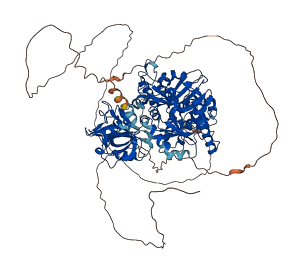
Descriptions
The autoinhibited protein was predicted that may have potential autoinhibitory elements via cis-regPred.
Autoinhibitory domains (AIDs)
Target domain |
|
Relief mechanism |
|
Assay |
cis-regPred |
Accessory elements
No accessory elements
Autoinhibited structure

Activated structure
1 structures for P37913
| Entry ID | Method | Resolution | Chain | Position | Source |
|---|---|---|---|---|---|
| AF-P37913-F1 | Predicted | AlphaFoldDB |
No variants for P37913
| Variant ID(s) | Position | Change | Description | Diseaes Association | Provenance |
|---|---|---|---|---|---|
| No variants for P37913 | |||||
No associated diseases with P37913
5 regional properties for P37913
| Type | Name | Position | InterPro Accession |
|---|---|---|---|
| domain | DNA ligase, ATP-dependent, N-terminal | 286 - 462 | IPR012308 |
| domain | DNA ligase, ATP-dependent, C-terminal | 769 - 880 | IPR012309 |
| domain | DNA ligase, ATP-dependent, central | 540 - 782 | IPR012310 |
| conserved_site | DNA ligase, ATP-dependent, conserved site | 564 - 572 | IPR016059-1 |
| conserved_site | DNA ligase, ATP-dependent, conserved site | 718 - 744 | IPR016059-2 |
Functions
| Description | ||
|---|---|---|
| EC Number | 6.5.1.1 | Forming phosphoric ester bonds |
| Subcellular Localization |
|
|
| PANTHER Family | ||
| PANTHER Subfamily | ||
| PANTHER Protein Class | ||
| PANTHER Pathway Category | No pathway information available | |
5 GO annotations of cellular component
| Name | Definition |
|---|---|
| cytoplasm | The contents of a cell excluding the plasma membrane and nucleus, but including other subcellular structures. |
| intracellular membrane-bounded organelle | Organized structure of distinctive morphology and function, bounded by a single or double lipid bilayer membrane and occurring within the cell. Includes the nucleus, mitochondria, plastids, vacuoles, and vesicles. Excludes the plasma membrane. |
| mitochondrion | A semiautonomous, self replicating organelle that occurs in varying numbers, shapes, and sizes in the cytoplasm of virtually all eukaryotic cells. It is notably the site of tissue respiration. |
| nucleoplasm | That part of the nuclear content other than the chromosomes or the nucleolus. |
| nucleus | A membrane-bounded organelle of eukaryotic cells in which chromosomes are housed and replicated. In most cells, the nucleus contains all of the cell's chromosomes except the organellar chromosomes, and is the site of RNA synthesis and processing. In some species, or in specialized cell types, RNA metabolism or DNA replication may be absent. |
5 GO annotations of molecular function
| Name | Definition |
|---|---|
| ATP binding | Binding to ATP, adenosine 5'-triphosphate, a universally important coenzyme and enzyme regulator. |
| DNA binding | Any molecular function by which a gene product interacts selectively and non-covalently with DNA (deoxyribonucleic acid). |
| DNA ligase (ATP) activity | Catalysis of the reaction: ATP + deoxyribonucleotide(n) + deoxyribonucleotide(m) = AMP + diphosphate + deoxyribonucleotide(n+m). |
| DNA ligase activity | Catalysis of the formation of a phosphodiester bond between the 3'-hydroxyl group at the end of one DNA chain and the 5'-phosphate group at the end of another. This reaction requires an energy source such as ATP or NAD+. |
| metal ion binding | Binding to a metal ion. |
11 GO annotations of biological process
| Name | Definition |
|---|---|
| base-excision repair | In base excision repair, an altered base is removed by a DNA glycosylase enzyme, followed by excision of the resulting sugar phosphate. The small gap left in the DNA helix is filled in by the sequential action of DNA polymerase and DNA ligase. |
| cell division | The process resulting in division and partitioning of components of a cell to form more cells; may or may not be accompanied by the physical separation of a cell into distinct, individually membrane-bounded daughter cells. |
| DNA biosynthetic process | The biosynthetic process resulting in the formation of DNA. |
| DNA ligation | The re-formation of a broken phosphodiester bond in the DNA backbone, carried out by DNA ligase. |
| DNA recombination | Any process in which a new genotype is formed by reassortment of genes resulting in gene combinations different from those that were present in the parents. In eukaryotes genetic recombination can occur by chromosome assortment, intrachromosomal recombination, or nonreciprocal interchromosomal recombination. Interchromosomal recombination occurs by crossing over. In bacteria it may occur by genetic transformation, conjugation, transduction, or F-duction. |
| DNA repair | The process of restoring DNA after damage. Genomes are subject to damage by chemical and physical agents in the environment (e.g. UV and ionizing radiations, chemical mutagens, fungal and bacterial toxins, etc.) and by free radicals or alkylating agents endogenously generated in metabolism. DNA is also damaged because of errors during its replication. A variety of different DNA repair pathways have been reported that include direct reversal, base excision repair, nucleotide excision repair, photoreactivation, bypass, double-strand break repair pathway, and mismatch repair pathway. |
| DNA replication | The cellular metabolic process in which a cell duplicates one or more molecules of DNA. DNA replication begins when specific sequences, known as origins of replication, are recognized and bound by initiation proteins, and ends when the original DNA molecule has been completely duplicated and the copies topologically separated. The unit of replication usually corresponds to the genome of the cell, an organelle, or a virus. The template for replication can either be an existing DNA molecule or RNA. |
| double-strand break repair via nonhomologous end joining | The repair of a double-strand break in DNA in which the two broken ends are rejoined with little or no sequence complementarity. Information at the DNA ends may be lost due to the modification of broken DNA ends. This term covers instances of separate pathways, called classical (or canonical) and alternative nonhomologous end joining (C-NHEJ and A-NHEJ). These in turn may further branch into sub-pathways, but evidence is still unclear. |
| lagging strand elongation | The process in which an existing DNA strand is extended in a net 3' to 5' direction by activities including the addition of nucleotides to the 3' end of the strand, complementary to an existing template, as part of DNA replication. Lagging strand DNA elongation proceeds by discontinuous synthesis of short stretches of DNA, known as Okazaki fragments, from RNA primers; these fragments are then joined by DNA ligase. Although each segment of nascent DNA is synthesized in the 5' to 3' direction, the overall direction of lagging strand synthesis is 3' to 5', mirroring the progress of the replication fork. |
| Okazaki fragment processing involved in mitotic DNA replication | Any DNA replication, Okazaki fragment processing that is involved in mitotic cell cycle DNA replication. |
| response to hydrogen peroxide | Any process that results in a change in state or activity of a cell or an organism (in terms of movement, secretion, enzyme production, gene expression, etc.) as a result of a hydrogen peroxide (H2O2) stimulus. |
5 homologous proteins in AiPD
| UniProt AC | Gene Name | Protein Name | Species | Evidence Code |
|---|---|---|---|---|
| P04819 | CDC9 | DNA ligase 1 | Saccharomyces cerevisiae (strain ATCC 204508 / S288c) (Baker's yeast) | PR |
| Q9W1H4 | DNAlig1 | DNA ligase 1 | Drosophila melanogaster (Fruit fly) | PR |
| P18858 | LIG1 | DNA ligase 1 | Homo sapiens (Human) | PR |
| P97386 | Lig3 | DNA ligase 3 | Mus musculus (Mouse) | PR |
| Q9JHY8 | Lig1 | DNA ligase 1 | Rattus norvegicus (Rat) | PR |
| 10 | 20 | 30 | 40 | 50 | 60 |
| MQRSIMSFFQ | PTKEGKAKKP | EKETPSSIRE | KEPPPKVALK | ERNQVVPESD | SPVKRTGRKV |
| 70 | 80 | 90 | 100 | 110 | 120 |
| AQVLSCEGED | EDEAPGTPKV | QKPVSDSEQS | SPPSPDTCPE | NSPVFNCSSP | MDISPSGFPK |
| 130 | 140 | 150 | 160 | 170 | 180 |
| RRTARKQLPK | RTIQDTLEEQ | NEDKTKTAKK | RKKEEETPKE | SLAEAEDIKQ | KEEKEGDQLI |
| 190 | 200 | 210 | 220 | 230 | 240 |
| VPSEPTKSPE | SVTLTKTENI | PVCKAGVKLK | PQEEEQSKPP | ARGAKTLSSF | FTPRKPAVKT |
| 250 | 260 | 270 | 280 | 290 | 300 |
| EVKQEESGTL | RKEETKGTLD | PANYNPSKNN | YHPIEDACWK | HGQKVPFLAV | ARTFEKIEEV |
| 310 | 320 | 330 | 340 | 350 | 360 |
| SARLKMVETL | SNLLRSVVAL | SPPDLLPVLY | LSLNRLGPPQ | QGLELGVGDG | VLLKAVAQAT |
| 370 | 380 | 390 | 400 | 410 | 420 |
| GRQLESIRAE | VAEKGDVGLV | AENSRSTQRL | MLPPPPLTIS | GVFTKFCDIA | RLTGSASMAK |
| 430 | 440 | 450 | 460 | 470 | 480 |
| KMDIIKGLFV | ACRHSEARYI | ARSLSGRLRL | GLAEQSVLAA | LAQAVSLTPP | GQEFPTVVVD |
| 490 | 500 | 510 | 520 | 530 | 540 |
| AGKGKTAEAR | KMWLEEQGMI | LKQTFCEVPD | LDRIIPVLLE | HGLERLPEHC | KLSPGVPLKP |
| 550 | 560 | 570 | 580 | 590 | 600 |
| MLAHPTRGVS | EVLKRFEEVD | FTCEYKYDGQ | RAQIHVLEGG | EVKIFSRNQE | DNTGKYPDII |
| 610 | 620 | 630 | 640 | 650 | 660 |
| SRIPKIKHPS | VTSFILDTEA | VAWDREKKQI | QPFQVLTTRK | RKEVDASEIQ | VQVCLYAFDL |
| 670 | 680 | 690 | 700 | 710 | 720 |
| IYLNGESLVR | QPLSRRRQLL | RENFVETEGE | FVFTTSLDTK | DTEQIAEFLE | QSVKDSCEGL |
| 730 | 740 | 750 | 760 | 770 | 780 |
| MVKTLDVDAT | YEIAKRSHNW | LKLKKDYLDG | VGDTLDLVVI | GAYLGRGKRA | GRYGGFLLAA |
| 790 | 800 | 810 | 820 | 830 | 840 |
| YDEESEELQA | ICKLGTGFSD | EELEEHHQSL | QALVLPTPRP | YVRIDGAVAP | DHWLDPSIVW |
| 850 | 860 | 870 | 880 | 890 | 900 |
| EVKCADLSLS | PIYPAARGLV | DKEKGISLRF | PRFIRVRKDK | QPEQATTSNQ | VASLYRKQSQ |
| 910 | |||||
| IQNQQSSDLD | SDVEDY |