P35844
Gene name |
KES1 (BSR3, OSH4, YPL145C, LPI3C, P2614) |
Protein name |
Oxysterol-binding protein homolog 4 |
Names |
Bypass SECl4 recessive protein 3, KRE11-1 suppressor protein 1, Protein KES1, Oxysterol-binding protein-related protein 4, ORP 4, OSBP-related protein 4 |
Species |
Saccharomyces cerevisiae (strain ATCC 204508 / S288c) (Baker's yeast) |
KEGG Pathway |
sce:YPL145C |
EC number |
|
Protein Class |
|
Descriptions
The autoinhibited protein was predicted that may have potential autoinhibitory elements via cis-regPred.
Autoinhibitory domains (AIDs)
Target domain |
|
Relief mechanism |
|
Assay |
cis-regPred |
Accessory elements
No accessory elements
Autoinhibited structure

Activated structure
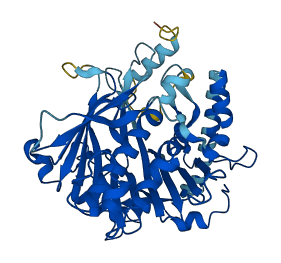
11 structures for P35844
| Entry ID | Method | Resolution | Chain | Position | Source |
|---|---|---|---|---|---|
| 1ZHT | X-ray | 190 A | A | 2-434 | PDB |
| 1ZHW | X-ray | 170 A | A | 2-434 | PDB |
| 1ZHX | X-ray | 150 A | A | 2-434 | PDB |
| 1ZHY | X-ray | 160 A | A | 2-434 | PDB |
| 1ZHZ | X-ray | 190 A | A | 2-434 | PDB |
| 1ZI7 | X-ray | 250 A | A/B/C | 30-434 | PDB |
| 3SPW | X-ray | 260 A | A/B | 1-434 | PDB |
| 4F4B | X-ray | 187 A | A/B | 2-434 | PDB |
| 4FES | X-ray | 200 A | A/B | 2-434 | PDB |
| 4JCH | X-ray | 170 A | A/B | 2-434 | PDB |
| AF-P35844-F1 | Predicted | AlphaFoldDB |
1 variants for P35844
| Variant ID(s) | Position | Change | Description | Diseaes Association | Provenance |
|---|---|---|---|---|---|
| s16-278866 | 278 | I>S | No | SGRP |
No associated diseases with P35844
1 regional properties for P35844
| Type | Name | Position | InterPro Accession |
|---|---|---|---|
| conserved_site | Oxysterol-binding protein, conserved site | 139 - 149 | IPR018494 |
6 GO annotations of cellular component
| Name | Definition |
|---|---|
| cytoplasm | The contents of a cell excluding the plasma membrane and nucleus, but including other subcellular structures. |
| cytosol | The part of the cytoplasm that does not contain organelles but which does contain other particulate matter, such as protein complexes. |
| extrinsic component of membrane | The component of a membrane consisting of gene products and protein complexes that are loosely bound to one of its surfaces, but not integrated into the hydrophobic region. |
| Golgi membrane | The lipid bilayer surrounding any of the compartments of the Golgi apparatus. |
| intracellular membrane-bounded organelle | Organized structure of distinctive morphology and function, bounded by a single or double lipid bilayer membrane and occurring within the cell. Includes the nucleus, mitochondria, plastids, vacuoles, and vesicles. Excludes the plasma membrane. |
| membrane | A lipid bilayer along with all the proteins and protein complexes embedded in it an attached to it. |
8 GO annotations of molecular function
| Name | Definition |
|---|---|
| lipid binding | Binding to a lipid. |
| oxysterol binding | Binding to oxysterol, an oxidized form of cholesterol. |
| phosphatidic acid binding | Binding to phosphatidic acid, any of a class of glycerol phosphate in which both the remaining hydroxyl groups of the glycerol moiety are esterified with fatty acids. |
| phosphatidylinositol-4,5-bisphosphate binding | Binding to phosphatidylinositol-4,5-bisphosphate, a derivative of phosphatidylinositol in which the inositol ring is phosphorylated at the 4' and 5' positions. |
| phosphatidylinositol-4-phosphate binding | Binding to phosphatidylinositol-4-phosphate, a derivative of phosphatidylinositol in which the inositol ring is phosphorylated at the 4' position. |
| sterol binding | Binding to a sterol, a steroid containing a hydroxy group in the 3 position, closely related to cholestan-3-ol. |
| sterol transfer activity | Removes a sterol from a membrane or a monolayer lipid particle, transports it through the aqueous phase while protected in a hydrophobic pocket, and brings it to an acceptor membrane or lipid particle. |
| sterol transporter activity | Enables the directed movement of sterols into, out of or within a cell, or between cells. Sterol are steroids with one or more hydroxyl groups and a hydrocarbon side-chain in the molecule. |
9 GO annotations of biological process
| Name | Definition |
|---|---|
| endocytosis | A vesicle-mediated transport process in which cells take up external materials or membrane constituents by the invagination of a small region of the plasma membrane to form a new membrane-bounded vesicle. |
| ER to Golgi ceramide transport | The directed movement of a ceramide from the endoplasmic reticulum (ER) to the Golgi. Ceramides are a class of lipid composed of sphingosine linked to a fatty acid. |
| exocytosis | A process of secretion by a cell that results in the release of intracellular molecules (e.g. hormones, matrix proteins) contained within a membrane-bounded vesicle. Exocytosis can occur either by full fusion, when the vesicle collapses into the plasma membrane, or by a kiss-and-run mechanism that involves the formation of a transient contact, a pore, between a granule (for exemple of chromaffin cells) and the plasma membrane. The latter process most of the time leads to only partial secretion of the granule content. Exocytosis begins with steps that prepare vesicles for fusion with the membrane (tethering and docking) and ends when molecules are secreted from the cell. |
| maintenance of cell polarity | The maintenance of established anisotropic intracellular organization or cell growth patterns. |
| piecemeal microautophagy of the nucleus | Degradation of a cell nucleus by lysosomal microautophagy. |
| positive regulation of phosphatase activity | Any process that increases the rate or frequency of phosphatase activity. Phosphatases catalyze the hydrolysis of phosphoric monoesters, releasing inorganic phosphate. |
| post-Golgi vesicle-mediated transport | The directed movement of substances from the Golgi to other parts of the cell, including organelles and the plasma membrane, mediated by small transport vesicles. |
| sphingolipid metabolic process | The chemical reactions and pathways involving sphingolipids, any of a class of lipids containing the long-chain amine diol sphingosine or a closely related base (a sphingoid). |
| sterol transport | The directed movement of sterols into, out of or within a cell, or between cells, by means of some agent such as a transporter or pore. Sterols are steroids with one or more hydroxyl groups and a hydrocarbon side-chain in the molecule. |
4 homologous proteins in AiPD
| UniProt AC | Gene Name | Protein Name | Species | Evidence Code |
|---|---|---|---|---|
| P38755 | OSH7 | Oxysterol-binding protein homolog 7 | Saccharomyces cerevisiae (strain ATCC 204508 / S288c) (Baker's yeast) | PR |
| P35843 | HES1 | Oxysterol-binding protein homolog 5 | Saccharomyces cerevisiae (strain ATCC 204508 / S288c) (Baker's yeast) | PR |
| Q9BZF1 | OSBPL8 | Oxysterol-binding protein-related protein 8 | Homo sapiens (Human) | PR |
| B9EJ86 | Osbpl8 | Oxysterol-binding protein-related protein 8 | Mus musculus (Mouse) | PR |
| 10 | 20 | 30 | 40 | 50 | 60 |
| MSQYASSSSW | TSFLKSIASF | NGDLSSLSAP | PFILSPISLT | EFSQYWAEHP | ELFLEPSFIN |
| 70 | 80 | 90 | 100 | 110 | 120 |
| DDNYKEHCLI | DPEVESPELA | RMLAVTKWFI | STLKSQYCSR | NESLGSEKKP | LNPFLGELFV |
| 130 | 140 | 150 | 160 | 170 | 180 |
| GKWENKEHPE | FGETVLLSEQ | VSHHPPVTAF | SIFNDKNKVK | LQGYNQIKAS | FTKSLMLTVK |
| 190 | 200 | 210 | 220 | 230 | 240 |
| QFGHTMLDIK | DESYLVTPPP | LHIEGILVAS | PFVELEGKSY | IQSSTGLLCV | IEFSGRGYFS |
| 250 | 260 | 270 | 280 | 290 | 300 |
| GKKNSFKARI | YKDSKDSKDK | EKALYTISGQ | WSGSSKIIKA | NKKEESRLFY | DAARIPAEHL |
| 310 | 320 | 330 | 340 | 350 | 360 |
| NVKPLEEQHP | LESRKAWYDV | AGAIKLGDFN | LIAKTKTELE | ETQRELRKEE | EAKGISWQRR |
| 370 | 380 | 390 | 400 | 410 | 420 |
| WFKDFDYSVT | PEEGALVPEK | DDTFLKLASA | LNLSTKNAPS | GTLVGDKEDR | KEDLSSIHWR |
| 430 | |||||
| FQRELWDEEK | EIVL |