P35189
Gene name |
TAF14 (ANC1, CST10, SWP29, TAF30, TFG3) |
Protein name |
Transcription initiation factor TFIID subunit 14 |
Names |
Actin non-complementing mutant 1, Chromosome stability protein 10, SWI/SNF chromatin-remodeling complex subunit TAF14, SWI/SNF complex 29 kDa subunit, SWI/SNF complex subunit TAF14, TBP-associated factor 14, TBP-associated factor 30 kDa, Transcription factor G 30 kDa subunit, Transcription initiation factor TFIIF 30 kDa subunit |
Species |
Saccharomyces cerevisiae (strain ATCC 204508 / S288c) (Baker's yeast) |
KEGG Pathway |
sce:YPL129W |
EC number |
|
Protein Class |
|
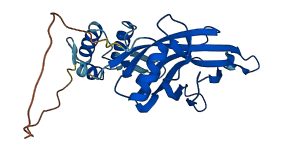
Descriptions
The autoinhibited protein was predicted that may have potential autoinhibitory elements via cis-regPred.
Autoinhibitory domains (AIDs)
Target domain |
|
Relief mechanism |
|
Assay |
cis-regPred |
Accessory elements
No accessory elements
Autoinhibited structure

Activated structure
13 structures for P35189
| Entry ID | Method | Resolution | Chain | Position | Source |
|---|---|---|---|---|---|
| 2L7E | NMR | - | A | 1-123 | PDB |
| 3QRL | X-ray | 170 A | A | 1-137 | PDB |
| 5D7E | X-ray | 190 A | A | 1-137 | PDB |
| 5IOK | X-ray | 222 A | A | 1-137 | PDB |
| 5SVA | EM | 1530 A | n | 1-244 | PDB |
| 6LQZ | NMR | - | A | 174-244 | PDB |
| 6MIN | X-ray | 190 A | A | 1-137 | PDB |
| 6MIO | X-ray | 185 A | A | 1-137 | PDB |
| 6MIP | X-ray | 200 A | A | 1-137 | PDB |
| 6MIQ | X-ray | 175 A | A | 1-137 | PDB |
| 7F4A | X-ray | 200 A | A | 2-137 | PDB |
| 7UHE | X-ray | 166 A | A/C | 168-243 | PDB |
| AF-P35189-F1 | Predicted | AlphaFoldDB |
3 variants for P35189
| Variant ID(s) | Position | Change | Description | Diseaes Association | Provenance |
|---|---|---|---|---|---|
| s16-305810 | 137 | T>A | No | SGRP | |
| s16-305811 | 137 | T>I | No | SGRP | |
| s16-306087 | 229 | E>G | No | SGRP |
No associated diseases with P35189
1 regional properties for P35189
| Type | Name | Position | InterPro Accession |
|---|---|---|---|
| domain | NET domain | 181 - 241 | IPR027353 |
12 GO annotations of cellular component
| Name | Definition |
|---|---|
| chromatin | The ordered and organized complex of DNA, protein, and sometimes RNA, that forms the chromosome. |
| Ino80 complex | A multisubunit protein complex that contains the Ino80p ATPase; exhibits chromatin remodeling activity. |
| mediator complex | A protein complex that interacts with the carboxy-terminal domain of the largest subunit of RNA polymerase II and plays an active role in transducing the signal from a transcription factor to the transcriptional machinery. The mediator complex is required for activation of transcription of most protein-coding genes, but can also act as a transcriptional corepressor. The Saccharomyces complex contains several identifiable subcomplexes: a head domain comprising Srb2, -4, and -5, Med6, -8, and -11, and Rox3 proteins; a middle domain comprising Med1, -4, and -7, Nut1 and -2, Cse2, Rgr1, Soh1, and Srb7 proteins; a tail consisting of Gal11p, Med2p, Pgd1p, and Sin4p; and a regulatory subcomplex comprising Ssn2, -3, and -8, and Srb8 proteins. Metazoan mediator complexes have similar modular structures and include homologs of yeast Srb and Med proteins. |
| NuA3 histone acetyltransferase complex | A Gcn5-independent multisubunit complex that catalyzes the acetylation of histone H3. The budding yeast complex includes Sas3p, Taf30p, and Yng1p. |
| NuA3a histone acetyltransferase complex | A NuA3 complex that catalyzes the acetylation of Histone H3. In S. cerevisiae, this complex consists of Eaf6p, Nto1p, Sas3p, Taf14p, Yng1p and associates with H3K4me3 using Yng1p. |
| NuA3b histone acetyltransferase complex | A NuA3 complex that catalyzes the acetylation of Histone H3. In S. cerevisiae, this complex consists of Eaf6p, Nto1p, Sas3p, Taf14p, Pdp3 and associates with H3K4me3 via Pdp3p. |
| NuA4 histone acetyltransferase complex | A complex having histone acetylase activity on chromatin, as well as ATPase, DNA helicase and structural DNA binding activities. The complex is thought to be involved in double-strand DNA break repair. Subunits of the human complex include HTATIP/TIP60, TRRAP, RUVBL1, BUVBL2, beta-actin and BAF53/ACTL6A. In yeast, the complex has 13 subunits, including the catalytic subunit Esa1 (homologous to human Tip60). |
| nucleus | A membrane-bounded organelle of eukaryotic cells in which chromosomes are housed and replicated. In most cells, the nucleus contains all of the cell's chromosomes except the organellar chromosomes, and is the site of RNA synthesis and processing. In some species, or in specialized cell types, RNA metabolism or DNA replication may be absent. |
| SWI/SNF complex | A SWI/SNF-type complex that contains 8 to 14 proteins, including both conserved (core) and nonconserved components; contains the ATPase product of the yeast SNF2 or mammalian SMARCA4/BAF190A/BRG1 gene, or an ortholog thereof. |
| Swr1 complex | A multisubunit protein complex that is involved in chromatin remodeling. It is required for the incorporation of the histone variant H2AZ into chromatin. In S. cerevisiae, the complex contains Swr1p, a Swi2/Snf2-related ATPase, and 12 additional subunits. |
| transcription factor TFIID complex | A complex composed of TATA binding protein (TBP) and TBP associated factors (TAFs); the total mass is typically about 800 kDa. Most of the TAFs are conserved across species. In TATA-containing promoters for RNA polymerase II (Pol II), TFIID is believed to recognize at least two distinct elements, the TATA element and a downstream promoter element. TFIID is also involved in recognition of TATA-less Pol II promoters. Binding of TFIID to DNA is necessary but not sufficient for transcription initiation from most RNA polymerase II promoters. |
| transcription factor TFIIF complex | A general transcription initiation factor which in humans consists of a heterodimer of an alpha and a beta subunit. Helps recruit RNA polymerase II to the initiation complex and promotes translation elongation. |
2 GO annotations of molecular function
| Name | Definition |
|---|---|
| histone binding | Binding to a histone, any of a group of water-soluble proteins found in association with the DNA of eukaryotic or archaeal chromosomes. They are involved in the condensation and coiling of chromosomes during cell division and have also been implicated in gene regulation and DNA replication. They may be chemically modified (methylated, acetlyated and others) to regulate gene transcription. |
| RNA polymerase II general transcription initiation factor activity | A general transcription initiation factor activity that contributes to transcription start site selection and transcription initiation of genes transcribed by RNA polymerase II. The general transcription factors for RNA polymerase II include TFIIB, TFIID, TFIIE, TFIIF, TFIIH and TATA-binding protein (TBP). In most species, RNA polymerase II transcribes all messenger RNAs (mRNAs), most untranslated regulatory RNAs, the majority of the snoRNAs, four of the five snRNAs (U1, U2, U4, and U5), and other small noncoding RNAs. For some small RNAs there is variability between species as to whether it is transcribed by RNA polymerase II or RNA polymerase III. However there are also rare exceptions, such as Trypanosoma brucei, where RNA polymerase I transcribes certain mRNAs in addition to its normal role in rRNA transcription. |
11 GO annotations of biological process
| Name | Definition |
|---|---|
| chromatin remodeling | A dynamic process of chromatin reorganization resulting in changes to chromatin structure. These changes allow DNA metabolic processes such as transcriptional regulation, DNA recombination, DNA repair, and DNA replication. |
| DNA repair | The process of restoring DNA after damage. Genomes are subject to damage by chemical and physical agents in the environment (e.g. UV and ionizing radiations, chemical mutagens, fungal and bacterial toxins, etc.) and by free radicals or alkylating agents endogenously generated in metabolism. DNA is also damaged because of errors during its replication. A variety of different DNA repair pathways have been reported that include direct reversal, base excision repair, nucleotide excision repair, photoreactivation, bypass, double-strand break repair pathway, and mismatch repair pathway. |
| DNA-templated transcription | The synthesis of an RNA transcript from a DNA template. |
| histone acetylation | The modification of a histone by the addition of an acetyl group. |
| positive regulation of double-strand break repair via homologous recombination | Any process that activates or increases the frequency, rate or extent of double-strand break repair via homologous recombination. |
| positive regulation of transcription by RNA polymerase II | Any process that activates or increases the frequency, rate or extent of transcription from an RNA polymerase II promoter. |
| regulation of DNA-templated transcription | Any process that modulates the frequency, rate or extent of cellular DNA-templated transcription. |
| regulation of transcription by RNA polymerase II | Any process that modulates the frequency, rate or extent of transcription mediated by RNA polymerase II. |
| RNA polymerase II preinitiation complex assembly | The aggregation, arrangement and bonding together of proteins on an RNA polymerase II promoter DNA to form the transcriptional preinitiation complex (PIC), the formation of which is a prerequisite for transcription by RNA polymerase. |
| transcription by RNA polymerase II | The synthesis of RNA from a DNA template by RNA polymerase II (RNAP II), originating at an RNA polymerase II promoter. Includes transcription of messenger RNA (mRNA) and certain small nuclear RNAs (snRNAs). |
| transcription initiation at RNA polymerase II promoter | A transcription initiation process that takes place at a RNA polymerase II gene promoter. Messenger RNAs (mRNA) genes, as well as some non-coding RNAs, are transcribed by RNA polymerase II. |
| 10 | 20 | 30 | 40 | 50 | 60 |
| MVATVKRTIR | IKTQQHILPE | VPPVENFPVR | QWSIEIVLLD | DEGKEIPATI | FDKVIYHLHP |
| 70 | 80 | 90 | 100 | 110 | 120 |
| TFANPNRTFT | DPPFRIEEQG | WGGFPLDISV | FLLEKAGERK | IPHDLNFLQE | SYEVEHVIQI |
| 130 | 140 | 150 | 160 | 170 | 180 |
| PLNKPLLTEE | LAKSGSTEET | TANTGTIGKR | RTTTNTTAEP | KAKRAKTGSA | STVKGSVDLE |
| 190 | 200 | 210 | 220 | 230 | 240 |
| KLAFGLTKLN | EDDLVGVVQM | VTDNKTPEMN | VTNNVEEGEF | IIDLYSLPEG | LLKSLWDYVK |
| KNTE |