A2AM29
Gene name |
Mllt3 (Af9) |
Protein name |
Protein AF-9 |
Names |
Myeloid/lymphoid or mixed-lineage leukemia translocated to chromosome 3 protein homolog |
Species |
Mus musculus (Mouse) |
KEGG Pathway |
mmu:70122 |
EC number |
|
Protein Class |
|
Descriptions
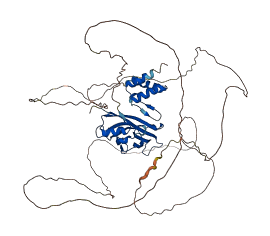
The autoinhibited protein was predicted that may have potential autoinhibitory elements via cis-regPred.
Autoinhibitory domains (AIDs)
Target domain |
|
Relief mechanism |
|
Assay |
cis-regPred |
Accessory elements
No accessory elements
Autoinhibited structure

Activated structure
1 structures for A2AM29
| Entry ID | Method | Resolution | Chain | Position | Source |
|---|---|---|---|---|---|
| AF-A2AM29-F1 | Predicted | AlphaFoldDB |
16 variants for A2AM29
| Variant ID(s) | Position | Change | Description | Diseaes Association | Provenance |
|---|---|---|---|---|---|
| rs3388682050 | 118 | R>H | No | EVA | |
| rs3388682024 | 128 | T>S | No | EVA | |
| rs3388691110 | 129 | E>K | No | EVA | |
| rs1134075603 | 247 | I>L | No | EVA | |
| rs1132119075 | 251 | M>I | No | EVA | |
| rs1134740316 | 253 | F>S | No | EVA | |
| rs1134185999 | 254 | K>E | No | EVA | |
| rs3388688209 | 269 | L>* | No | EVA | |
| rs3388682069 | 351 | S>L | No | EVA | |
| rs28097387 | 352 | M>T | No | EVA | |
| rs3388688560 | 371 | M>I | No | EVA | |
| rs3388690750 | 389 | S>P | No | EVA | |
| rs3388688581 | 417 | E>K | No | EVA | |
| rs3388696142 | 482 | V>M | No | EVA | |
| rs3388686084 | 490 | K>R | No | EVA | |
| rs3388693868 | 549 | C>* | No | EVA |
No associated diseases with A2AM29
1 regional properties for A2AM29
| Type | Name | Position | InterPro Accession |
|---|---|---|---|
| domain | AF-9, ANC1 homology domain | 504 - 564 | IPR040930 |
7 GO annotations of cellular component
| Name | Definition |
|---|---|
| chromosome | A structure composed of a very long molecule of DNA and associated proteins (e.g. histones) that carries hereditary information. |
| cytosol | The part of the cytoplasm that does not contain organelles but which does contain other particulate matter, such as protein complexes. |
| NuA4 histone acetyltransferase complex | A complex having histone acetylase activity on chromatin, as well as ATPase, DNA helicase and structural DNA binding activities. The complex is thought to be involved in double-strand DNA break repair. Subunits of the human complex include HTATIP/TIP60, TRRAP, RUVBL1, BUVBL2, beta-actin and BAF53/ACTL6A. In yeast, the complex has 13 subunits, including the catalytic subunit Esa1 (homologous to human Tip60). |
| nucleoplasm | That part of the nuclear content other than the chromosomes or the nucleolus. |
| nucleus | A membrane-bounded organelle of eukaryotic cells in which chromosomes are housed and replicated. In most cells, the nucleus contains all of the cell's chromosomes except the organellar chromosomes, and is the site of RNA synthesis and processing. In some species, or in specialized cell types, RNA metabolism or DNA replication may be absent. |
| super elongation complex | A transcription elongation factor complex that increases the overall rate of RNA polymerase II transcription elongation by suppressing transient polymerase pausing. At minimum, the complex contains a transcription factor of the ELL family, an EAF protein, and an AFF family protein or distant relative and most likely also P-TEFb and AF9 or ENL. The complex is conserved from yeast to humans. In Schizosaccharomyces pombe it contains Ell1, Eaf1, and Ebp1, but it is absent from S. cerevisiae. |
| transcription elongation factor complex | Any protein complex that interacts with RNA polymerase II to increase (positive transcription elongation factor) or reduce (negative transcription elongation factor) the rate of transcription elongation. |
5 GO annotations of molecular function
| Name | Definition |
|---|---|
| chromatin binding | Binding to chromatin, the network of fibers of DNA, protein, and sometimes RNA, that make up the chromosomes of the eukaryotic nucleus during interphase. |
| DNA binding | Any molecular function by which a gene product interacts selectively and non-covalently with DNA (deoxyribonucleic acid). |
| histone binding | Binding to a histone, any of a group of water-soluble proteins found in association with the DNA of eukaryotic or archaeal chromosomes. They are involved in the condensation and coiling of chromosomes during cell division and have also been implicated in gene regulation and DNA replication. They may be chemically modified (methylated, acetlyated and others) to regulate gene transcription. |
| lysine-acetylated histone binding | Binding to a histone in which a lysine residue has been modified by acetylation. |
| modification-dependent protein binding | Binding to a protein upon post-translation modification of the target protein. |
12 GO annotations of biological process
| Name | Definition |
|---|---|
| anterior/posterior pattern specification | The regionalization process in which specific areas of cell differentiation are determined along the anterior-posterior axis. The anterior-posterior axis is defined by a line that runs from the head or mouth of an organism to the tail or opposite end of the organism. |
| chromatin remodeling | A dynamic process of chromatin reorganization resulting in changes to chromatin structure. These changes allow DNA metabolic processes such as transcriptional regulation, DNA recombination, DNA repair, and DNA replication. |
| gene expression | The process in which a gene's sequence is converted into a mature gene product (protein or RNA). This includes the production of an RNA transcript and its processing, translation and maturation for protein-coding genes. |
| hematopoietic stem cell differentiation | The process in which a relatively unspecialized cell acquires specialized features of a hematopoietic stem cell. A stem cell is a cell that retains the ability to divide and proliferate throughout life to provide progenitor cells that can differentiate into specialized cells. |
| histone acetylation | The modification of a histone by the addition of an acetyl group. |
| negative regulation of canonical Wnt signaling pathway | Any process that decreases the rate, frequency, or extent of the Wnt signaling pathway through beta-catenin, the series of molecular signals initiated by binding of a Wnt protein to a frizzled family receptor on the surface of the target cell, followed by propagation of the signal via beta-catenin, and ending with a change in transcription of target genes. |
| positive regulation of DNA-templated transcription | Any process that activates or increases the frequency, rate or extent of cellular DNA-templated transcription. |
| positive regulation of Wnt signaling pathway, planar cell polarity pathway | Any process that activates or increases the frequency, rate or extent of Wnt signaling pathway, planar cell polarity pathway. |
| regulation of chromatin organization | Any process that modulates the frequency, rate or extent of chromatin organization. |
| regulation of stem cell division | Any process that modulates the frequency, rate or extent of stem cell division. |
| regulation of transcription by RNA polymerase II | Any process that modulates the frequency, rate or extent of transcription mediated by RNA polymerase II. |
| segment specification | The process in which segments assume individual identities; exemplified in insects by the actions of the products of the homeotic genes. |
| 10 | 20 | 30 | 40 | 50 | 60 |
| MASSCAVQVK | LELGHRAQVR | KKPTVEGFTH | DWMVFVRGPE | HSNIQHFVEK | VVFHLHESFP |
| 70 | 80 | 90 | 100 | 110 | 120 |
| RPKRVCKDPP | YKVEESGYAG | FILPIEVYFK | NKEEPKKVRF | DYDLFLHLEG | HPPVNHLRCE |
| 130 | 140 | 150 | 160 | 170 | 180 |
| KLTFNNPTED | FRRKLLKAGG | DPNRSIHTSS | SSSSSSSSSS | SSSSSSSSSS | SSSSSSSSSS |
| 190 | 200 | 210 | 220 | 230 | 240 |
| SSSSSSSSSS | TSFSKPHKLM | KEHKEKPSKD | SREHKSAFKE | PSRDHNKSSK | DSSKKPKENK |
| 250 | 260 | 270 | 280 | 290 | 300 |
| PLKEEKIVPK | MAFKEPKPMS | KEPKADSNLL | TVTSGQQDKK | APSKRPPASD | SEELSAKKRK |
| 310 | 320 | 330 | 340 | 350 | 360 |
| KSSSEALFKS | FSSAPPLILT | CSADKKQIKD | KSHVKMGKVK | IESETSEKKK | SMLPPFDDIV |
| 370 | 380 | 390 | 400 | 410 | 420 |
| DPNDSDVEEN | MSSKSDSEQP | SPASSSSSSS | SSFTPSQTRQ | QGPLRSIMKD | LHSDDNEEES |
| 430 | 440 | 450 | 460 | 470 | 480 |
| DEAEDNDNDS | EMERPVNRGG | SRSRRVSLSD | GSDSESSSAS | SPLHHEPPPP | LLKTNNNQIL |
| 490 | 500 | 510 | 520 | 530 | 540 |
| EVKSPIKQSK | SDKQIKNGEC | DKAYLDELVE | LHRRLMTLRE | RHILQQIVNL | IEETGHFHIT |
| 550 | 560 | ||||
| NTTFDFDLCS | LDKTTVRKLQ | SYLETSGTS |