P31378
Gene name |
NTG1 |
Protein name |
Endonuclease III homolog 1 |
Names |
Bifunctional DNA N-glycosylase/DNA-(apurinic or apyrimidinic site) lyase 1, DNA glycosylase/AP lyase 1, Endonuclease III-like glycosylase 1, Redoxyendonuclease 1 |
Species |
Saccharomyces cerevisiae (strain ATCC 204508 / S288c) (Baker's yeast) |
KEGG Pathway |
sce:YAL015C |
EC number |
4.2.99.18: Other carbon-oxygen lyases |
Protein Class |
|
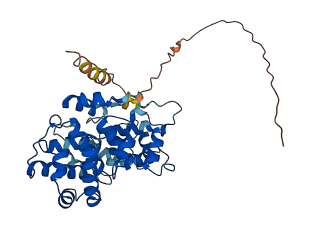
Descriptions
The autoinhibited protein was predicted that may have potential autoinhibitory elements via cis-regPred.
Autoinhibitory domains (AIDs)
Target domain |
|
Relief mechanism |
|
Assay |
cis-regPred |
Accessory elements
No accessory elements
Autoinhibited structure

Activated structure
1 structures for P31378
| Entry ID | Method | Resolution | Chain | Position | Source |
|---|---|---|---|---|---|
| AF-P31378-F1 | Predicted | AlphaFoldDB |
10 variants for P31378
| Variant ID(s) | Position | Change | Description | Diseaes Association | Provenance |
|---|---|---|---|---|---|
| s01-127872 | 78 | P>S | No | SGRP | |
| s01-127854 | 84 | L>F | No | SGRP | |
| s01-127713 | 131 | G>C | No | SGRP | |
| s01-127710 | 132 | I>F | No | SGRP | |
| s01-127707 | 133 | S>T | No | SGRP | |
| s01-127672 | 144 | L>F | No | SGRP | |
| s01-127604 | 167 | N>I | No | SGRP | |
| s01-127397 | 236 | G>D | No | SGRP | |
| s01-127275 | 277 | A>P | No | SGRP | |
| s01-126993 | 371 | A>T | No | SGRP |
No associated diseases with P31378
Functions
| Description | ||
|---|---|---|
| EC Number | 4.2.99.18 | Other carbon-oxygen lyases |
| Subcellular Localization |
|
|
| PANTHER Family | ||
| PANTHER Subfamily | ||
| PANTHER Protein Class | ||
| PANTHER Pathway Category | No pathway information available | |
2 GO annotations of cellular component
| Name | Definition |
|---|---|
| mitochondrion | A semiautonomous, self replicating organelle that occurs in varying numbers, shapes, and sizes in the cytoplasm of virtually all eukaryotic cells. It is notably the site of tissue respiration. |
| nucleus | A membrane-bounded organelle of eukaryotic cells in which chromosomes are housed and replicated. In most cells, the nucleus contains all of the cell's chromosomes except the organellar chromosomes, and is the site of RNA synthesis and processing. In some species, or in specialized cell types, RNA metabolism or DNA replication may be absent. |
5 GO annotations of molecular function
| Name | Definition |
|---|---|
| class I DNA-(apurinic or apyrimidinic site) endonuclease activity | Catalysis of the cleavage of an AP site 3' of the baseless site by a beta-lyase mechanism, leaving an unsaturated aldehyde, termed a 3'-(4-hydroxy-5-phospho-2-pentenal) residue, and a 5'-phosphate. |
| DNA binding | Any molecular function by which a gene product interacts selectively and non-covalently with DNA (deoxyribonucleic acid). |
| DNA-(apurinic or apyrimidinic site) endonuclease activity | Catalysis of the cleavage of the C-O-P bond in the AP site created when DNA glycosylase removes a damaged base, involved in the DNA base excision repair pathway (BER). |
| oxidized purine nucleobase lesion DNA N-glycosylase activity | Catalysis of the removal of oxidized purine bases by cleaving the N-C1' glycosidic bond between the oxidized purine and the deoxyribose sugar. The reaction involves the formation of a covalent enzyme-substrate intermediate. Release of the enzyme and free base by a beta-elimination or a beta, gamma-elimination mechanism results in the cleavage of the DNA backbone 3' of the apurinic (AP) site. |
| oxidized pyrimidine nucleobase lesion DNA N-glycosylase activity | Catalysis of the removal oxidized pyrimidine bases by cleaving the N-C1' glycosidic bond between the oxidized pyrimidine and the deoxyribose sugar. The reaction involves formation of a covalent enzyme-pyrimidine base intermediate. Release of the enzyme and free base by a beta-elimination or a beta, gamma-elimination mechanism results in the cleavage of the DNA backbone 3' of the apyrimidinic (AP) site. |
6 GO annotations of biological process
| Name | Definition |
|---|---|
| base-excision repair | In base excision repair, an altered base is removed by a DNA glycosylase enzyme, followed by excision of the resulting sugar phosphate. The small gap left in the DNA helix is filled in by the sequential action of DNA polymerase and DNA ligase. |
| base-excision repair, AP site formation | The formation of an AP site, a deoxyribose sugar with a missing base, by DNA glycosylase which recognizes an altered base in DNA and catalyzes its hydrolytic removal. This sugar phosphate is the substrate recognized by the AP endonuclease, which cuts the DNA phosphodiester backbone at the 5' side of the altered site to leave a gap which is subsequently repaired. |
| cellular response to oxidative stress | Any process that results in a change in state or activity of a cell (in terms of movement, secretion, enzyme production, gene expression, etc.) as a result of oxidative stress, a state often resulting from exposure to high levels of reactive oxygen species, e.g. superoxide anions, hydrogen peroxide (H2O2), and hydroxyl radicals. |
| DNA repair | The process of restoring DNA after damage. Genomes are subject to damage by chemical and physical agents in the environment (e.g. UV and ionizing radiations, chemical mutagens, fungal and bacterial toxins, etc.) and by free radicals or alkylating agents endogenously generated in metabolism. DNA is also damaged because of errors during its replication. A variety of different DNA repair pathways have been reported that include direct reversal, base excision repair, nucleotide excision repair, photoreactivation, bypass, double-strand break repair pathway, and mismatch repair pathway. |
| nucleotide-excision repair, DNA incision, 5'-to lesion | The endonucleolytic cleavage of the damaged strand of DNA 5' to the site of damage. The incision occurs at the junction of single-stranded DNA and double-stranded DNA that is formed when the DNA duplex is unwound. The incision follows the incision formed 3' to the site of damage. |
| positive regulation of mitochondrial DNA replication | Any process that increases the rate, frequency or extent of the process in which new strands of DNA are synthesized in the mitochondrion. |
| 10 | 20 | 30 | 40 | 50 | 60 |
| MQKISKYSSM | AILRKRPLVK | TETGPESELL | PEKRTKIKQE | EVVPQPVDID | WVKSLPNKQY |
| 70 | 80 | 90 | 100 | 110 | 120 |
| FEWIVVRNGN | VPNRWATPLD | PSILVTPAST | KVPYKFQETY | ARMRVLRSKI | LAPVDIIGGS |
| 130 | 140 | 150 | 160 | 170 | 180 |
| SIPVTVASKC | GISKEQISPR | DYRLQVLLGV | MLSSQTKDEV | TAMAMLNIMR | YCIDELHSEE |
| 190 | 200 | 210 | 220 | 230 | 240 |
| GMTLEAVLQI | NETKLDELIH | SVGFHTRKAK | YILSTCKILQ | DQFSSDVPAT | INELLGLPGV |
| 250 | 260 | 270 | 280 | 290 | 300 |
| GPKMAYLTLQ | KAWGKIEGIC | VDVHVDRLTK | LWKWVDAQKC | KTPDQTRTQL | QNWLPKGLWT |
| 310 | 320 | 330 | 340 | 350 | 360 |
| EINGLLVGFG | QIITKSRNLG | DMLQFLPPDD | PRSSLDWDLQ | SQLYKEIQQN | IMSYPKWVKY |
| 370 | 380 | 390 | |||
| LEGKRELNVE | AEINVKHEEK | TVEETMVKLE | NDISVKVED |