P25961
Gene name |
Pth1r (Pthr, Pthr1) |
Protein name |
Parathyroid hormone/parathyroid hormone-related peptide receptor |
Names |
PTH/PTHrP type I receptor, PTH/PTHr receptor, Parathyroid hormone 1 receptor, PTH1 receptor |
Species |
Rattus norvegicus (Rat) |
KEGG Pathway |
rno:56813 |
EC number |
|
Protein Class |
|
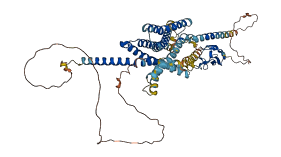
Descriptions
The autoinhibited protein was predicted that may have potential autoinhibitory elements via cis-regPred.
Autoinhibitory domains (AIDs)
Target domain |
|
Relief mechanism |
|
Assay |
cis-regPred |
Accessory elements
No accessory elements
Autoinhibited structure

Activated structure
1 structures for P25961
| Entry ID | Method | Resolution | Chain | Position | Source |
|---|---|---|---|---|---|
| AF-P25961-F1 | Predicted | AlphaFoldDB |
2 variants for P25961
| Variant ID(s) | Position | Change | Description | Diseaes Association | Provenance |
|---|---|---|---|---|---|
| rs8161272 | 165 | A>T | No | EVA | |
| rs3321491276 | 577 | A>V | No | EVA |
No associated diseases with P25961
4 regional properties for P25961
| Type | Name | Position | InterPro Accession |
|---|---|---|---|
| domain | GPCR, family 2, extracellular hormone receptor domain | 47 - 179 | IPR001879 |
| domain | GPCR, family 2-like, transmembrane domain | 187 - 463 | IPR017981 |
| conserved_site | GPCR, family 2, secretin-like, conserved site | 108 - 132 | IPR017983-1 |
| conserved_site | GPCR, family 2, secretin-like, conserved site | 451 - 466 | IPR017983-2 |
8 GO annotations of cellular component
| Name | Definition |
|---|---|
| apical plasma membrane | The region of the plasma membrane located at the apical end of the cell. |
| basolateral plasma membrane | The region of the plasma membrane that includes the basal end and sides of the cell. Often used in reference to animal polarized epithelial membranes, where the basal membrane is the part attached to the extracellular matrix, or in plant cells, where the basal membrane is defined with respect to the zygotic axis. |
| brush border membrane | The portion of the plasma membrane surrounding the brush border. |
| cytoplasm | The contents of a cell excluding the plasma membrane and nucleus, but including other subcellular structures. |
| integral component of plasma membrane | The component of the plasma membrane consisting of the gene products and protein complexes having at least some part of their peptide sequence embedded in the hydrophobic region of the membrane. |
| nucleus | A membrane-bounded organelle of eukaryotic cells in which chromosomes are housed and replicated. In most cells, the nucleus contains all of the cell's chromosomes except the organellar chromosomes, and is the site of RNA synthesis and processing. In some species, or in specialized cell types, RNA metabolism or DNA replication may be absent. |
| plasma membrane | The membrane surrounding a cell that separates the cell from its external environment. It consists of a phospholipid bilayer and associated proteins. |
| receptor complex | Any protein complex that undergoes combination with a hormone, neurotransmitter, drug or intracellular messenger to initiate a change in cell function. |
5 GO annotations of molecular function
| Name | Definition |
|---|---|
| G protein-coupled peptide receptor activity | Combining with a peptide and transmitting the signal across the membrane by activating an associated G-protein; promotes the exchange of GDP for GTP on the alpha subunit of a heterotrimeric G-protein complex. |
| parathyroid hormone receptor activity | Combining with parathyroid hormone to initiate a change in cell activity. |
| peptide hormone binding | Binding to a peptide with hormonal activity in animals. |
| protein homodimerization activity | Binding to an identical protein to form a homodimer. |
| protein self-association | Binding to a domain within the same polypeptide. |
21 GO annotations of biological process
| Name | Definition |
|---|---|
| adenylate cyclase-activating G protein-coupled receptor signaling pathway | A G protein-coupled receptor signaling pathway in which the signal is transmitted via the activation of adenylyl cyclase activity and a subsequent increase in the intracellular concentration of cyclic AMP (cAMP). |
| adenylate cyclase-modulating G protein-coupled receptor signaling pathway | A G protein-coupled receptor signaling pathway in which the signal is transmitted via the activation or inhibition of adenylyl cyclase activity and a subsequent change in the intracellular concentration of cyclic AMP (cAMP). |
| aging | A developmental process that is a deterioration and loss of function over time. Aging includes loss of functions such as resistance to disease, homeostasis, and fertility, as well as wear and tear. Aging includes cellular senescence, but is more inclusive. May precede death and may succeed developmental maturation (GO:0021700). |
| bone mineralization | The deposition of hydroxyapatite, a form of calcium phosphate with the formula Ca10(PO4)6(OH)2, in bone tissue. |
| bone resorption | The process in which specialized cells known as osteoclasts degrade the organic and inorganic portions of bone, and endocytose and transport the degradation products. |
| cell maturation | A developmental process, independent of morphogenetic (shape) change, that is required for a cell to attain its fully functional state. |
| cell population proliferation | The multiplication or reproduction of cells, resulting in the expansion of a cell population. |
| cell surface receptor signaling pathway | The series of molecular signals initiated by activation of a receptor on the surface of a cell. The pathway begins with binding of an extracellular ligand to a cell surface receptor, or for receptors that signal in the absence of a ligand, by ligand-withdrawal or the activity of a constitutively active receptor. The pathway ends with regulation of a downstream cellular process, e.g. transcription. |
| cellular calcium ion homeostasis | Any process involved in the maintenance of an internal steady state of calcium ions at the level of a cell. |
| chondrocyte differentiation | The process in which a chondroblast acquires specialized structural and/or functional features of a chondrocyte. A chondrocyte is a polymorphic cell that forms cartilage. |
| G protein-coupled receptor signaling pathway | The series of molecular signals initiated by a ligand binding to its receptor, in which the activated receptor promotes the exchange of GDP for GTP on the alpha-subunit of an associated heterotrimeric G-protein complex. The GTP-bound activated alpha-G-protein then dissociates from the beta- and gamma-subunits to further transmit the signal within the cell. The pathway begins with receptor-ligand interaction, and ends with regulation of a downstream cellular process. The pathway can start from the plasma membrane, Golgi or nuclear membrane. |
| G protein-coupled receptor signaling pathway, coupled to cyclic nucleotide second messenger | A G protein-coupled receptor signaling pathway in which the signal is transmitted via the activation or inhibition of a nucleotide cyclase activity and a subsequent change in the concentration of a cyclic nucleotide. |
| in utero embryonic development | The process whose specific outcome is the progression of the embryo in the uterus over time, from formation of the zygote in the oviduct, to birth. An example of this process is found in Mus musculus. |
| negative regulation of cell population proliferation | Any process that stops, prevents or reduces the rate or extent of cell proliferation. |
| ossification | The formation of bone or of a bony substance, or the conversion of fibrous tissue or of cartilage into bone or a bony substance. |
| osteoblast development | The process whose specific outcome is the progression of an osteoblast over time, from its formation to the mature structure. Osteoblast development does not include the steps involved in committing a cranial neural crest cell or an osteoprogenitor cell to an osteoblast fate. An osteoblast is a cell that gives rise to bone. |
| phospholipase C-activating G protein-coupled receptor signaling pathway | A G protein-coupled receptor signaling pathway in which the signal is transmitted via the activation of phospholipase C (PLC) and a subsequent increase in the intracellular concentration of inositol trisphosphate (IP3) and diacylglycerol (DAG). |
| positive regulation of cell population proliferation | Any process that activates or increases the rate or extent of cell proliferation. |
| positive regulation of cytosolic calcium ion concentration | Any process that increases the concentration of calcium ions in the cytosol. |
| positive regulation of inositol phosphate biosynthetic process | Any process that increases the rate, frequency or extent of inositol phosphate biosynthesis. Inositol phosphate biosynthetic processes are the chemical reactions and pathways resulting in the formation of an inositol phosphate, 1,2,3,4,5,6-cyclohexanehexol, with one or more phosphate groups attached. |
| skeletal system development | The process whose specific outcome is the progression of the skeleton over time, from its formation to the mature structure. The skeleton is the bony framework of the body in vertebrates (endoskeleton) or the hard outer envelope of insects (exoskeleton or dermoskeleton). |
| 10 | 20 | 30 | 40 | 50 | 60 |
| MGAARIAPSL | ALLLCCPVLS | SAYALVDADD | VFTKEEQIFL | LHRAQAQCDK | LLKEVLHTAA |
| 70 | 80 | 90 | 100 | 110 | 120 |
| NIMESDKGWT | PASTSGKPRK | EKASGKFYPE | SKENKDVPTG | SRRRGRPCLP | EWDNIVCWPL |
| 130 | 140 | 150 | 160 | 170 | 180 |
| GAPGEVVAVP | CPDYIYDFNH | KGHAYRRCDR | NGSWEVVPGH | NRTWANYSEC | LKFMTNETRE |
| 190 | 200 | 210 | 220 | 230 | 240 |
| REVFDRLGMI | YTVGYSMSLA | SLTVAVLILA | YFRRLHCTRN | YIHMHMFLSF | MLRAASIFVK |
| 250 | 260 | 270 | 280 | 290 | 300 |
| DAVLYSGFTL | DEAERLTEEE | LHIIAQVPPP | PAAAAVGYAG | CRVAVTFFLY | FLATNYYWIL |
| 310 | 320 | 330 | 340 | 350 | 360 |
| VEGLYLHSLI | FMAFFSEKKY | LWGFTIFGWG | LPAVFVAVWV | GVRATLANTG | CWDLSSGHKK |
| 370 | 380 | 390 | 400 | 410 | 420 |
| WIIQVPILAS | VVLNFILFIN | IIRVLATKLR | ETNAGRCDTR | QQYRKLLRST | LVLVPLFGVH |
| 430 | 440 | 450 | 460 | 470 | 480 |
| YTVFMALPYT | EVSGTLWQIQ | MHYEMLFNSF | QGFFVAIIYC | FCNGEVQAEI | RKSWSRWTLA |
| 490 | 500 | 510 | 520 | 530 | 540 |
| LDFKRKARSG | SSSYSYGPMV | SHTSVTNVGP | RAGLSLPLSP | RLPPATTNGH | SQLPGHAKPG |
| 550 | 560 | 570 | 580 | 590 | |
| APATETETLP | VTMAVPKDDG | FLNGSCSGLD | EEASGSARPP | PLLQEEWETV | M |