P25044
Gene name |
PTP1 (YDL230W) |
Protein name |
Tyrosine-protein phosphatase 1 |
Names |
Protein-tyrosine phosphatase 1, PTPase 1 |
Species |
Saccharomyces cerevisiae (strain ATCC 204508 / S288c) (Baker's yeast) |
KEGG Pathway |
sce:YDL230W |
EC number |
3.1.3.48: Phosphoric monoester hydrolases |
Protein Class |
|
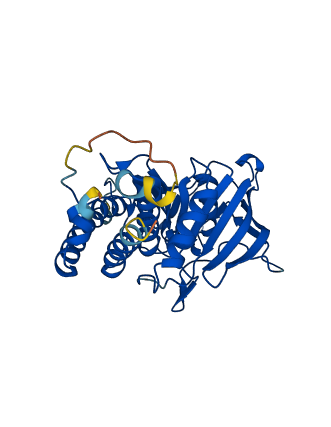
Descriptions
The autoinhibited protein was predicted that may have potential autoinhibitory elements via cis-regPred.
Autoinhibitory domains (AIDs)
Target domain |
|
Relief mechanism |
|
Assay |
cis-regPred |
Accessory elements
No accessory elements
Autoinhibited structure

Activated structure
1 structures for P25044
| Entry ID | Method | Resolution | Chain | Position | Source |
|---|---|---|---|---|---|
| AF-P25044-F1 | Predicted | AlphaFoldDB |
7 variants for P25044
| Variant ID(s) | Position | Change | Description | Diseaes Association | Provenance |
|---|---|---|---|---|---|
| s04-42849 | 50 | P>L | No | SGRP | |
| s04-42915 | 72 | K>R | No | SGRP | |
| s04-42971 | 91 | G>R | No | SGRP | |
| s04-43020 | 107 | R>H | No | SGRP | |
| s04-43076 | 126 | I>V | No | SGRP | |
| s04-43157 | 153 | D>N | No | SGRP | |
| s04-43688 | 330 | S>G | No | SGRP |
No associated diseases with P25044
4 regional properties for P25044
| Type | Name | Position | InterPro Accession |
|---|---|---|---|
| domain | Tyrosine-specific protein phosphatase, PTPase domain | 15 - 330 | IPR000242 |
| domain | Tyrosine-specific protein phosphatases domain | 226 - 319 | IPR000387 |
| domain | Protein-tyrosine phosphatase, catalytic | 210 - 327 | IPR003595 |
| active_site | Protein-tyrosine phosphatase, active site | 250 - 260 | IPR016130 |
Functions
| Description | ||
|---|---|---|
| EC Number | 3.1.3.48 | Phosphoric monoester hydrolases |
| Subcellular Localization |
|
|
| PANTHER Family | ||
| PANTHER Subfamily | ||
| PANTHER Protein Class | ||
| PANTHER Pathway Category | No pathway information available | |
2 GO annotations of cellular component
| Name | Definition |
|---|---|
| cytoplasm | The contents of a cell excluding the plasma membrane and nucleus, but including other subcellular structures. |
| mitochondrion | A semiautonomous, self replicating organelle that occurs in varying numbers, shapes, and sizes in the cytoplasm of virtually all eukaryotic cells. It is notably the site of tissue respiration. |
1 GO annotations of molecular function
| Name | Definition |
|---|---|
| protein tyrosine phosphatase activity | Catalysis of the reaction: protein tyrosine phosphate + H2O = protein tyrosine + phosphate. |
3 GO annotations of biological process
| Name | Definition |
|---|---|
| invasive growth in response to glucose limitation | A growth pattern exhibited by budding haploid cells under certain growth conditions, in which cells retain the typical axial budding pattern of haploids, but become elongated and fail to separate after division; during growth on a solid substrate, this results in penetration of cells into the agar medium. An example of this process is found in Saccharomyces cerevisiae. |
| protein dephosphorylation | The process of removing one or more phosphoric residues from a protein. |
| pseudohyphal growth | The process in which cells grow as a chain of physically attached, elongated cells in response to an environmental stimulus or stimuli. |
1 homologous proteins in AiPD
| UniProt AC | Gene Name | Protein Name | Species | Evidence Code |
|---|---|---|---|---|
| P08575 | PTPRC | Receptor-type tyrosine-protein phosphatase C | Homo sapiens (Human) | PR |
| 10 | 20 | 30 | 40 | 50 | 60 |
| MAAAPWYIRQ | RDTDLLGKFK | FIQNQEDGRL | REATNGTVNS | RWSLGVSIEP | RNDARNRYVN |
| 70 | 80 | 90 | 100 | 110 | 120 |
| IMPYERNRVH | LKTLSGNDYI | NASYVKVNVP | GQSIEPGYYI | ATQGPTRKTW | DQFWQMCYHN |
| 130 | 140 | 150 | 160 | 170 | 180 |
| CPLDNIVIVM | VTPLVEYNRE | KCYQYWPRGG | VDDTVRIASK | WESPGGANDM | TQFPSDLKIE |
| 190 | 200 | 210 | 220 | 230 | 240 |
| FVNVHKVKDY | YTVTDIKLTP | TDPLVGPVKT | VHHFYFDLWK | DMNKPEEVVP | IMELCAHSHS |
| 250 | 260 | 270 | 280 | 290 | 300 |
| LNSRGNPIIV | HCSAGVGRTG | TFIALDHLMH | DTLDFKNITE | RSRHSDRATE | EYTRDLIEQI |
| 310 | 320 | 330 | |||
| VLQLRSQRMK | MVQTKDQFLF | IYHAAKYLNS | LSVNQ |