P23595
Gene name |
PPH22 (SIS4, YDL188C, D1271) |
Protein name |
Serine/threonine-protein phosphatase PP2A-2 catalytic subunit |
Names |
|
Species |
Saccharomyces cerevisiae (strain ATCC 204508 / S288c) (Baker's yeast) |
KEGG Pathway |
sce:YDL188C |
EC number |
3.1.3.16: Phosphoric monoester hydrolases |
Protein Class |
|
Descriptions
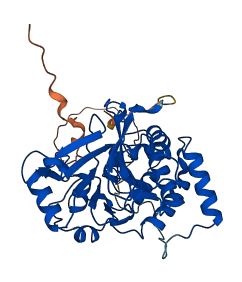
The autoinhibited protein was predicted that may have potential autoinhibitory elements via cis-regPred.
Autoinhibitory domains (AIDs)
Target domain |
|
Relief mechanism |
|
Assay |
cis-regPred |
Accessory elements
No accessory elements
Autoinhibited structure

Activated structure
1 structures for P23595
| Entry ID | Method | Resolution | Chain | Position | Source |
|---|---|---|---|---|---|
| AF-P23595-F1 | Predicted | AlphaFoldDB |
3 variants for P23595
| Variant ID(s) | Position | Change | Description | Diseaes Association | Provenance |
|---|---|---|---|---|---|
| s04-124963 | 13 | D>N | No | SGRP | |
| s04-124663 | 113 | V>I | No | SGRP | |
| s04-124333 | 223 | V>I | No | SGRP |
No associated diseases with P23595
Functions
| Description | ||
|---|---|---|
| EC Number | 3.1.3.16 | Phosphoric monoester hydrolases |
| Subcellular Localization |
|
|
| PANTHER Family | ||
| PANTHER Subfamily | ||
| PANTHER Protein Class | ||
| PANTHER Pathway Category | No pathway information available | |
5 GO annotations of cellular component
| Name | Definition |
|---|---|
| condensed chromosome, centromeric region | The region of a condensed chromosome that includes the centromere and associated proteins, including the kinetochore. In monocentric chromosomes, this region corresponds to a single area of the chromosome, whereas in holocentric chromosomes, it is evenly distributed along the chromosome. |
| cytoplasm | The contents of a cell excluding the plasma membrane and nucleus, but including other subcellular structures. |
| nuclear periphery | The portion of the nuclear lumen proximal to the inner nuclear membrane. |
| nucleus | A membrane-bounded organelle of eukaryotic cells in which chromosomes are housed and replicated. In most cells, the nucleus contains all of the cell's chromosomes except the organellar chromosomes, and is the site of RNA synthesis and processing. In some species, or in specialized cell types, RNA metabolism or DNA replication may be absent. |
| protein phosphatase type 2A complex | A protein complex that has protein serine/threonine phosphatase activity that is polycation-stimulated (PCS), being directly stimulated by protamine, polylysine, or histone H1; it constitutes a subclass of several enzymes activated by different histones and polylysine, and consists of catalytic, scaffolding, and regulatory subunits. The catalytic and scaffolding subunits form the core enzyme, and the holoenzyme also includes the regulatory subunit. |
3 GO annotations of molecular function
| Name | Definition |
|---|---|
| metal ion binding | Binding to a metal ion. |
| myosin phosphatase activity | Catalysis of the reaction: phosphomyosin + H2O = myosin + phosphate. |
| protein serine/threonine phosphatase activity | Catalysis of the reaction: protein serine phosphate + H2O = protein serine + phosphate, and protein threonine phosphate + H2O = protein threonine + phosphate. |
6 GO annotations of biological process
| Name | Definition |
|---|---|
| G1/S transition of mitotic cell cycle | The mitotic cell cycle transition by which a cell in G1 commits to S phase. The process begins with the build up of G1 cyclin-dependent kinase (G1 CDK), resulting in the activation of transcription of G1 cyclins. The process ends with the positive feedback of the G1 cyclins on the G1 CDK which commits the cell to S phase, in which DNA replication is initiated. |
| negative regulation of ribonucleoprotein complex localization | Any process that stops, prevents, or reduces the frequency, rate or extent of ribonucleoprotein complex localization. |
| positive regulation of autophagosome assembly | Any process that activates or increases the frequency, rate or extent of autophagic vacuole assembly. |
| protein dephosphorylation | The process of removing one or more phosphoric residues from a protein. |
| regulation of translation | Any process that modulates the frequency, rate or extent of the chemical reactions and pathways resulting in the formation of proteins by the translation of mRNA or circRNA. |
| TOR signaling | The series of molecular signals mediated by TOR (Target of rapamycin) proteins, members of the phosphoinositide (PI) 3-kinase related kinase (PIKK) family that act as serine/threonine kinases in response to nutrient availability or growth factors. |
2 homologous proteins in AiPD
| UniProt AC | Gene Name | Protein Name | Species | Evidence Code |
|---|---|---|---|---|
| P32838 | PPG1 | Serine/threonine-protein phosphatase PP2A-like PPG1 | Saccharomyces cerevisiae (strain ATCC 204508 / S288c) (Baker's yeast) | PR |
| P23594 | PPH21 | Serine/threonine-protein phosphatase PP2A-1 catalytic subunit | Saccharomyces cerevisiae (strain ATCC 204508 / S288c) (Baker's yeast) | PR |
| 10 | 20 | 30 | 40 | 50 | 60 |
| MDMEIDDPMH | GSDEDQLSPT | LDEDMNSDDG | KNNTKARSND | EDTDEELEDF | NFKPGSSGIA |
| 70 | 80 | 90 | 100 | 110 | 120 |
| DHKSSKPLKL | TNTNINQLDQ | WIEHLSKCEP | LSEDDVARLC | KMAVDVLQFE | ENVKPINVPV |
| 130 | 140 | 150 | 160 | 170 | 180 |
| TICGDVHGQF | HDLLELFKIG | GPCPDTNYLF | MGDYVDRGYY | SVETVSYLVA | MKVRYPHRIT |
| 190 | 200 | 210 | 220 | 230 | 240 |
| ILRGNHESRQ | ITQVYGFYDE | CLRKYGSANV | WKMFTDLFDY | FPVTALVDNK | IFCLHGGLSP |
| 250 | 260 | 270 | 280 | 290 | 300 |
| MIETIDQVRD | LNRIQEVPHE | GPMCDLLWSD | PDDRGGWGIS | PRGAGFTFGQ | DISEQFNHTN |
| 310 | 320 | 330 | 340 | 350 | 360 |
| DLSLIARAHQ | LVMEGYSWSH | QQNVVTIFSA | PNYCYRCGNQ | AAIMEVDENH | NRQFLQYDPS |
| 370 | |||||
| VRPGEPTVTR | KTPDYFL |