P22892
Gene name |
Ap1g1 (Adtg, Clapg1) |
Protein name |
AP-1 complex subunit gamma-1 |
Names |
Adaptor protein complex AP-1 subunit gamma-1, Adaptor-related protein complex 1 subunit gamma-1, Clathrin assembly protein complex 1 gamma-1 large chain, Gamma-adaptin, Gamma1-adaptin, Golgi adaptor HA1/AP1 adaptin subunit gamma-1 |
Species |
Mus musculus (Mouse) |
KEGG Pathway |
mmu:11765 |
EC number |
|
Protein Class |
|
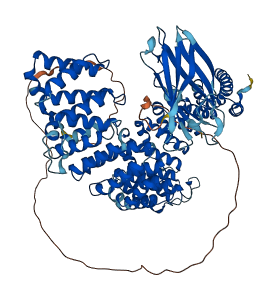
Descriptions
The autoinhibited protein was predicted that may have potential autoinhibitory elements via cis-regPred.
Autoinhibitory domains (AIDs)
Target domain |
|
Relief mechanism |
|
Assay |
cis-regPred |
Accessory elements
No accessory elements
Autoinhibited structure

Activated structure
27 structures for P22892
| Entry ID | Method | Resolution | Chain | Position | Source |
|---|---|---|---|---|---|
| 1GYU | X-ray | 181 A | A | 704-822 | PDB |
| 1GYV | X-ray | 171 A | A | 704-822 | PDB |
| 1GYW | X-ray | 240 A | A/B | 695-822 | PDB |
| 1W63 | X-ray | 400 A | A/C/E/G/I/K | 1-613 | PDB |
| 2A7B | X-ray | 165 A | A | 704-822 | PDB |
| 3ZY7 | X-ray | 109 A | A/B | 704-822 | PDB |
| 4HMY | X-ray | 700 A | A | 1-595 | PDB |
| 4P6Z | X-ray | 300 A | G | 1-613 | PDB |
| 6CM9 | EM | 373 A | G | 1-595 | PDB |
| 6CRI | EM | 680 A | G/Q/R | 4-588 | PDB |
| 6D83 | EM | 427 A | G | 1-595 | PDB |
| 6D84 | EM | 672 A | G/K | 1-595 | PDB |
| 6DFF | EM | 390 A | G | 1-595 | PDB |
| 7R4H | EM | 234 A | G | 1-595 | PDB |
| 7UX3 | EM | 960 A | G | 2-595 | PDB |
| 8D4C | EM | 930 A | E/G | 2-595 | PDB |
| 8D4D | EM | 960 A | E/G | 1-595 | PDB |
| 8D4E | EM | 920 A | G | 1-595 | PDB |
| 8D4F | EM | 980 A | E/G | 1-595 | PDB |
| 8D4G | EM | 1160 A | E/G | 1-595 | PDB |
| 8D9R | EM | 2000 A | G/R/T/U/V/W | 1-595 | PDB |
| 8D9S | EM | 2000 A | G/R/T/U/V/W | 1-595 | PDB |
| 8D9T | EM | 2000 A | G/R/T/U/V/W | 1-595 | PDB |
| 8D9U | EM | 2000 A | G/R/T/U/V/W | 1-595 | PDB |
| 8D9V | EM | 940 A | E/G | 1-595 | PDB |
| 8D9W | EM | 930 A | K/O | 1-595 | PDB |
| AF-P22892-F1 | Predicted | AlphaFoldDB |
27 variants for P22892
| Variant ID(s) | Position | Change | Description | Diseaes Association | Provenance |
|---|---|---|---|---|---|
| rs3399416350 | 86 | Y>S | No | EVA | |
| rs3389011422 | 123 | L>I | No | EVA | |
| rs3388961403 | 139 | A>S | No | EVA | |
| rs3389012601 | 144 | K>R | No | EVA | |
| rs3399099982 | 159 | L>Q | No | EVA | |
| rs3399588849 | 160 | C>S | No | EVA | |
| rs3388979143 | 235 | H>Q | No | EVA | |
| rs3389015984 | 240 | I>F | No | EVA | |
| rs3388961360 | 243 | P>H | No | EVA | |
| rs3388961419 | 286 | N>I | No | EVA | |
| rs3388992066 | 304 | G>* | No | EVA | |
| rs3389011438 | 369 | S>N | No | EVA | |
| rs3399100056 | 392 | C>W | No | EVA | |
| rs3399310477 | 393 | E>D | No | EVA | |
| rs3399590041 | 393 | E>K | No | EVA | |
| rs3399100020 | 396 | F>I | No | EVA | |
| rs3399590037 | 396 | F>Y | No | EVA | |
| rs3389009005 | 405 | F>V | No | EVA | |
| rs3398679013 | 417 | W>C | No | EVA | |
| rs3389004529 | 430 | G>* | No | EVA | |
| rs3388998151 | 565 | E>* | No | EVA | |
| rs3388979108 | 566 | Y>* | No | EVA | |
| rs3389012607 | 580 | L>I | No | EVA | |
| rs3389015945 | 586 | V>I | No | EVA | |
| rs3399100880 | 607 | P>H | No | EVA | |
| rs3389004599 | 683 | Q>H | No | EVA | |
| rs3389006715 | 736 | Q>* | No | EVA |
No associated diseases with P22892
3 regional properties for P22892
Functions
11 GO annotations of cellular component
| Name | Definition |
|---|---|
| AP-1 adaptor complex | A heterotetrameric AP-type membrane coat adaptor complex that consists of beta1, gamma, mu1 and sigma1 subunits and links clathrin to the membrane surface of a vesicle; vesicles with AP-1-containing coats are normally found primarily in the trans-Golgi network. In at least humans, the AP-1 complex can be heterogeneric due to the existence of multiple subunit isoforms encoded by different genes (gamma1 and gamma2, mu1A and mu1B, and sigma1A, sigma1B and sigma1C). |
| clathrin-coated vesicle | A vesicle with a coat formed of clathrin connected to the membrane via one of the clathrin adaptor complexes. |
| cytosol | The part of the cytoplasm that does not contain organelles but which does contain other particulate matter, such as protein complexes. |
| early endosome | A membrane-bounded organelle that receives incoming material from primary endocytic vesicles that have been generated by clathrin-dependent and clathrin-independent endocytosis; vesicles fuse with the early endosome to deliver cargo for sorting into recycling or degradation pathways. |
| Golgi apparatus | A membrane-bound cytoplasmic organelle of the endomembrane system that further processes the core oligosaccharides (e.g. N-glycans) added to proteins in the endoplasmic reticulum and packages them into membrane-bound vesicles. The Golgi apparatus operates at the intersection of the secretory, lysosomal, and endocytic pathways. |
| intracellular membrane-bounded organelle | Organized structure of distinctive morphology and function, bounded by a single or double lipid bilayer membrane and occurring within the cell. Includes the nucleus, mitochondria, plastids, vacuoles, and vesicles. Excludes the plasma membrane. |
| lysosomal membrane | The lipid bilayer surrounding the lysosome and separating its contents from the cell cytoplasm. |
| perinuclear region of cytoplasm | Cytoplasm situated near, or occurring around, the nucleus. |
| recycling endosome | An organelle consisting of a network of tubules that functions in targeting molecules, such as receptors transporters and lipids, to the plasma membrane. |
| trans-Golgi network | The network of interconnected tubular and cisternal structures located within the Golgi apparatus on the side distal to the endoplasmic reticulum, from which secretory vesicles emerge. The trans-Golgi network is important in the later stages of protein secretion where it is thought to play a key role in the sorting and targeting of secreted proteins to the correct destination. |
| trans-Golgi network membrane | The lipid bilayer surrounding any of the compartments that make up the trans-Golgi network. |
5 GO annotations of molecular function
| Name | Definition |
|---|---|
| cargo adaptor activity | Binding directly to the structural scaffolding elements of a vesicle coat (such as clathrin or COPII), and bridging the membrane, cargo receptor, and membrane deformation machinery. |
| clathrin adaptor activity | Bringing together a cargo protein with clathrin, responsible for the formation of endocytic vesicles. |
| GTP-dependent protein binding | Binding to a protein or protein complex when at least one of the interacting partners is in the GTP-bound state. |
| kinesin binding | Interacting selectively and non-covalently and stoichiometrically with kinesin, a member of a superfamily of microtubule-based motor proteins that perform force-generating tasks such as organelle transport and chromosome segregation. |
| small GTPase binding | Binding to a small monomeric GTPase. |
11 GO annotations of biological process
| Name | Definition |
|---|---|
| basolateral protein secretion | The controlled release of proteins from a cell at the sides which interface adjacent cells and near the base. |
| endosome to melanosome transport | The directed movement of substances from endosomes to the melanosome, a specialised lysosome-related organelle. |
| Golgi to lysosome transport | The directed movement of substances from the Golgi to lysosomes. |
| Golgi to vacuole transport | The directed movement of substances from the Golgi to the vacuole. |
| intracellular protein transport | The directed movement of proteins in a cell, including the movement of proteins between specific compartments or structures within a cell, such as organelles of a eukaryotic cell. |
| melanosome assembly | The aggregation, arrangement and bonding together of a set of components to form a melanosome, a tissue-specific, membrane-bounded cytoplasmic organelle within which melanin pigments are synthesized and stored. |
| platelet dense granule organization | A process that is carried out at the cellular level which results in the assembly, arrangement of constituent parts, or disassembly of a platelet dense granule. A platelet dense granule is an electron-dense granule occurring in blood platelets that stores and secretes adenosine nucleotides and serotonin. They contain a highly condensed core consisting of serotonin, histamine, calcium, magnesium, ATP, ADP, pyrophosphate and membrane lysosomal proteins. |
| positive regulation of natural killer cell degranulation | Any process that activates or increases the frequency, rate or extent of natural killer cell degranulation. |
| positive regulation of natural killer cell mediated cytotoxicity | Any process that activates or increases the frequency, rate or extent of natural killer cell mediated cytotoxicity. |
| receptor-mediated endocytosis | An endocytosis process in which cell surface receptors ensure specificity of transport. A specific receptor on the cell surface binds tightly to the extracellular macromolecule (the ligand) that it recognizes; the plasma-membrane region containing the receptor-ligand complex then undergoes endocytosis, forming a transport vesicle containing the receptor-ligand complex and excluding most other plasma-membrane proteins. Receptor-mediated endocytosis generally occurs via clathrin-coated pits and vesicles. |
| vesicle-mediated transport | A cellular transport process in which transported substances are moved in membrane-bounded vesicles; transported substances are enclosed in the vesicle lumen or located in the vesicle membrane. The process begins with a step that directs a substance to the forming vesicle, and includes vesicle budding and coating. Vesicles are then targeted to, and fuse with, an acceptor membrane. |
| 10 | 20 | 30 | 40 | 50 | 60 |
| MPAPIRLREL | IRTIRTARTQ | AEEREMIQKE | CAAIRSSFRE | EDNTYRCRNV | AKLLYMHMLG |
| 70 | 80 | 90 | 100 | 110 | 120 |
| YPAHFGQLEC | LKLIASQKFT | DKRIGYLGAM | LLLDERQDVH | LLMTNCIKND | LNHSTQFVQG |
| 130 | 140 | 150 | 160 | 170 | 180 |
| LALCTLGCMG | SSEMCRDLAG | EVEKLLKTSN | SYLRKKAALC | AVHVIRKVPE | LMEMFLPATK |
| 190 | 200 | 210 | 220 | 230 | 240 |
| NLLNEKNHGV | LHTSVVLLTE | MCERSPDMLA | HFRKLVPQLV | RILKNLIMSG | YSPEHDVSGI |
| 250 | 260 | 270 | 280 | 290 | 300 |
| SDPFLQVRIL | RLLRILGRND | DDSSEAMNDI | LAQVATNTET | SKNVGNAILY | ETVLTIMDIK |
| 310 | 320 | 330 | 340 | 350 | 360 |
| SESGLRVLAI | NILGRFLLNN | DKNIRYVALT | SLLKTVQTDH | NAVQRHRSTI | VDCLKDLDVS |
| 370 | 380 | 390 | 400 | 410 | 420 |
| IKRRAMELSF | ALVNGNNIRG | MMKELLYFLD | SCEPEFKADC | ASGIFLAAEK | YAPSKRWHID |
| 430 | 440 | 450 | 460 | 470 | 480 |
| TIMRVLTTAG | SYVRDDAVPN | LIQLITNSVE | MHAYTVQRLY | KAILGDYSQQ | PLVQVAAWCI |
| 490 | 500 | 510 | 520 | 530 | 540 |
| GEYGDLLVSG | QCEEEEPIQV | TEDEVLDILE | SVLISNMSTS | VTRGYALTAI | MKLSTRFTCT |
| 550 | 560 | 570 | 580 | 590 | 600 |
| VNRIKKVVSI | YGSSIDVELQ | QRAVEYNALF | KKYDHMRSAL | LERMPVMEKV | TTNGPSEIVQ |
| 610 | 620 | 630 | 640 | 650 | 660 |
| TNGETEPAPL | ETKPPPSGPQ | PTSQANDLLD | LLGGNDITPV | IPTAPTSKPA | SAGGELLDLL |
| 670 | 680 | 690 | 700 | 710 | 720 |
| GDITLTGAPA | AAPTPASVPQ | ISQPPFLLDG | LSSQPLFNDI | APGIPSITAY | SKNGLKIEFT |
| 730 | 740 | 750 | 760 | 770 | 780 |
| FERSNTNPSV | TVITIQASNS | TELDMTDFVF | QAAVPKTFQL | QLLSPSSSVV | PAFNTGTITQ |
| 790 | 800 | 810 | 820 | ||
| VIKVLNPQKQ | QLRMRIKLTY | NHKGSAMQDL | AEVNNFPPQS | WQ |