P17426
Gene name |
Ap2a1 (Adtaa, Clapa1) |
Protein name |
AP-2 complex subunit alpha-1 |
Names |
100 kDa coated vesicle protein A, Adaptor protein complex AP-2 subunit alpha-1, Adaptor-related protein complex 2 subunit alpha-1, Alpha-adaptin A, Alpha1-adaptin, Clathrin assembly protein complex 2 alpha-A large chain, Plasma membrane adaptor HA2/AP2 adaptin alpha A subunit |
Species |
Mus musculus (Mouse) |
KEGG Pathway |
mmu:11771 |
EC number |
|
Protein Class |
|
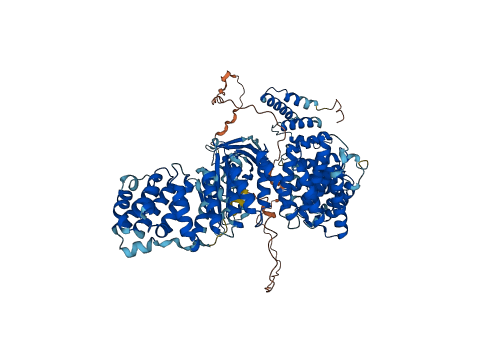
Descriptions
The autoinhibited protein was predicted that may have potential autoinhibitory elements via cis-regPred.
Autoinhibitory domains (AIDs)
Target domain |
|
Relief mechanism |
|
Assay |
cis-regPred |
Accessory elements
No accessory elements
Autoinhibited structure

Activated structure
1 structures for P17426
| Entry ID | Method | Resolution | Chain | Position | Source |
|---|---|---|---|---|---|
| AF-P17426-F1 | Predicted | AlphaFoldDB |
33 variants for P17426
| Variant ID(s) | Position | Change | Description | Diseaes Association | Provenance |
|---|---|---|---|---|---|
| rs3388904887 | 127 | F>S | No | EVA | |
| rs3388908737 | 184 | P>H | No | EVA | |
| rs3388893795 | 195 | L>M | No | EVA | |
| rs3388908667 | 213 | C>Y | No | EVA | |
| rs3388908643 | 218 | N>K | No | EVA | |
| rs3388908677 | 255 | P>A | No | EVA | |
| rs3388907679 | 298 | K>M | No | EVA | |
| rs3397853069 | 299 | K>E | No | EVA | |
| rs3397871557 | 313 | T>I | No | EVA | |
| rs3411747147 | 358 | S>N | No | EVA | |
| rs3397707544 | 371 | D>N | No | EVA | |
| rs3388903323 | 401 | N>S | No | EVA | |
| rs3388911874 | 421 | R>Q | No | EVA | |
| rs3388904885 | 431 | L>M | No | EVA | |
| rs3388903308 | 434 | K>R | No | EVA | |
| rs3388911892 | 476 | Q>K | No | EVA | |
| rs3388908994 | 525 | L>M | No | EVA | |
| rs3388904966 | 597 | T>K | No | EVA | |
| rs3388904958 | 610 | S>L | No | EVA | |
| rs3388887006 | 617 | K>E | No | EVA | |
| rs3397707576 | 645 | E>A | No | EVA | |
| rs3411112006 | 645 | E>D | No | EVA | |
| rs3397841549 | 649 | S>G | No | EVA | |
| rs1132301862 | 676 | V>I | No | EVA | |
| rs3388889477 | 681 | L>P | No | EVA | |
| rs3388910376 | 697 | P>S | No | EVA | |
| rs3388908682 | 775 | R>H | No | EVA | |
| rs3388880534 | 806 | A>T | No | EVA | |
| rs3388866973 | 861 | I>F | No | EVA | |
| rs3388909796 | 920 | D>E | No | EVA | |
| rs3388910432 | 943 | L>H | No | EVA | |
| rs3388904893 | 947 | P>T | No | EVA | |
| rs3388898631 | 948 | N>T | No | EVA |
No associated diseases with P17426
No regional properties for P17426
| Type | Name | Position | InterPro Accession |
|---|---|---|---|
| No domain, repeats, and functional sites for P17426 | |||
Functions
10 GO annotations of cellular component
| Name | Definition |
|---|---|
| AP-2 adaptor complex | A heterotetrameric AP-type membrane coat adaptor complex that consists of alpha, beta2, mu2 and sigma2 subunits, and links clathrin to the membrane surface of a vesicle, and the cargo receptors during receptor/clathrin mediated endocytosis. Vesicles with AP-2-containing coats are normally found primarily near the plasma membrane, on endocytic vesicles. In at least humans, the AP-2 complex can be heterogeneric due to the existence of multiple subunit isoforms encoded by different alpha genes (alphaA and alphaC). |
| apical plasma membrane | The region of the plasma membrane located at the apical end of the cell. |
| basolateral plasma membrane | The region of the plasma membrane that includes the basal end and sides of the cell. Often used in reference to animal polarized epithelial membranes, where the basal membrane is the part attached to the extracellular matrix, or in plant cells, where the basal membrane is defined with respect to the zygotic axis. |
| clathrin-coated vesicle | A vesicle with a coat formed of clathrin connected to the membrane via one of the clathrin adaptor complexes. |
| cytoplasmic side of plasma membrane | The leaflet the plasma membrane that faces the cytoplasm and any proteins embedded or anchored in it or attached to its surface. |
| filopodium tip | The end of a filopodium distal to the body of the cell. |
| membrane coat | Any of several different proteinaceous coats that can associate with membranes. Membrane coats include those formed by clathrin plus an adaptor complex, the COPI and COPII complexes, and possibly others. They are found associated with membranes on many vesicles as well as other membrane features such as pits and perhaps tubules. |
| postsynapse | The part of a synapse that is part of the post-synaptic cell. |
| protein-containing complex | A stable assembly of two or more macromolecules, i.e. proteins, nucleic acids, carbohydrates or lipids, in which at least one component is a protein and the constituent parts function together. |
| secretory granule | A small subcellular vesicle, surrounded by a membrane, that is formed from the Golgi apparatus and contains a highly concentrated protein destined for secretion. Secretory granules move towards the periphery of the cell and upon stimulation, their membranes fuse with the cell membrane, and their protein load is exteriorized. Processing of the contained protein may take place in secretory granules. |
6 GO annotations of molecular function
| Name | Definition |
|---|---|
| cargo adaptor activity | Binding directly to the structural scaffolding elements of a vesicle coat (such as clathrin or COPII), and bridging the membrane, cargo receptor, and membrane deformation machinery. |
| clathrin adaptor activity | Bringing together a cargo protein with clathrin, responsible for the formation of endocytic vesicles. |
| low-density lipoprotein particle receptor binding | Binding to a low-density lipoprotein receptor. |
| protein C-terminus binding | Binding to a protein C-terminus, the end of a peptide chain at which the 1-carboxyl function of a constituent amino acid is not attached in peptide linkage to another amino-acid residue. |
| protein kinase binding | Binding to a protein kinase, any enzyme that catalyzes the transfer of a phosphate group, usually from ATP, to a protein substrate. |
| protein-containing complex binding | Binding to a macromolecular complex. |
8 GO annotations of biological process
| Name | Definition |
|---|---|
| clathrin-dependent endocytosis | An endocytosis process that begins when material is taken up into clathrin-coated pits, which then pinch off to form clathrin-coated endocytic vesicles. |
| intracellular protein transport | The directed movement of proteins in a cell, including the movement of proteins between specific compartments or structures within a cell, such as organelles of a eukaryotic cell. |
| negative regulation of hyaluronan biosynthetic process | Any process that stops, prevents or reduces the frequency, rate or extent of hyaluronan biosynthetic process. |
| positive regulation of neuron projection development | Any process that increases the rate, frequency or extent of neuron projection development. Neuron projection development is the process whose specific outcome is the progression of a neuron projection over time, from its formation to the mature structure. A neuron projection is any process extending from a neural cell, such as axons or dendrites (collectively called neurites). |
| positive regulation of receptor-mediated endocytosis | Any process that activates or increases the frequency, rate or extent of receptor mediated endocytosis, the uptake of external materials by cells, utilizing receptors to ensure specificity of transport. |
| postsynaptic neurotransmitter receptor internalization | A receptor-mediated endocytosis process that results in the internalization of a neurotransmitter receptor from the postsynaptic membrane endocytic zone into an endocytic vesicle. |
| receptor-mediated endocytosis | An endocytosis process in which cell surface receptors ensure specificity of transport. A specific receptor on the cell surface binds tightly to the extracellular macromolecule (the ligand) that it recognizes; the plasma-membrane region containing the receptor-ligand complex then undergoes endocytosis, forming a transport vesicle containing the receptor-ligand complex and excluding most other plasma-membrane proteins. Receptor-mediated endocytosis generally occurs via clathrin-coated pits and vesicles. |
| vesicle-mediated transport | A cellular transport process in which transported substances are moved in membrane-bounded vesicles; transported substances are enclosed in the vesicle lumen or located in the vesicle membrane. The process begins with a step that directs a substance to the forming vesicle, and includes vesicle budding and coating. Vesicles are then targeted to, and fuse with, an acceptor membrane. |
| 10 | 20 | 30 | 40 | 50 | 60 |
| MPAVSKGDGM | RGLAVFISDI | RNCKSKEAEI | KRINKELANI | RSKFKGDKAL | DGYSKKKYVC |
| 70 | 80 | 90 | 100 | 110 | 120 |
| KLLFIFLLGH | DIDFGHMEAV | NLLSSNKYTE | KQIGYLFISV | LVNSNSELIR | LINNAIKNDL |
| 130 | 140 | 150 | 160 | 170 | 180 |
| ASRNPTFMCL | ALHCIANVGS | REMGEAFAAD | IPRILVAGDS | MDSVKQSAAL | CLLRLYKASP |
| 190 | 200 | 210 | 220 | 230 | 240 |
| DLVPMGEWTA | RVVHLLNDQH | MGVVTAAVSL | ITCLCKKNPD | DFKTCISLAV | SRLSRIVSSA |
| 250 | 260 | 270 | 280 | 290 | 300 |
| STDLQDYTYY | FVPAPWLSVK | LLRLLQCYPP | PEDAAVKGRL | VECLETVLNK | AQEPPKSKKV |
| 310 | 320 | 330 | 340 | 350 | 360 |
| QHSNAKNAIL | FETISLIIHY | DSEPNLLVRA | CNQLGQFLQH | RETNLRYLAL | ESMCTLASSE |
| 370 | 380 | 390 | 400 | 410 | 420 |
| FSHEAVKTHI | DTVINALKTE | RDVSVRQRAA | DLLYAMCDRS | NAKQIVSEML | RYLETADYAI |
| 430 | 440 | 450 | 460 | 470 | 480 |
| REEIVLKVAI | LAEKYAVDYS | WYVDTILNLI | RIAGDYVSEE | VWYRVLQIVT | NRDDVQGYAA |
| 490 | 500 | 510 | 520 | 530 | 540 |
| KTVFEALQAP | ACHENMVKVG | GYILGEFGNL | IAGDPRSSPP | VQFSLLHSKF | HLCSVATRAL |
| 550 | 560 | 570 | 580 | 590 | 600 |
| LLSTYIKFIN | LFPETKATIQ | GVLRAGSQLR | NADVELQQRA | VEYLTLSSVA | STDVLATVLE |
| 610 | 620 | 630 | 640 | 650 | 660 |
| EMPPFPERES | SILAKLKRKK | GPGAASALDD | SRRDTSSNDI | NGGVEPTPST | VSTPSPSADL |
| 670 | 680 | 690 | 700 | 710 | 720 |
| LGLRAAPPPA | APPAPVGGNL | LVDVFSDGPT | AQPSLGPTPE | EAFLSELEPP | APESPMALLA |
| 730 | 740 | 750 | 760 | 770 | 780 |
| DPAPAADPGP | EDIGPPIPEA | DELLNKFVCK | NSGVLFENQL | LQIGVKSEFR | QNLGRMYLFY |
| 790 | 800 | 810 | 820 | 830 | 840 |
| GNKTSVQFQN | FLPTVVHPGD | LQTQLAVQTK | RVAAQVDGGA | QVQQVLNIEC | LRDFLTPPLL |
| 850 | 860 | 870 | 880 | 890 | 900 |
| SVRFRYGGTA | QSLTLKLPVT | INKFFQPTEM | AAQDFFQRWK | QLSLPLQEAQ | KIFKANHPMD |
| 910 | 920 | 930 | 940 | 950 | 960 |
| AEVTKAKLLG | FGSALLDNVD | PNPENFVGAG | IIQTKALQVG | CLLRLEPNAQ | AQMYRLTLRT |
| 970 | |||||
| SKEPVSRHLC | ELLAQQF |