P17745
Gene name |
TUFA (RAB8D, RABE1B, At4g20360, F9F13.10) |
Protein name |
Elongation factor Tu, chloroplastic |
Names |
EF-Tu, Ras-related protein RABE1b, AtRABE1b, Ras-related protein Rab8D, AtRab8D |
Species |
Arabidopsis thaliana (Mouse-ear cress) |
KEGG Pathway |
ath:AT4G20360 |
EC number |
|
Protein Class |
|
Descriptions
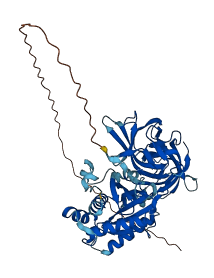
The autoinhibited protein was predicted that may have potential autoinhibitory elements via cis-regPred.
Autoinhibitory domains (AIDs)
Target domain |
|
Relief mechanism |
|
Assay |
cis-regPred |
Accessory elements
No accessory elements
Autoinhibited structure

Activated structure
1 structures for P17745
| Entry ID | Method | Resolution | Chain | Position | Source |
|---|---|---|---|---|---|
| AF-P17745-F1 | Predicted | AlphaFoldDB |
9 variants for P17745
| Variant ID(s) | Position | Change | Description | Diseaes Association | Provenance |
|---|---|---|---|---|---|
| tmp_4_10990054_G_T | 7 | A>S | No | 1000Genomes | |
| tmp_4_10990073_C_T | 13 | S>F | No | 1000Genomes | |
| ENSVATH14263914 | 23 | S>Y | No | 1000Genomes | |
| tmp_4_10990171_C_G,T | 46 | L>F | No | 1000Genomes | |
| tmp_4_10990171_C_G,T | 46 | L>V | No | 1000Genomes | |
| ENSVATH06735260 | 59 | S>F | No | 1000Genomes | |
| ENSVATH00526306 | 66 | V>I | No | 1000Genomes | |
| ENSVATH06735266 | 268 | E>D | No | 1000Genomes | |
| ENSVATH06735267 | 330 | S>N | No | 1000Genomes |
No associated diseases with P17745
7 regional properties for P17745
| Type | Name | Position | InterPro Accession |
|---|---|---|---|
| domain | Translational (tr)-type GTP-binding domain | 77 - 281 | IPR000795 |
| domain | Translation elongation factor EFTu/EF1A, C-terminal | 375 - 474 | IPR004160 |
| domain | Translation elongation factor EFTu-like, domain 2 | 302 - 370 | IPR004161 |
| domain | Small GTP-binding protein domain | 80 - 216 | IPR005225 |
| conserved_site | Tr-type G domain, conserved site | 118 - 133 | IPR031157 |
| domain | Elongation factor Tu, domain 2 | 288 - 374 | IPR033720 |
| domain | Elongation factor Tu (EF-Tu), GTP-binding domain | 78 - 280 | IPR041709 |
11 GO annotations of cellular component
| Name | Definition |
|---|---|
| apoplast | The cell membranes and intracellular regions in a plant are connected through plasmodesmata, and plants may be described as having two major compartments: the living symplast and the non-living apoplast. The apoplast is external to the plasma membrane and includes cell walls, intercellular spaces and the lumen of dead structures such as xylem vessels. Water and solutes pass freely through it. |
| chloroplast | A chlorophyll-containing plastid with thylakoids organized into grana and frets, or stroma thylakoids, and embedded in a stroma. |
| chloroplast envelope | The double lipid bilayer enclosing the chloroplast and separating its contents from the rest of the cytoplasm; includes the intermembrane space. |
| chloroplast nucleoid | The region of a chloroplast to which the DNA is confined. |
| chloroplast stroma | The space enclosed by the double membrane of a chloroplast but excluding the thylakoid space. It contains DNA, ribosomes and some temporary products of photosynthesis. |
| chloroplast thylakoid | Sac-like membranous structures (cisternae) in a chloroplast combined into stacks (grana) and present singly in the stroma (stroma thylakoids or frets) as interconnections between grana. An example of this component is found in Arabidopsis thaliana. |
| chloroplast thylakoid membrane | The pigmented membrane of a chloroplast thylakoid. An example of this component is found in Arabidopsis thaliana. |
| mitochondrion | A semiautonomous, self replicating organelle that occurs in varying numbers, shapes, and sizes in the cytoplasm of virtually all eukaryotic cells. It is notably the site of tissue respiration. |
| nucleolus | A small, dense body one or more of which are present in the nucleus of eukaryotic cells. It is rich in RNA and protein, is not bounded by a limiting membrane, and is not seen during mitosis. Its prime function is the transcription of the nucleolar DNA into 45S ribosomal-precursor RNA, the processing of this RNA into 5.8S, 18S, and 28S components of ribosomal RNA, and the association of these components with 5S RNA and proteins synthesized outside the nucleolus. This association results in the formation of ribonucleoprotein precursors; these pass into the cytoplasm and mature into the 40S and 60S subunits of the ribosome. |
| nucleus | A membrane-bounded organelle of eukaryotic cells in which chromosomes are housed and replicated. In most cells, the nucleus contains all of the cell's chromosomes except the organellar chromosomes, and is the site of RNA synthesis and processing. In some species, or in specialized cell types, RNA metabolism or DNA replication may be absent. |
| plastid | Any member of a family of organelles found in the cytoplasm of plants and some protists, which are membrane-bounded and contain DNA. Plant plastids develop from a common type, the proplastid. |
4 GO annotations of molecular function
| Name | Definition |
|---|---|
| GTP binding | Binding to GTP, guanosine triphosphate. |
| GTPase activity | Catalysis of the reaction: GTP + H2O = GDP + H+ + phosphate. |
| mRNA binding | Binding to messenger RNA (mRNA), an intermediate molecule between DNA and protein. mRNA includes UTR and coding sequences, but does not contain introns. |
| translation elongation factor activity | Functions in chain elongation during polypeptide synthesis at the ribosome. |
4 GO annotations of biological process
| Name | Definition |
|---|---|
| chloroplast organization | A process that is carried out at the cellular level which results in the assembly, arrangement of constituent parts, or disassembly of the chloroplast. |
| leaf development | The process whose specific outcome is the progression of the leaf over time, from its formation to the mature structure. |
| mitochondrial translational elongation | The successive addition of amino acid residues to a nascent polypeptide chain during protein biosynthesis in a mitochondrion. |
| translational elongation | The successive addition of amino acid residues to a nascent polypeptide chain during protein biosynthesis. |
1 homologous proteins in AiPD
| UniProt AC | Gene Name | Protein Name | Species | Evidence Code |
|---|---|---|---|---|
| P02992 | TUF1 | Elongation factor Tu, mitochondrial | Saccharomyces cerevisiae (strain ATCC 204508 / S288c) (Baker's yeast) | PR |
| 10 | 20 | 30 | 40 | 50 | 60 |
| MAISAPAACS | SSSRILCSYS | SPSPSLCPAI | STSGKLKTLT | LSSSFLPSYS | LTTTSASQST |
| 70 | 80 | 90 | 100 | 110 | 120 |
| RRSFTVRAAR | GKFERKKPHV | NIGTIGHVDH | GKTTLTAALT | MALASIGSSV | AKKYDEIDAA |
| 130 | 140 | 150 | 160 | 170 | 180 |
| PEERARGITI | NTATVEYETE | NRHYAHVDCP | GHADYVKNMI | TGAAQMDGAI | LVVSGADGPM |
| 190 | 200 | 210 | 220 | 230 | 240 |
| PQTKEHILLA | KQVGVPDMVV | FLNKEDQVDD | AELLELVELE | VRELLSSYEF | NGDDIPIISG |
| 250 | 260 | 270 | 280 | 290 | 300 |
| SALLAVETLT | ENPKVKRGDN | KWVDKIYELM | DAVDDYIPIP | QRQTELPFLL | AVEDVFSITG |
| 310 | 320 | 330 | 340 | 350 | 360 |
| RGTVATGRVE | RGTVKVGETV | DLVGLRETRS | YTVTGVEMFQ | KILDEALAGD | NVGLLLRGIQ |
| 370 | 380 | 390 | 400 | 410 | 420 |
| KADIQRGMVL | AKPGSITPHT | KFEAIIYVLK | KEEGGRHSPF | FAGYRPQFYM | RTTDVTGKVT |
| 430 | 440 | 450 | 460 | 470 | |
| KIMNDKDEES | KMVMPGDRVK | IVVELIVPVA | CEQGMRFAIR | EGGKTVGAGV | IGTILE |