P02992
Gene name |
TUF1 (TUFM, YOR187W) |
Protein name |
Elongation factor Tu, mitochondrial |
Names |
tufM |
Species |
Saccharomyces cerevisiae (strain ATCC 204508 / S288c) (Baker's yeast) |
KEGG Pathway |
sce:YOR187W |
EC number |
|
Protein Class |
|
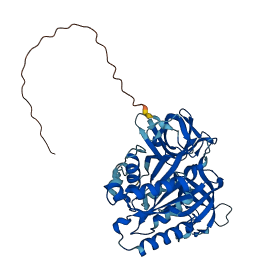
Descriptions
The autoinhibited protein was predicted that may have potential autoinhibitory elements via cis-regPred.
Autoinhibitory domains (AIDs)
Target domain |
|
Relief mechanism |
|
Assay |
cis-regPred |
Accessory elements
No accessory elements
Autoinhibited structure

Activated structure
1 structures for P02992
| Entry ID | Method | Resolution | Chain | Position | Source |
|---|---|---|---|---|---|
| AF-P02992-F1 | Predicted | AlphaFoldDB |
3 variants for P02992
| Variant ID(s) | Position | Change | Description | Diseaes Association | Provenance |
|---|---|---|---|---|---|
| s15-684079 | 17 | S>P | No | SGRP | |
| s15-684106 | 26 | V>I | No | SGRP | |
| s15-684133 | 35 | T>A | No | SGRP |
No associated diseases with P02992
1 GO annotations of cellular component
| Name | Definition |
|---|---|
| mitochondrion | A semiautonomous, self replicating organelle that occurs in varying numbers, shapes, and sizes in the cytoplasm of virtually all eukaryotic cells. It is notably the site of tissue respiration. |
3 GO annotations of molecular function
| Name | Definition |
|---|---|
| GTP binding | Binding to GTP, guanosine triphosphate. |
| GTPase activity | Catalysis of the reaction: GTP + H2O = GDP + H+ + phosphate. |
| translation elongation factor activity | Functions in chain elongation during polypeptide synthesis at the ribosome. |
3 GO annotations of biological process
| Name | Definition |
|---|---|
| mitochondrial translation | The chemical reactions and pathways resulting in the formation of a protein in a mitochondrion. This is a ribosome-mediated process in which the information in messenger RNA (mRNA) is used to specify the sequence of amino acids in the protein; the mitochondrion has its own ribosomes and transfer RNAs, and uses a genetic code that differs from the nuclear code. |
| mitochondrial translational elongation | The successive addition of amino acid residues to a nascent polypeptide chain during protein biosynthesis in a mitochondrion. |
| translational elongation | The successive addition of amino acid residues to a nascent polypeptide chain during protein biosynthesis. |
1 homologous proteins in AiPD
| UniProt AC | Gene Name | Protein Name | Species | Evidence Code |
|---|---|---|---|---|
| P17745 | TUFA | Elongation factor Tu, chloroplastic | Arabidopsis thaliana (Mouse-ear cress) | PR |
| 10 | 20 | 30 | 40 | 50 | 60 |
| MSALLPRLLT | RTAFKASGKL | LRLSSVISRT | FSQTTTSYAA | AFDRSKPHVN | IGTIGHVDHG |
| 70 | 80 | 90 | 100 | 110 | 120 |
| KTTLTAAITK | TLAAKGGANF | LDYAAIDKAP | EERARGITIS | TAHVEYETAK | RHYSHVDCPG |
| 130 | 140 | 150 | 160 | 170 | 180 |
| HADYIKNMIT | GAAQMDGAII | VVAATDGQMP | QTREHLLLAR | QVGVQHIVVF | VNKVDTIDDP |
| 190 | 200 | 210 | 220 | 230 | 240 |
| EMLELVEMEM | RELLNEYGFD | GDNAPIIMGS | ALCALEGRQP | EIGEQAIMKL | LDAVDEYIPT |
| 250 | 260 | 270 | 280 | 290 | 300 |
| PERDLNKPFL | MPVEDIFSIS | GRGTVVTGRV | ERGNLKKGEE | LEIVGHNSTP | LKTTVTGIEM |
| 310 | 320 | 330 | 340 | 350 | 360 |
| FRKELDSAMA | GDNAGVLLRG | IRRDQLKRGM | VLAKPGTVKA | HTKILASLYI | LSKEEGGRHS |
| 370 | 380 | 390 | 400 | 410 | 420 |
| GFGENYRPQM | FIRTADVTVV | MRFPKEVEDH | SMQVMPGDNV | EMECDLIHPT | PLEVGQRFNI |
| 430 | |||||
| REGGRTVGTG | LITRIIE |