P17225
Gene name |
Ptbp1 (Ptb) |
Protein name |
Polypyrimidine tract-binding protein 1 |
Names |
PTB, Heterogeneous nuclear ribonucleoprotein I, hnRNP I |
Species |
Mus musculus (Mouse) |
KEGG Pathway |
mmu:19205 |
EC number |
|
Protein Class |
|
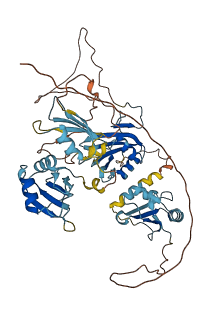
Descriptions
The autoinhibited protein was predicted that may have potential autoinhibitory elements via cis-regPred.
Autoinhibitory domains (AIDs)
Target domain |
|
Relief mechanism |
|
Assay |
cis-regPred |
Accessory elements
No accessory elements
Autoinhibited structure

Activated structure
1 structures for P17225
| Entry ID | Method | Resolution | Chain | Position | Source |
|---|---|---|---|---|---|
| AF-P17225-F1 | Predicted | AlphaFoldDB |
28 variants for P17225
| Variant ID(s) | Position | Change | Description | Diseaes Association | Provenance |
|---|---|---|---|---|---|
| rs3389106055 | 28 | P>S | No | EVA | |
| rs3389106029 | 34 | S>P | No | EVA | |
| rs1131808190 | 43 | S>N | No | EVA | |
| rs3389123657 | 63 | R>* | No | EVA | |
| rs3389115800 | 80 | P>R | No | EVA | |
| rs3389115804 | 112 | Y>N | No | EVA | |
| rs1132648737 | 136 | K>E | No | EVA | |
| rs3389099728 | 138 | D>H | No | EVA | |
| rs3389114407 | 164 | A>T | No | EVA | |
| rs3389114441 | 180 | S>G | No | EVA | |
| rs3401129313 | 199 | L>R | No | EVA | |
| rs3389086279 | 236 | A>T | No | EVA | |
| rs3389123054 | 279 | L>M | No | EVA | |
| rs3389086300 | 325 | S>T | No | EVA | |
| rs3389123611 | 332 | A>T | No | EVA | |
| rs3389114489 | 385 | Y>H | No | EVA | |
| rs3389111547 | 386 | G>D | No | EVA | |
| rs3389112912 | 443 | E>G | No | EVA | |
| rs3389099741 | 462 | F>Y | No | EVA | |
| rs258696961 | 463 | K>R | No | EVA | |
| rs3389123092 | 466 | G>S | No | EVA | |
| rs3389123651 | 471 | Q>H | No | EVA | |
| rs3389112937 | 478 | A>T | No | EVA | |
| rs3389099664 | 498 | F>S | No | EVA | |
| rs3389099676 | 507 | G>D | No | EVA | |
| rs3389089041 | 510 | F>Y | No | EVA | |
| rs3389115759 | 536 | H>Y | No | EVA | |
| rs3389115769 | 547 | R>Q | No | EVA |
No associated diseases with P17225
7 regional properties for P17225
| Type | Name | Position | InterPro Accession |
|---|---|---|---|
| domain | RNA recognition motif domain | 58 - 142 | IPR000504-1 |
| domain | RNA recognition motif domain | 183 - 259 | IPR000504-2 |
| domain | RNA recognition motif domain | 361 - 435 | IPR000504-3 |
| domain | RNA recognition motif domain | 478 - 553 | IPR000504-4 |
| domain | PTBP1-like, RNA recognition motif 2 | 177 - 257 | IPR021790 |
| domain | PTBP1, RNA recognition motif 1 | 58 - 138 | IPR035000 |
| domain | PTBP1, RNA recognition motif 3 | 362 - 454 | IPR035001 |
3 GO annotations of cellular component
| Name | Definition |
|---|---|
| cytoplasm | The contents of a cell excluding the plasma membrane and nucleus, but including other subcellular structures. |
| neuron projection terminus | The specialized, terminal region of a neuron projection such as an axon or a dendrite. |
| nucleus | A membrane-bounded organelle of eukaryotic cells in which chromosomes are housed and replicated. In most cells, the nucleus contains all of the cell's chromosomes except the organellar chromosomes, and is the site of RNA synthesis and processing. In some species, or in specialized cell types, RNA metabolism or DNA replication may be absent. |
7 GO annotations of molecular function
| Name | Definition |
|---|---|
| mRNA binding | Binding to messenger RNA (mRNA), an intermediate molecule between DNA and protein. mRNA includes UTR and coding sequences, but does not contain introns. |
| pre-mRNA binding | Binding to a pre-messenger RNA (pre-mRNA), an intermediate molecule between DNA and protein that may contain introns and, at least in part, encodes one or more proteins. Introns are removed from pre-mRNA to form a mRNA molecule. |
| regulatory region RNA binding | Binding to a RNA region that regulates a nucleic acid-based process. Such processes include transcription, DNA replication, and DNA repair. |
| RNA binding | Binding to an RNA molecule or a portion thereof. |
| sequence-specific DNA binding | Binding to DNA of a specific nucleotide composition, e.g. GC-rich DNA binding, or with a specific sequence motif or type of DNA e.g. promotor binding or rDNA binding. |
| single-stranded DNA binding | Binding to single-stranded DNA. |
| single-stranded DNA endodeoxyribonuclease activity | Catalysis of the hydrolysis of ester linkages within a single-stranded deoxyribonucleic acid molecule by creating internal breaks. |
21 GO annotations of biological process
| Name | Definition |
|---|---|
| 3'-UTR-mediated mRNA stabilization | An mRNA stabilization process in which one or more RNA-binding proteins associate with the 3'-untranslated region (UTR) of an mRNA. |
| gene expression | The process in which a gene's sequence is converted into a mature gene product (protein or RNA). This includes the production of an RNA transcript and its processing, translation and maturation for protein-coding genes. |
| IRES-dependent viral translational initiation | Process by which viral mRNA translation is initiated, where a domain in the 5' untranslated region (UTR) of the viral mRNA called an internal ribosome entry site (IRES) binds the host 43S preinitiation complex, circumventing regular cap-dependent translation initiation. |
| mRNA processing | Any process involved in the conversion of a primary mRNA transcript into one or more mature mRNA(s) prior to translation into polypeptide. |
| negative regulation of mRNA splicing, via spliceosome | Any process that stops, prevents or reduces the rate or extent of mRNA splicing via a spliceosomal mechanism. |
| negative regulation of muscle cell differentiation | Any process that stops, prevents, or reduces the frequency, rate or extent of muscle cell differentiation. |
| negative regulation of neuron differentiation | Any process that stops, prevents, or reduces the frequency, rate or extent of neuron differentiation. |
| negative regulation of RNA splicing | Any process that stops, prevents, or reduces the frequency, rate or extent of RNA splicing. |
| neurogenesis | Generation of cells within the nervous system. |
| nuclear-transcribed mRNA catabolic process | The chemical reactions and pathways resulting in the breakdown of nuclear-transcribed mRNAs in eukaryotic cells. |
| positive regulation of calcineurin-NFAT signaling cascade | Any process that activates or increases the frequency, rate or extent of signaling via the calcineurin-NFAT signaling cascade. |
| positive regulation of insulin secretion | Any process that activates or increases the frequency, rate or extent of the regulated release of insulin. |
| positive regulation of neuron projection development | Any process that increases the rate, frequency or extent of neuron projection development. Neuron projection development is the process whose specific outcome is the progression of a neuron projection over time, from its formation to the mature structure. A neuron projection is any process extending from a neural cell, such as axons or dendrites (collectively called neurites). |
| positive regulation of protein dephosphorylation | Any process that activates or increases the frequency, rate or extent of removal of phosphate groups from a protein. |
| positive regulation of secretory granule organization | Any process that activates or increases the frequency, rate or extent of secretory granule organization. |
| positive regulation of transcription by RNA polymerase II | Any process that activates or increases the frequency, rate or extent of transcription from an RNA polymerase II promoter. |
| positive regulation of translation | Any process that activates or increases the frequency, rate or extent of the chemical reactions and pathways resulting in the formation of proteins by the translation of mRNA or circRNA. |
| regulation of alternative mRNA splicing, via spliceosome | Any process that modulates the frequency, rate or extent of alternative splicing of nuclear mRNAs. |
| regulation of cell differentiation | Any process that modulates the frequency, rate or extent of cell differentiation, the process in which relatively unspecialized cells acquire specialized structural and functional features. |
| regulation of RNA splicing | Any process that modulates the frequency, rate or extent of RNA splicing, the process of removing sections of the primary RNA transcript to remove sequences not present in the mature form of the RNA and joining the remaining sections to form the mature form of the RNA. |
| RNA splicing | The process of removing sections of the primary RNA transcript to remove sequences not present in the mature form of the RNA and joining the remaining sections to form the mature form of the RNA. |
3 homologous proteins in AiPD
| 10 | 20 | 30 | 40 | 50 | 60 |
| MDGIVPDIAV | GTKRGSDELF | STCVSNGPFI | MSSSASAANG | NDSKKFKGDN | RSAGVPSRVI |
| 70 | 80 | 90 | 100 | 110 | 120 |
| HVRKLPSDVT | EGEVISLGLP | FGKVTNLLML | KGKNQAFIEM | NTEEAANTMV | NYYTSVAPVL |
| 130 | 140 | 150 | 160 | 170 | 180 |
| RGQPIYIQFS | NHKELKTDSS | PNQARAQAAL | QAVNSVQSGN | LALAASAAAV | DAGMAMAGQS |
| 190 | 200 | 210 | 220 | 230 | 240 |
| PVLRIIVENL | FYPVTLDVLH | QIFSKFGTVL | KIITFTKNNQ | FQALLQYADP | VSAQHAKLSL |
| 250 | 260 | 270 | 280 | 290 | 300 |
| DGQNIYNACC | TLRIDFSKLT | SLNVKYNNDK | SRDYTRPDLP | SGDSQPSLDQ | TMAAAFGAPG |
| 310 | 320 | 330 | 340 | 350 | 360 |
| IMSASPYAGA | GFPPTFAIPQ | AAGLSVPNVH | GALAPLAIPS | AAAAAAASRI | AIPGLAGAGN |
| 370 | 380 | 390 | 400 | 410 | 420 |
| SVLLVSNLNP | ERVTPQSLFI | LFGVYGDVQR | VKILFNKKEN | ALVQMADGSQ | AQLAMSHLNG |
| 430 | 440 | 450 | 460 | 470 | 480 |
| HKLHGKSVRI | TLSKHQSVQL | PREGQEDQGL | TKDYGSSPLH | RFKKPGSKNF | QNIFPPSATL |
| 490 | 500 | 510 | 520 | 530 | 540 |
| HLSNIPPSVS | EDDLKSLFSS | NGGVVKGFKF | FQKDRKMALI | QMGSVEEAVQ | ALIELHNHDL |
| 550 | |||||
| GENHHLRVSF | SKSTI |