P16330
Gene name |
Cnp |
Protein name |
2',3'-cyclic-nucleotide 3'-phosphodiesterase |
Names |
CNP, CNPase |
Species |
Mus musculus (Mouse) |
KEGG Pathway |
mmu:12799 |
EC number |
3.1.4.37: Phosphoric diester hydrolases |
Protein Class |
|
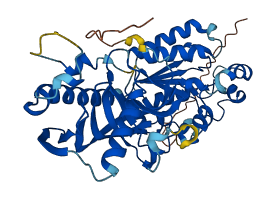
Descriptions
The autoinhibited protein was predicted that may have potential autoinhibitory elements via cis-regPred.
Autoinhibitory domains (AIDs)
Target domain |
|
Relief mechanism |
|
Assay |
cis-regPred |
Accessory elements
No accessory elements
Autoinhibited structure

Activated structure
34 structures for P16330
| Entry ID | Method | Resolution | Chain | Position | Source |
|---|---|---|---|---|---|
| 2XMI | X-ray | 174 A | A | 179-398 | PDB |
| 2Y1P | X-ray | 182 A | A | 179-398 | PDB |
| 2Y3X | X-ray | 210 A | A/B/E | 179-398 | PDB |
| 2YDB | X-ray | 215 A | A | 179-398 | PDB |
| 2YDC | X-ray | 205 A | A | 179-398 | PDB |
| 2YDD | X-ray | 240 A | A | 179-398 | PDB |
| 2YOZ | X-ray | 210 A | A | 179-398 | PDB |
| 2YP0 | X-ray | 230 A | A | 179-398 | PDB |
| 2YPC | X-ray | 189 A | A | 179-398 | PDB |
| 2YPE | X-ray | 190 A | A | 179-398 | PDB |
| 2YPH | X-ray | 210 A | A | 179-398 | PDB |
| 2YQ9 | X-ray | 190 A | A | 179-398 | PDB |
| 3ZBR | X-ray | 230 A | A/B | 179-398 | PDB |
| 3ZBS | X-ray | 245 A | A | 179-398 | PDB |
| 3ZBZ | X-ray | 210 A | A | 179-398 | PDB |
| 4WBI | X-ray | 200 A | A | 179-398 | PDB |
| 4WBL | X-ray | 250 A | A | 179-398 | PDB |
| 4WC9 | X-ray | 200 A | A | 179-398 | PDB |
| 4WCA | X-ray | 185 A | A | 179-398 | PDB |
| 4WCB | X-ray | 157 A | A | 179-398 | PDB |
| 4WCC | X-ray | 270 A | A | 179-398 | PDB |
| 4WDA | X-ray | 185 A | A | 179-398 | PDB |
| 4WDB | X-ray | 160 A | A | 179-398 | PDB |
| 4WDD | X-ray | 210 A | A | 179-398 | PDB |
| 4WDE | X-ray | 240 A | A/B | 179-398 | PDB |
| 4WDF | X-ray | 200 A | A | 179-398 | PDB |
| 4WDG | X-ray | 205 A | A | 179-398 | PDB |
| 4WDH | X-ray | 190 A | A | 179-398 | PDB |
| 4WEX | X-ray | 210 A | A | 179-398 | PDB |
| 4WFR | X-ray | 200 A | A | 179-398 | PDB |
| 5AE0 | X-ray | 104 A | A | 179-398 | PDB |
| 7QZK | X-ray | 166 A | A | 179-398 | PDB |
| 7QZS | X-ray | 180 A | A | 179-398 | PDB |
| AF-P16330-F1 | Predicted | AlphaFoldDB |
23 variants for P16330
| Variant ID(s) | Position | Change | Description | Diseaes Association | Provenance |
|---|---|---|---|---|---|
| rs3389205713 | 7 | R>H | No | EVA | |
| rs3389197984 | 10 | H>L | No | EVA | |
| rs3389197039 | 37 | L>H | No | EVA | |
| rs3389205569 | 39 | D>N | No | EVA | |
| rs3389197098 | 44 | A>D | No | EVA | |
| rs3389205677 | 80 | M>L | No | EVA | |
| rs3389212543 | 107 | L>P | No | EVA | |
| rs3389136721 | 118 | L>I | No | EVA | |
| rs3389217826 | 120 | L>H | No | EVA | |
| rs3389136746 | 130 | L>V | No | EVA | |
| rs3389197970 | 143 | Q>L | No | EVA | |
| rs3389176474 | 154 | R>Q | No | EVA | |
| rs3389197895 | 166 | W>R | No | EVA | |
| rs3389205722 | 166 | W>S | No | EVA | |
| rs3389203316 | 184 | F>I | No | EVA | |
| rs3389205752 | 196 | K>E | No | EVA | |
| rs3389210544 | 203 | K>N | No | EVA | |
| rs3389212601 | 218 | F>I | No | EVA | |
| rs3389203334 | 219 | K>M | No | EVA | |
| rs3389205540 | 251 | C>F | No | EVA | |
| rs3389138179 | 293 | K>N | No | EVA | |
| rs225429568 | 303 | D>G | No | EVA | |
| rs3389210527 | 407 | G>S | No | EVA |
No associated diseases with P16330
1 regional properties for P16330
| Type | Name | Position | InterPro Accession |
|---|---|---|---|
| domain | Cyclic nucleotide phosphodiesterase, catalytic domain | 185 - 419 | IPR047325 |
Functions
| Description | ||
|---|---|---|
| EC Number | 3.1.4.37 | Phosphoric diester hydrolases |
| Subcellular Localization |
|
|
| PANTHER Family | ||
| PANTHER Subfamily | ||
| PANTHER Protein Class | ||
| PANTHER Pathway Category | No pathway information available | |
15 GO annotations of cellular component
| Name | Definition |
|---|---|
| cell projection | A prolongation or process extending from a cell, e.g. a flagellum or axon. |
| cytoplasm | The contents of a cell excluding the plasma membrane and nucleus, but including other subcellular structures. |
| extracellular space | That part of a multicellular organism outside the cells proper, usually taken to be outside the plasma membranes, and occupied by fluid. |
| melanosome | A tissue-specific, membrane-bounded cytoplasmic organelle within which melanin pigments are synthesized and stored. Melanosomes are synthesized in melanocyte cells. |
| membrane | A lipid bilayer along with all the proteins and protein complexes embedded in it an attached to it. |
| microtubule | Any of the long, generally straight, hollow tubes of internal diameter 12-15 nm and external diameter 24 nm found in a wide variety of eukaryotic cells; each consists (usually) of 13 protofilaments of polymeric tubulin, staggered in such a manner that the tubulin monomers are arranged in a helical pattern on the microtubular surface, and with the alpha/beta axes of the tubulin subunits parallel to the long axis of the tubule; exist in equilibrium with pool of tubulin monomers and can be rapidly assembled or disassembled in response to physiological stimuli; concerned with force generation, e.g. in the spindle. |
| microvillus | Thin cylindrical membrane-covered projections on the surface of an animal cell containing a core bundle of actin filaments. Present in especially large numbers on the absorptive surface of intestinal cells. |
| mitochondrial inner membrane | The inner, i.e. lumen-facing, lipid bilayer of the mitochondrial envelope. It is highly folded to form cristae. |
| mitochondrial outer membrane | The outer, i.e. cytoplasm-facing, lipid bilayer of the mitochondrial envelope. |
| myelin sheath | An electrically insulating fatty layer that surrounds the axons of many neurons. It is an outgrowth of glial cells: Schwann cells supply the myelin for peripheral neurons while oligodendrocytes supply it to those of the central nervous system. |
| myelin sheath abaxonal region | The region of the myelin sheath furthest from the axon. |
| myelin sheath adaxonal region | The region of the myelin sheath nearest to the axon. |
| perinuclear region of cytoplasm | Cytoplasm situated near, or occurring around, the nucleus. |
| plasma membrane | The membrane surrounding a cell that separates the cell from its external environment. It consists of a phospholipid bilayer and associated proteins. |
| pseudopodium | A temporary protrusion or retractile process of a cell, associated with flowing movements of the protoplasm, and serving for locomotion and feeding. |
3 GO annotations of molecular function
| Name | Definition |
|---|---|
| 2',3'-cyclic-nucleotide 3'-phosphodiesterase activity | Catalysis of the reaction: nucleoside 2',3'-cyclic phosphate + H2O = nucleoside 2'-phosphate. |
| cyclic nucleotide binding | Binding to a cyclic nucleotide, a nucleotide in which the phosphate group is in diester linkage to two positions on the sugar residue. |
| RNA binding | Binding to an RNA molecule or a portion thereof. |
10 GO annotations of biological process
| Name | Definition |
|---|---|
| adult locomotory behavior | Locomotory behavior in a fully developed and mature organism. |
| aging | A developmental process that is a deterioration and loss of function over time. Aging includes loss of functions such as resistance to disease, homeostasis, and fertility, as well as wear and tear. Aging includes cellular senescence, but is more inclusive. May precede death and may succeed developmental maturation (GO:0021700). |
| axonogenesis | De novo generation of a long process of a neuron, including the terminal branched region. Refers to the morphogenesis or creation of shape or form of the developing axon, which carries efferent (outgoing) action potentials from the cell body towards target cells. |
| cyclic nucleotide catabolic process | The chemical reactions and pathways resulting in the breakdown of a cyclic nucleotide, a nucleotide in which the phosphate group is in diester linkage to two positions on the sugar residue. |
| forebrain development | The process whose specific outcome is the progression of the forebrain over time, from its formation to the mature structure. The forebrain is the anterior of the three primary divisions of the developing chordate brain or the corresponding part of the adult brain (in vertebrates, includes especially the cerebral hemispheres, the thalamus, and the hypothalamus and especially in higher vertebrates is the main control center for sensory and associative information processing, visceral functions, and voluntary motor functions). |
| microtubule cytoskeleton organization | A process that is carried out at the cellular level which results in the assembly, arrangement of constituent parts, or disassembly of cytoskeletal structures comprising microtubules and their associated proteins. |
| oligodendrocyte differentiation | The process in which a relatively unspecialized cell acquires the specialized features of an oligodendrocyte. An oligodendrocyte is a type of glial cell involved in myelinating the axons of neurons in the central nervous system. |
| regulation of mitochondrial membrane permeability | Any process that modulates the frequency, rate or extent of the passage or uptake of molecules by the mitochondrial membrane. |
| response to lipopolysaccharide | Any process that results in a change in state or activity of an organism (in terms of movement, secretion, enzyme production, gene expression, etc.) as a result of a lipopolysaccharide stimulus; lipopolysaccharide is a major component of the cell wall of gram-negative bacteria. |
| response to toxic substance | Any process that results in a change in state or activity of a cell or an organism (in terms of movement, secretion, enzyme production, gene expression, etc.) as a result of a toxic stimulus. |
4 homologous proteins in AiPD
| UniProt AC | Gene Name | Protein Name | Species | Evidence Code |
|---|---|---|---|---|
| P06623 | CNP | 2',3'-cyclic-nucleotide 3'-phosphodiesterase | Bos taurus (Bovine) | PR |
| Q92802 | N4BP2L2 | NEDD4-binding protein 2-like 2 | Homo sapiens (Human) | PR |
| P09543 | CNP | 2',3'-cyclic-nucleotide 3'-phosphodiesterase | Homo sapiens (Human) | PR |
| P13233 | Cnp | 2',3'-cyclic-nucleotide 3'-phosphodiesterase | Rattus norvegicus (Rat) | PR |
| 10 | 20 | 30 | 40 | 50 | 60 |
| MNTSFTRKSH | TFLPKLFFRK | MSSSGAKEKP | ELQFPFLQDE | DTVATLHECK | TLFILRGLPG |
| 70 | 80 | 90 | 100 | 110 | 120 |
| SGKSTLARLI | LEKYHDGTKM | VSADAYKIIP | GSRADFSEAY | KRLDEDLAGY | CRRDIRVLVL |
| 130 | 140 | 150 | 160 | 170 | 180 |
| DDTNHERERL | DQLFEMADQY | QYQVVLVEPK | TAWRLDCAQL | KEKNQWQLSA | DDLKKLKPGL |
| 190 | 200 | 210 | 220 | 230 | 240 |
| EKDFLPLYFG | WFLTKKSSET | LRKAGQVFLE | ELGNHKAFKK | ELRHFISGDE | PKEKLELVSY |
| 250 | 260 | 270 | 280 | 290 | 300 |
| FGKRPPGVLH | CTTKFCDYGK | AAGAEEYAQQ | EVVKRSYGKA | FKLSISALFV | TPKTAGAQVV |
| 310 | 320 | 330 | 340 | 350 | 360 |
| LTDQELQLWP | SDLDKPSASE | GLPPGSRAHV | TLGCAADVQP | VQTGLDLLDI | LQQVKGGSQG |
| 370 | 380 | 390 | 400 | 410 | |
| EAVGELPRGK | LYSLGKGRWM | LSLTKKMEVK | AIFTGYYGKG | KPVPIHGSRK | GGAMQICTII |