P11983
Gene name |
Tcp1 (Cct1, Ccta) |
Protein name |
T-complex protein 1 subunit alpha |
Names |
TCP-1-alpha, CCT-alpha, Tailless complex polypeptide 1A, TCP-1-A, Tailless complex polypeptide 1B, TCP-1-B |
Species |
Mus musculus (Mouse) |
KEGG Pathway |
mmu:21454 |
EC number |
|
Protein Class |
|
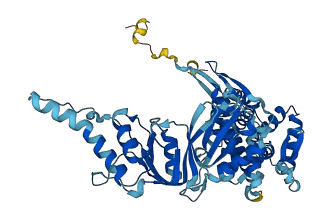
Descriptions
The autoinhibited protein was predicted that may have potential autoinhibitory elements via cis-regPred.
Autoinhibitory domains (AIDs)
Target domain |
|
Relief mechanism |
|
Assay |
cis-regPred |
Accessory elements
No accessory elements
Autoinhibited structure

Activated structure
1 structures for P11983
| Entry ID | Method | Resolution | Chain | Position | Source |
|---|---|---|---|---|---|
| AF-P11983-F1 | Predicted | AlphaFoldDB |
24 variants for P11983
| Variant ID(s) | Position | Change | Description | Diseaes Association | Provenance |
|---|---|---|---|---|---|
| rs3389347855 | 10 | D>Y | No | EVA | |
| rs3389432869 | 14 | G>E | No | EVA | |
| rs250901756 | 17 | V>I | No | EVA | |
| rs3389425331 | 121 | Y>H | No | EVA | |
| rs3407485056 | 125 | C>G | No | EVA | |
| rs224823628 | 145 | R>K | No | EVA | |
| rs3389425301 | 149 | I>N | No | EVA | |
| rs212570014 | 291 | G>C | No | EVA | |
| rs231229925 | 296 | Y>C | No | EVA | |
| rs249957851 | 318 | H>R | No | EVA | |
| rs258215486 | 329 | S>P | No | EVA | |
| rs220947121 | 342 | V>A | No | EVA | |
| rs3389425653 | 363 | L>V | No | EVA | |
| rs3389424427 | 392 | L>I | No | EVA | |
| rs3389401701 | 409 | V>I | No | EVA | |
| rs3389432401 | 454 | V>L | No | EVA | |
| rs3389382799 | 456 | A>D | No | EVA | |
| rs3389449113 | 468 | R>S | No | EVA | |
| rs259774298 | 480 | R>H | No | EVA | |
| rs259774298 | 480 | R>L | No | EVA | |
| rs3389431274 | 496 | R>Q | No | EVA | |
| rs3389413529 | 511 | V>A | No | EVA | |
| rs3406812173 | 516 | F>L | No | EVA | |
| rs3389427604 | 557 | D>R | No | EVA |
No associated diseases with P11983
3 regional properties for P11983
| Type | Name | Position | InterPro Accession |
|---|---|---|---|
| conserved_site | Chaperonin TCP-1, conserved site | 33 - 45 | IPR002194-1 |
| conserved_site | Chaperonin TCP-1, conserved site | 54 - 70 | IPR002194-2 |
| conserved_site | Chaperonin TCP-1, conserved site | 82 - 90 | IPR002194-3 |
11 GO annotations of cellular component
| Name | Definition |
|---|---|
| acrosomal vesicle | A structure in the head of a spermatozoon that contains acid hydrolases, and is concerned with the breakdown of the outer membrane of the ovum during fertilization. It lies just beneath the plasma membrane and is derived from the lysosome. |
| cell body | The portion of a cell bearing surface projections such as axons, dendrites, cilia, or flagella that includes the nucleus, but excludes all cell projections. |
| centrosome | A structure comprised of a core structure (in most organisms, a pair of centrioles) and peripheral material from which a microtubule-based structure, such as a spindle apparatus, is organized. Centrosomes occur close to the nucleus during interphase in many eukaryotic cells, though in animal cells it changes continually during the cell-division cycle. |
| chaperonin-containing T-complex | A multisubunit ring-shaped complex that mediates protein folding in the cytosol without a cofactor. |
| Golgi apparatus | A membrane-bound cytoplasmic organelle of the endomembrane system that further processes the core oligosaccharides (e.g. N-glycans) added to proteins in the endoplasmic reticulum and packages them into membrane-bound vesicles. The Golgi apparatus operates at the intersection of the secretory, lysosomal, and endocytic pathways. |
| heterochromatin | A compact and highly condensed form of chromatin that is refractory to transcription. |
| microtubule | Any of the long, generally straight, hollow tubes of internal diameter 12-15 nm and external diameter 24 nm found in a wide variety of eukaryotic cells; each consists (usually) of 13 protofilaments of polymeric tubulin, staggered in such a manner that the tubulin monomers are arranged in a helical pattern on the microtubular surface, and with the alpha/beta axes of the tubulin subunits parallel to the long axis of the tubule; exist in equilibrium with pool of tubulin monomers and can be rapidly assembled or disassembled in response to physiological stimuli; concerned with force generation, e.g. in the spindle. |
| microtubule organizing center | An intracellular structure that can catalyze gamma-tubulin-dependent microtubule nucleation and that can anchor microtubules by interacting with their minus ends, plus ends or sides. |
| myelin sheath | An electrically insulating fatty layer that surrounds the axons of many neurons. It is an outgrowth of glial cells: Schwann cells supply the myelin for peripheral neurons while oligodendrocytes supply it to those of the central nervous system. |
| pericentriolar material | A network of small fibers that surrounds the centrioles in cells; contains the microtubule nucleating activity of the centrosome. |
| zona pellucida receptor complex | A multisubunit complex comprising the chaperonin-containing T-complex and several other components involved in mediating sperm-oocyte Interaction. |
6 GO annotations of molecular function
| Name | Definition |
|---|---|
| ATP binding | Binding to ATP, adenosine 5'-triphosphate, a universally important coenzyme and enzyme regulator. |
| ATP hydrolysis activity | Catalysis of the reaction: ATP + H2O = ADP + H+ phosphate. ATP hydrolysis is used in some reactions as an energy source, for example to catalyze a reaction or drive transport against a concentration gradient. |
| ATP-dependent protein folding chaperone | Binding to a protein or a protein-containing complex to assist the protein folding process, driven by ATP hydrolysis. |
| protein folding chaperone | Binding to a protein or a protein-containing complex to assist the protein folding process. |
| ubiquitin protein ligase binding | Binding to a ubiquitin protein ligase enzyme, any of the E3 proteins. |
| unfolded protein binding | Binding to an unfolded protein. |
12 GO annotations of biological process
| Name | Definition |
|---|---|
| binding of sperm to zona pellucida | The process in which the sperm binds to the zona pellucida glycoprotein layer of the egg. The process begins with the attachment of the sperm plasma membrane to the zona pellucida and includes attachment of the acrosome inner membrane to the zona pellucida after the acrosomal reaction takes place. |
| chaperone-mediated protein folding | The process of inhibiting aggregation and assisting in the covalent and noncovalent assembly of single chain polypeptides or multisubunit complexes into the correct tertiary structure that is dependent on interaction with a chaperone. |
| positive regulation of establishment of protein localization to telomere | Any process that activates or increases the frequency, rate or extent of establishment of protein localization to telomere. |
| positive regulation of telomerase activity | Any process that activates or increases the frequency, rate or extent of telomerase activity, the catalysis of the reaction: deoxynucleoside triphosphate + DNA(n) = diphosphate + DNA(n+1). |
| positive regulation of telomerase RNA localization to Cajal body | Any process that activates or increases the frequency, rate or extent of telomerase RNA localization to Cajal body. |
| positive regulation of telomere maintenance via telomerase | Any process that activates or increases the frequency, rate or extent of the addition of telomeric repeats by telomerase. |
| protein folding | The process of assisting in the covalent and noncovalent assembly of single chain polypeptides or multisubunit complexes into the correct tertiary structure. |
| protein stabilization | Any process involved in maintaining the structure and integrity of a protein and preventing it from degradation or aggregation. |
| regulation of macrophage apoptotic process | Any process that modulates the frequency, rate or extent of macrophage apoptotic process. |
| scaRNA localization to Cajal body | A process in which a small Cajal body-specific RNA is transported to, or maintained in, a Cajal body. |
| toxin transport | The directed movement of a toxin into, out of or within a cell, or between cells, by means of some agent such as a transporter or pore. |
| translocation of peptides or proteins into host cell cytoplasm | The directed movement of peptides or proteins produced by a symbiont organism to a location within the host cell cytoplasm. |
| 10 | 20 | 30 | 40 | 50 | 60 |
| MEGPLSVFGD | RSTGEAVRSQ | NVMAAASIAN | IVKSSFGPVG | LDKMLVDDIG | DVTITNDGAT |
| 70 | 80 | 90 | 100 | 110 | 120 |
| ILKLLEVEHP | AAKVLCELAD | LQDKEVGDGT | TSVVIIAAEL | LKNADELVKQ | KIHPTSVISG |
| 130 | 140 | 150 | 160 | 170 | 180 |
| YRLACKEAVR | YINENLIINT | DELGRDCLIN | AAKTSMSSKI | IGINGDYFAN | MVVDAVLAVK |
| 190 | 200 | 210 | 220 | 230 | 240 |
| YTDARGQPRY | PVNSVNILKA | HGRSQIESML | INGYALNCVV | GSQGMPKRIV | NAKIACLDFS |
| 250 | 260 | 270 | 280 | 290 | 300 |
| LQKTKMKLGV | QVVITDPEKL | DQIRQRESDI | TKERIQKILA | TGANVILTTG | GIDDMYLKYF |
| 310 | 320 | 330 | 340 | 350 | 360 |
| VEAGAMAVRR | VLKRDLKHVA | KASGASILST | LANLEGEETF | EVTMLGQAEE | VVQERICDDE |
| 370 | 380 | 390 | 400 | 410 | 420 |
| LILIKNTKAR | TSASIILRGA | NDFMCDEMER | SLHDALCVVK | RVLELKSVVP | GGGAVEAALS |
| 430 | 440 | 450 | 460 | 470 | 480 |
| IYLENYATSM | GSREQLAIAE | FARSLLVIPN | TLAVNAAQDS | TDLVAKLRAF | HNEAQVNPER |
| 490 | 500 | 510 | 520 | 530 | 540 |
| KNLKWIGLDL | VHGKPRDNKQ | AGVFEPTIVK | VKSLKFATEA | AITILRIDDL | IKLHPESKDD |
| 550 | |||||
| KHGSYENAVH | SGALDD |