P07687
Gene name |
Ephx1 |
Protein name |
Epoxide hydrolase 1 |
Names |
Epoxide hydratase, Microsomal epoxide hydrolase, mEH |
Species |
Rattus norvegicus (Rat) |
KEGG Pathway |
rno:25315 |
EC number |
|
Protein Class |
|
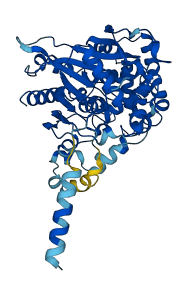
Descriptions
The autoinhibited protein was predicted that may have potential autoinhibitory elements via cis-regPred.
Autoinhibitory domains (AIDs)
Target domain |
|
Relief mechanism |
|
Assay |
cis-regPred |
Accessory elements
No accessory elements
Autoinhibited structure

Activated structure
1 structures for P07687
| Entry ID | Method | Resolution | Chain | Position | Source |
|---|---|---|---|---|---|
| AF-P07687-F1 | Predicted | AlphaFoldDB |
No variants for P07687
| Variant ID(s) | Position | Change | Description | Diseaes Association | Provenance |
|---|---|---|---|---|---|
| No variants for P07687 | |||||
No associated diseases with P07687
1 regional properties for P07687
| Type | Name | Position | InterPro Accession |
|---|---|---|---|
| domain | Epoxide hydrolase, N-terminal | 48 - 157 | IPR010497 |
5 GO annotations of cellular component
| Name | Definition |
|---|---|
| endoplasmic reticulum membrane | The lipid bilayer surrounding the endoplasmic reticulum. |
| integral component of membrane | The component of a membrane consisting of the gene products and protein complexes having at least some part of their peptide sequence embedded in the hydrophobic region of the membrane. |
| intracellular membrane-bounded organelle | Organized structure of distinctive morphology and function, bounded by a single or double lipid bilayer membrane and occurring within the cell. Includes the nucleus, mitochondria, plastids, vacuoles, and vesicles. Excludes the plasma membrane. |
| membrane | A lipid bilayer along with all the proteins and protein complexes embedded in it an attached to it. |
| plasma membrane | The membrane surrounding a cell that separates the cell from its external environment. It consists of a phospholipid bilayer and associated proteins. |
3 GO annotations of molecular function
| Name | Definition |
|---|---|
| cis-stilbene-oxide hydrolase activity | Catalysis of the reaction: cis-stilbene oxide + H2O = (+)-(1R,2R)-1,2-diphenylethane-1,2-diol. |
| enzyme binding | Binding to an enzyme, a protein with catalytic activity. |
| epoxide hydrolase activity | Catalysis of the reaction: an epoxide + H2O = a glycol. |
10 GO annotations of biological process
| Name | Definition |
|---|---|
| arachidonic acid metabolic process | The chemical reactions and pathways involving arachidonic acid, a straight chain fatty acid with 20 carbon atoms and four double bonds per molecule. Arachidonic acid is the all-Z-(5,8,11,14)-isomer. |
| aromatic compound catabolic process | The chemical reactions and pathways resulting in the breakdown of aromatic compounds, any substance containing an aromatic carbon ring. |
| cellular aromatic compound metabolic process | The chemical reactions and pathways involving aromatic compounds, any organic compound characterized by one or more planar rings, each of which contains conjugated double bonds and delocalized pi electrons, as carried out by individual cells. |
| cellular response to glucocorticoid stimulus | Any process that results in a change in state or activity of a cell (in terms of movement, secretion, enzyme production, gene expression, etc.) as a result of a glucocorticoid stimulus. Glucocorticoids are hormonal C21 corticosteroids synthesized from cholesterol with the ability to bind with the cortisol receptor and trigger similar effects. Glucocorticoids act primarily on carbohydrate and protein metabolism, and have anti-inflammatory effects. |
| cellular response to organic substance | Any process that results in a change in state or activity of a cell (in terms of movement, secretion, enzyme production, gene expression, etc.) as a result of an organic substance stimulus. |
| diol biosynthetic process | The chemical reactions and pathways resulting in the formation of a diol, any alcohol containing two hydroxyl groups attached to saturated carbon atoms. |
| epoxide metabolic process | The chemical reactions and pathways involving epoxides, compounds in which an oxygen atom is directly attached to two adjacent or non-adjacent carbon atoms of a carbon chain or ring system; thus cyclic ethers. |
| liver development | The process whose specific outcome is the progression of the liver over time, from its formation to the mature structure. The liver is an exocrine gland which secretes bile and functions in metabolism of protein and carbohydrate and fat, synthesizes substances involved in the clotting of the blood, synthesizes vitamin A, detoxifies poisonous substances, stores glycogen, and breaks down worn-out erythrocytes. |
| response to organic cyclic compound | Any process that results in a change in state or activity of a cell or an organism (in terms of movement, secretion, enzyme production, gene expression, etc.) as a result of an organic cyclic compound stimulus. |
| response to toxic substance | Any process that results in a change in state or activity of a cell or an organism (in terms of movement, secretion, enzyme production, gene expression, etc.) as a result of a toxic stimulus. |
| 10 | 20 | 30 | 40 | 50 | 60 |
| MWLELVLASL | LGFVIYWFVS | RDKEETLPLG | DGWWGPGSKP | SAKEDESIRP | FKVETSDEEI |
| 70 | 80 | 90 | 100 | 110 | 120 |
| KDLHQRIDRF | RASPPLEGSR | FHYGFNSNYM | KKVVSYWRNE | FDWRKQVEIL | NQYPHFKTKI |
| 130 | 140 | 150 | 160 | 170 | 180 |
| EGLDIHFIHV | KPPQLPSGRT | PKPLLMVHGW | PGSFYEFYKI | IPLLTDPKSH | GLSDEHVFEV |
| 190 | 200 | 210 | 220 | 230 | 240 |
| ICPSIPGYGY | SEASSKKGLN | SVATARIFYK | LMTRLGFQKF | YIQGGDWGSL | ICTNMAQMVP |
| 250 | 260 | 270 | 280 | 290 | 300 |
| NHVKGLHLNM | AFISRSFYTM | TPLLGQRFGR | FLGYTEKDIE | LLYPYKEKVF | YSIMRESGYL |
| 310 | 320 | 330 | 340 | 350 | 360 |
| HIQATKPDTV | GCALNDSPVG | LAAYILEKFS | TWTKSEYREL | EDGGLERKFS | LDDLLVNIMI |
| 370 | 380 | 390 | 400 | 410 | 420 |
| YWTTGTIVSS | QRYYKENLGQ | GIMVHKHEGM | KVFVPTGFSA | FPSELLHAPE | KWVKVKYPKL |
| 430 | 440 | 450 | |||
| ISYSYMERGG | HFAAFEEPKL | LAQDIRKFVS | LAELQ |