P07356
Gene name |
Anxa2 (Anx2, Cal1h) |
Protein name |
Annexin A2 |
Names |
Annexin II, Annexin-2, Calpactin I heavy chain, Calpactin-1 heavy chain, Chromobindin-8, Lipocortin II, Placental anticoagulant protein IV, PAP-IV, Protein I, p36 |
Species |
Mus musculus (Mouse) |
KEGG Pathway |
mmu:12306 |
EC number |
|
Protein Class |
|
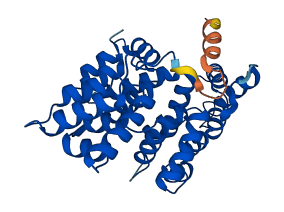
Descriptions
The autoinhibited protein was predicted that may have potential autoinhibitory elements via cis-regPred.
Autoinhibitory domains (AIDs)
Target domain |
|
Relief mechanism |
|
Assay |
cis-regPred |
Accessory elements
No accessory elements
Autoinhibited structure

Activated structure
2 structures for P07356
| Entry ID | Method | Resolution | Chain | Position | Source |
|---|---|---|---|---|---|
| 4HRE | X-ray | 279 A | A/B/C/D | 1-339 | PDB |
| AF-P07356-F1 | Predicted | AlphaFoldDB |
7 variants for P07356
| Variant ID(s) | Position | Change | Description | Diseaes Association | Provenance |
|---|---|---|---|---|---|
| rs3389063640 | 73 | F>S | No | EVA | |
| rs3412774999 | 81 | K>R | No | EVA | |
| rs3389058517 | 108 | Q>L | No | EVA | |
| rs3389035961 | 114 | L>P | No | EVA | |
| rs3389064788 | 176 | K>* | No | EVA | |
| rs3389048923 | 243 | S>R | No | EVA | |
| rs3400217885 | 272 | D>Y | No | EVA |
No associated diseases with P07356
35 GO annotations of cellular component
| Name | Definition |
|---|---|
| AnxA2-p11 complex | A heterotetrameric protein complex comprising two Annexin A2 (AnxA2) monomers and two copies of its binding partner, S100 protein p11 (S100A10). |
| basement membrane | A collagen-containing extracellular matrix consisting of a thin layer of dense material found in various animal tissues interposed between the cells and the adjacent connective tissue. It consists of the basal lamina plus an associated layer of reticulin fibers. |
| basolateral plasma membrane | The region of the plasma membrane that includes the basal end and sides of the cell. Often used in reference to animal polarized epithelial membranes, where the basal membrane is the part attached to the extracellular matrix, or in plant cells, where the basal membrane is defined with respect to the zygotic axis. |
| cell cortex | The region of a cell that lies just beneath the plasma membrane and often, but not always, contains a network of actin filaments and associated proteins. |
| cell surface | The external part of the cell wall and/or plasma membrane. |
| collagen-containing extracellular matrix | An extracellular matrix consisting mainly of proteins (especially collagen) and glycosaminoglycans (mostly as proteoglycans) that provides not only essential physical scaffolding for the cellular constituents but can also initiate crucial biochemical and biomechanical cues required for tissue morphogenesis, differentiation and homeostasis. The components are secreted by cells in the vicinity and form a sheet underlying or overlying cells such as endothelial and epithelial cells. |
| cornified envelope | A type of plasma membrane that has been modified through addition of distinct intracellular and extracellular components, including ceramide, found in cornifying epithelial cells (corneocytes). |
| cytoplasm | The contents of a cell excluding the plasma membrane and nucleus, but including other subcellular structures. |
| cytosol | The part of the cytoplasm that does not contain organelles but which does contain other particulate matter, such as protein complexes. |
| early endosome | A membrane-bounded organelle that receives incoming material from primary endocytic vesicles that have been generated by clathrin-dependent and clathrin-independent endocytosis; vesicles fuse with the early endosome to deliver cargo for sorting into recycling or degradation pathways. |
| endosome | A vacuole to which materials ingested by endocytosis are delivered. |
| extracellular exosome | A vesicle that is released into the extracellular region by fusion of the limiting endosomal membrane of a multivesicular body with the plasma membrane. Extracellular exosomes, also simply called exosomes, have a diameter of about 40-100 nm. |
| extracellular space | That part of a multicellular organism outside the cells proper, usually taken to be outside the plasma membranes, and occupied by fluid. |
| extrinsic component of plasma membrane | The component of a plasma membrane consisting of gene products and protein complexes that are loosely bound to one of its surfaces, but not integrated into the hydrophobic region. |
| late endosome membrane | The lipid bilayer surrounding a late endosome. |
| lipid droplet | An intracellular non-membrane-bounded organelle comprising a matrix of coalesced lipids surrounded by a phospholipid monolayer. May include associated proteins. |
| lysosomal membrane | The lipid bilayer surrounding the lysosome and separating its contents from the cell cytoplasm. |
| macropinosome | A membrane-bounded, uncoated intracellular vesicle formed by the process of macropinocytosis. |
| melanosome | A tissue-specific, membrane-bounded cytoplasmic organelle within which melanin pigments are synthesized and stored. Melanosomes are synthesized in melanocyte cells. |
| membrane | A lipid bilayer along with all the proteins and protein complexes embedded in it an attached to it. |
| membrane raft | Any of the small (10-200 nm), heterogeneous, highly dynamic, sterol- and sphingolipid-enriched membrane domains that compartmentalize cellular processes. Small rafts can sometimes be stabilized to form larger platforms through protein-protein and protein-lipid interactions. |
| midbody | A thin cytoplasmic bridge formed between daughter cells at the end of cytokinesis. The midbody forms where the contractile ring constricts, and may persist for some time before finally breaking to complete cytokinesis. |
| myelin sheath adaxonal region | The region of the myelin sheath nearest to the axon. |
| nuclear matrix | The dense fibrillar network lying on the inner side of the nuclear membrane. |
| nucleus | A membrane-bounded organelle of eukaryotic cells in which chromosomes are housed and replicated. In most cells, the nucleus contains all of the cell's chromosomes except the organellar chromosomes, and is the site of RNA synthesis and processing. In some species, or in specialized cell types, RNA metabolism or DNA replication may be absent. |
| PCSK9-AnxA2 complex | A protein complex consisting of the serine protease PCSK9 (proprotein convertase subtilisin/kexin-9) and annexin A2 (AnxA2). |
| perinuclear region of cytoplasm | Cytoplasm situated near, or occurring around, the nucleus. |
| plasma membrane | The membrane surrounding a cell that separates the cell from its external environment. It consists of a phospholipid bilayer and associated proteins. |
| plasma membrane protein complex | Any protein complex that is part of the plasma membrane. |
| protein-containing complex | A stable assembly of two or more macromolecules, i.e. proteins, nucleic acids, carbohydrates or lipids, in which at least one component is a protein and the constituent parts function together. |
| RNA polymerase II transcription regulator complex | A transcription factor complex that acts at a regulatory region of a gene transcribed by RNA polymerase II. |
| ruffle | Projection at the leading edge of a crawling cell; the protrusions are supported by a microfilament meshwork. |
| sarcolemma | The outer membrane of a muscle cell, consisting of the plasma membrane, a covering basement membrane (about 100 nm thick and sometimes common to more than one fiber), and the associated loose network of collagen fibers. |
| Schmidt-Lanterman incisure | Regions within compact myelin in which the cytoplasmic faces of the enveloping myelin sheath are not tightly juxtaposed, and include cytoplasm from the cell responsible for making the myelin. Schmidt-Lanterman incisures occur in the compact myelin internode, while lateral loops are analogous structures found in the paranodal region adjacent to the nodes of Ranvier. |
| vesicle | Any small, fluid-filled, spherical organelle enclosed by membrane. |
15 GO annotations of molecular function
| Name | Definition |
|---|---|
| bone sialoprotein binding | Binding to a bone sialoprotein, an extracellular matrix glycoprotein found on the surface of bones and dentin. |
| calcium channel activity | Enables the facilitated diffusion of a calcium ion (by an energy-independent process) involving passage through a transmembrane aqueous pore or channel without evidence for a carrier-mediated mechanism. |
| calcium ion binding | Binding to a calcium ion (Ca2+). |
| calcium-dependent phospholipid binding | Binding to a phospholipid, a class of lipids containing phosphoric acid as a mono- or diester, in the presence of calcium. |
| calcium-dependent protein binding | Binding to a protein or protein complex in the presence of calcium. |
| cytoskeletal protein binding | Binding to a protein component of a cytoskeleton (actin, microtubule, or intermediate filament cytoskeleton). |
| identical protein binding | Binding to an identical protein or proteins. |
| phosphatidylinositol-4,5-bisphosphate binding | Binding to phosphatidylinositol-4,5-bisphosphate, a derivative of phosphatidylinositol in which the inositol ring is phosphorylated at the 4' and 5' positions. |
| phosphatidylserine binding | Binding to phosphatidylserine, a class of glycophospholipids in which a phosphatidyl group is esterified to the hydroxyl group of L-serine. |
| phospholipase A2 inhibitor activity | Binds to and stops, prevents or reduces the activity of phospholipase A2. |
| protease binding | Binding to a protease or a peptidase. |
| S100 protein binding | Binding to a S100 protein. S100 is a small calcium and zinc binding protein produced in astrocytes that is implicated in Alzheimer's disease, Down Syndrome and ALS. |
| serine-type endopeptidase inhibitor activity | Binds to and stops, prevents or reduces the activity of serine-type endopeptidases, enzymes that catalyze the hydrolysis of nonterminal peptide bonds in a polypeptide chain; a serine residue (and a histidine residue) are at the active center of the enzyme. |
| small GTPase binding | Binding to a small monomeric GTPase. |
| virion binding | Binding to a virion, either by binding to components of the capsid or the viral envelope. |
26 GO annotations of biological process
| Name | Definition |
|---|---|
| angiogenesis | Blood vessel formation when new vessels emerge from the proliferation of pre-existing blood vessels. |
| body fluid secretion | The controlled release of a fluid by a cell or tissue in an animal. |
| collagen fibril organization | Any process that determines the size and arrangement of collagen fibrils within an extracellular matrix. |
| fibrinolysis | A process that solubilizes fibrin in the bloodstream of a multicellular organism, chiefly by the proteolytic action of plasmin. |
| membrane raft assembly | The aggregation, arrangement and bonding together of a set of components to form a membrane raft, a small (10-200 nm), heterogeneous, highly dynamic, sterol- and sphingolipid-enriched membrane domains that compartmentalizes cellular processes. |
| mRNA transcription by RNA polymerase II | The cellular synthesis of messenger RNA (mRNA) from a DNA template by RNA polymerase II, originating at an RNA polymerase II promoter. |
| negative regulation of low-density lipoprotein particle receptor catabolic process | Any process that stops, prevents, or reduces the frequency, rate or extent of the chemical reactions and pathways resulting in the breakdown of low-density lipoprotein receptors. |
| negative regulation of receptor internalization | Any process that stops, prevents, or reduces the frequency, rate or extent of receptor internalization. |
| osteoclast development | The process whose specific outcome is the progression of a osteoclast from its formation to the mature structure. Cell development does not include the steps involved in committing a cell to a specific fate. An osteoclast is a specialized phagocytic cell associated with the absorption and removal of the mineralized matrix of bone tissue. |
| positive regulation of binding | Any process that activates or increases the rate or extent of binding, the selective interaction of a molecule with one or more specific sites on another molecule. |
| positive regulation of exocytosis | Any process that activates or increases the frequency, rate or extent of exocytosis. |
| positive regulation of fibroblast proliferation | Any process that activates or increases the frequency, rate or extent of multiplication or reproduction of fibroblast cells. |
| positive regulation of low-density lipoprotein particle clearance | Any process that activates or increases the frequency, rate or extent of low-density lipoprotein particle clearance. |
| positive regulation of low-density lipoprotein particle receptor binding | Any process that activates or increases the frequency, rate or extent of low-density lipoprotein particle receptor binding. |
| positive regulation of low-density lipoprotein receptor activity | Any process that activates or increases the frequency, rate or extent of low-density lipoprotein receptor activity. |
| positive regulation of plasma membrane repair | Any process that activates or increases the frequency, rate or extent of plasma membrane repair. |
| positive regulation of plasminogen activation | Any process that increases the rate, frequency or extent of plasminogen activation. Plasminogen activation is the process in which plasminogen is processed to plasmin. |
| positive regulation of protein phosphorylation | Any process that activates or increases the frequency, rate or extent of addition of phosphate groups to amino acids within a protein. |
| positive regulation of receptor recycling | Any process that activates or increases the frequency, rate or extent of receptor recycling. |
| positive regulation of receptor-mediated endocytosis involved in cholesterol transport | Any process that activates or increases the frequency, rate or extent of receptor-mediated endocytosis involved in cholesterol transport. |
| positive regulation of transcription by RNA polymerase II | Any process that activates or increases the frequency, rate or extent of transcription from an RNA polymerase II promoter. |
| positive regulation of vacuole organization | Any process that activates or increases the frequency, rate or extent of a process involved in the formation, arrangement of constituent parts, or disassembly of a vacuole. |
| positive regulation of vesicle fusion | Any process that activates or increases the frequency, rate or extent of vesicle fusion. |
| protein localization to plasma membrane | A process in which a protein is transported to, or maintained in, a specific location in the plasma membrane. |
| regulation of neurogenesis | Any process that modulates the frequency, rate or extent of neurogenesis, the generation of cells in the nervous system. |
| vesicle budding from membrane | The evagination of a membrane, resulting in formation of a vesicle. |
1 homologous proteins in AiPD
| UniProt AC | Gene Name | Protein Name | Species | Evidence Code |
|---|---|---|---|---|
| P46193 | ANXA1 | Annexin A1 | Bos taurus (Bovine) | PR |
| 10 | 20 | 30 | 40 | 50 | 60 |
| MSTVHEILCK | LSLEGDHSTP | PSAYGSVKPY | TNFDAERDAL | NIETAVKTKG | VDEVTIVNIL |
| 70 | 80 | 90 | 100 | 110 | 120 |
| TNRSNVQRQD | IAFAYQRRTK | KELPSALKSA | LSGHLETVIL | GLLKTPAQYD | ASELKASMKG |
| 130 | 140 | 150 | 160 | 170 | 180 |
| LGTDEDSLIE | IICSRTNQEL | QEINRVYKEM | YKTDLEKDII | SDTSGDFRKL | MVALAKGRRA |
| 190 | 200 | 210 | 220 | 230 | 240 |
| EDGSVIDYEL | IDQDARELYD | AGVKRKGTDV | PKWISIMTER | SVCHLQKVFE | RYKSYSPYDM |
| 250 | 260 | 270 | 280 | 290 | 300 |
| LESIKKEVKG | DLENAFLNLV | QCIQNKPLYF | ADRLYDSMKG | KGTRDKVLIR | IMVSRSEVDM |
| 310 | 320 | 330 | |||
| LKIRSEFKRK | YGKSLYYYIQ | QDTKGDYQKA | LLYLCGGDD |