P06245
Gene name |
TPK2 (PKA2, YKR1, YPL203W) |
Protein name |
cAMP-dependent protein kinase type 2 |
Names |
PKA 2 |
Species |
Saccharomyces cerevisiae (strain ATCC 204508 / S288c) (Baker's yeast) |
KEGG Pathway |
sce:YPL203W |
EC number |
2.7.11.11: Protein-serine/threonine kinases |
Protein Class |
|
Descriptions
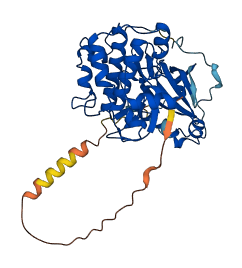
The autoinhibited protein was predicted that may have potential autoinhibitory elements via cis-regPred.
Autoinhibitory domains (AIDs)
Target domain |
|
Relief mechanism |
|
Assay |
cis-regPred |
Accessory elements
210-230 (Activation loop from InterPro)
Target domain |
70-324 (Protein kinase domain) |
Relief mechanism |
|
Assay |
|
Autoinhibited structure

Activated structure
1 structures for P06245
| Entry ID | Method | Resolution | Chain | Position | Source |
|---|---|---|---|---|---|
| AF-P06245-F1 | Predicted | AlphaFoldDB |
5 variants for P06245
| Variant ID(s) | Position | Change | Description | Diseaes Association | Provenance |
|---|---|---|---|---|---|
| s16-166273 | 7 | R>G | No | SGRP | |
| s16-166317 | 21 | N>K | No | SGRP | |
| s16-166457 | 68 | H>R | No | SGRP | |
| s16-166976 | 241 | P>L | No | SGRP | |
| s16-167335 | 361 | E>K | No | SGRP |
No associated diseases with P06245
4 regional properties for P06245
Functions
| Description | ||
|---|---|---|
| EC Number | 2.7.11.11 | Protein-serine/threonine kinases |
| Subcellular Localization |
|
|
| PANTHER Family | ||
| PANTHER Subfamily | ||
| PANTHER Protein Class | ||
| PANTHER Pathway Category | No pathway information available | |
5 GO annotations of cellular component
| Name | Definition |
|---|---|
| cAMP-dependent protein kinase complex | An enzyme complex, composed of regulatory and catalytic subunits, that catalyzes protein phosphorylation. Inactive forms of the enzyme have two regulatory chains and two catalytic chains; activation by cAMP produces two active catalytic monomers and a regulatory dimer. |
| chromatin | The ordered and organized complex of DNA, protein, and sometimes RNA, that forms the chromosome. |
| cytosol | The part of the cytoplasm that does not contain organelles but which does contain other particulate matter, such as protein complexes. |
| nucleus | A membrane-bounded organelle of eukaryotic cells in which chromosomes are housed and replicated. In most cells, the nucleus contains all of the cell's chromosomes except the organellar chromosomes, and is the site of RNA synthesis and processing. In some species, or in specialized cell types, RNA metabolism or DNA replication may be absent. |
| P-body | A focus in the cytoplasm where mRNAs may become inactivated by decapping or some other mechanism. Protein and RNA localized to these foci are involved in mRNA degradation, nonsense-mediated mRNA decay (NMD), translational repression, and RNA-mediated gene silencing. |
6 GO annotations of molecular function
| Name | Definition |
|---|---|
| AMP-activated protein kinase activity | Catalysis of the reaction: ATP + a protein = ADP + a phosphoprotein. This reaction requires the presence of AMP. |
| ATP binding | Binding to ATP, adenosine 5'-triphosphate, a universally important coenzyme and enzyme regulator. |
| cAMP-dependent protein kinase activity | cAMP-dependent catalysis of the reaction: ATP + a protein = ADP + a phosphoprotein. |
| protein kinase activity | Catalysis of the phosphorylation of an amino acid residue in a protein, usually according to the reaction: a protein + ATP = a phosphoprotein + ADP. |
| protein serine kinase activity | Catalysis of the reactions: ATP + protein serine = ADP + protein serine phosphate. |
| translation initiation factor binding | Binding to a translation initiation factor, any polypeptide factor involved in the initiation of ribosome-mediated translation. |
6 GO annotations of biological process
| Name | Definition |
|---|---|
| invasive growth in response to glucose limitation | A growth pattern exhibited by budding haploid cells under certain growth conditions, in which cells retain the typical axial budding pattern of haploids, but become elongated and fail to separate after division; during growth on a solid substrate, this results in penetration of cells into the agar medium. An example of this process is found in Saccharomyces cerevisiae. |
| negative regulation of cytoplasmic mRNA processing body assembly | Any process that decreases the rate, frequency, or extent of the aggregation, arrangement and bonding together of proteins and RNA molecules to form a cytoplasmic mRNA processing body. |
| negative regulation of cytoplasmic translation | Any process that stops, prevents or reduces the frequency, rate or extent of cytoplasmic translation. |
| protein kinase A signaling | A series of reactions, mediated by the intracellular serine/threonine kinase protein kinase A, which occurs as a result of a single trigger reaction or compound. |
| protein phosphorylation | The process of introducing a phosphate group on to a protein. |
| Ras protein signal transduction | The series of molecular signals within the cell that are mediated by a member of the Ras superfamily of proteins switching to a GTP-bound active state. |
2 homologous proteins in AiPD
| 10 | 20 | 30 | 40 | 50 | 60 |
| MEFVAERAQP | VGQTIQQQNV | NTYGQGVLQP | HHDLQQRQQQ | QQQRQHQQLL | TSQLPQKSLV |
| 70 | 80 | 90 | 100 | 110 | 120 |
| SKGKYTLHDF | QIMRTLGTGS | FGRVHLVRSV | HNGRYYAIKV | LKKQQVVKMK | QVEHTNDERR |
| 130 | 140 | 150 | 160 | 170 | 180 |
| MLKLVEHPFL | IRMWGTFQDA | RNIFMVMDYI | EGGELFSLLR | KSQRFPNPVA | KFYAAEVILA |
| 190 | 200 | 210 | 220 | 230 | 240 |
| LEYLHAHNII | YRDLKPENIL | LDRNGHIKIT | DFGFAKEVQT | VTWTLCGTPD | YIAPEVITTK |
| 250 | 260 | 270 | 280 | 290 | 300 |
| PYNKSVDWWS | LGVLIYEMLA | GYTPFYDTTP | MKTYEKILQG | KVVYPPYFHP | DVVDLLSKLI |
| 310 | 320 | 330 | 340 | 350 | 360 |
| TADLTRRIGN | LQSGSRDIKA | HPWFSEVVWE | RLLAKDIETP | YEPPITSGIG | DTSLFDQYPE |
| 370 | |||||
| EQLDYGIQGD | DPYAEYFQDF |