P02197
Gene name |
MB |
Protein name |
Myoglobin |
Names |
|
Species |
Gallus gallus (Chicken) |
KEGG Pathway |
gga:418056 |
EC number |
|
Protein Class |
|
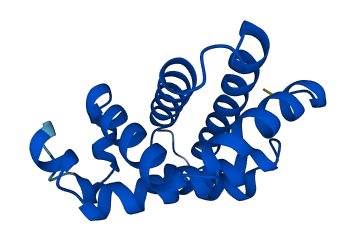
Descriptions
The autoinhibited protein was predicted that may have potential autoinhibitory elements via cis-regPred.
Autoinhibitory domains (AIDs)
Target domain |
|
Relief mechanism |
|
Assay |
cis-regPred |
Accessory elements
No accessory elements
Autoinhibited structure

Activated structure
1 structures for P02197
| Entry ID | Method | Resolution | Chain | Position | Source |
|---|---|---|---|---|---|
| AF-P02197-F1 | Predicted | AlphaFoldDB |
3 variants for P02197
| Variant ID(s) | Position | Change | Description | Diseaes Association | Provenance |
|---|---|---|---|---|---|
| rs735946493 | 14 | I>L | No | Ensembl | |
| rs736750219 | 18 | V>G | No | Ensembl | |
| rs315204999 | 30 | L>M | No | Ensembl |
No associated diseases with P02197
1 regional properties for P02197
| Type | Name | Position | InterPro Accession |
|---|---|---|---|
| domain | Globin | 3 - 148 | IPR000971 |
No GO annotations of cellular component
| Name | Definition |
|---|---|
| No GO annotations for cellular component |
4 GO annotations of molecular function
| Name | Definition |
|---|---|
| heme binding | Binding to a heme, a compound composed of iron complexed in a porphyrin (tetrapyrrole) ring. |
| metal ion binding | Binding to a metal ion. |
| oxygen binding | Binding to oxygen (O2). |
| oxygen carrier activity | Binding to oxygen and delivering it to an acceptor molecule or a specific location. |
4 GO annotations of biological process
| Name | Definition |
|---|---|
| enucleate erythrocyte differentiation | The process in which a myeloid precursor cell acquires specialized features of an erythrocyte without a nucleus. An example of this process is found in Mus musculus. |
| heart development | The process whose specific outcome is the progression of the heart over time, from its formation to the mature structure. The heart is a hollow, muscular organ, which, by contracting rhythmically, keeps up the circulation of the blood. |
| oxygen transport | The directed movement of oxygen (O2) into, out of or within a cell, or between cells, by means of some agent such as a transporter or pore. |
| response to hypoxia | Any process that results in a change in state or activity of a cell or an organism (in terms of movement, secretion, enzyme production, gene expression, etc.) as a result of a stimulus indicating lowered oxygen tension. Hypoxia, defined as a decline in O2 levels below normoxic levels of 20.8 - 20.95%, results in metabolic adaptation at both the cellular and organismal level. |
| 10 | 20 | 30 | 40 | 50 | 60 |
| MGLSDQEWQQ | VLTIWGKVEA | DIAGHGHEVL | MRLFHDHPET | LDRFDKFKGL | KTPDQMKGSE |
| 70 | 80 | 90 | 100 | 110 | 120 |
| DLKKHGATVL | TQLGKILKQK | GNHESELKPL | AQTHATKHKI | PVKYLEFISE | VIIKVIAEKH |
| 130 | 140 | 150 | |||
| AADFGADSQA | AMKKALELFR | NDMASKYKEF | GFQG |