O88995
Gene name |
Nfkbil1 (Ikbl) |
Protein name |
NF-kappa-B inhibitor-like protein 1 |
Names |
Inhibitor of kappa B-like protein, I-kappa-B-like protein, IkappaBL, Nuclear factor of kappa light polypeptide gene enhancer in B-cells inhibitor-like 1 |
Species |
Mus musculus (Mouse) |
KEGG Pathway |
mmu:18038 |
EC number |
|
Protein Class |
|
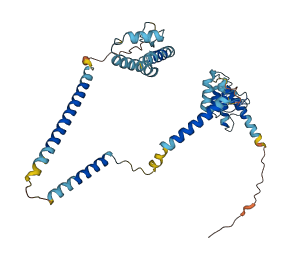
Descriptions
The autoinhibited protein was predicted that may have potential autoinhibitory elements via cis-regPred.
Autoinhibitory domains (AIDs)
Target domain |
|
Relief mechanism |
|
Assay |
cis-regPred |
Accessory elements
No accessory elements
Autoinhibited structure

Activated structure
1 structures for O88995
| Entry ID | Method | Resolution | Chain | Position | Source |
|---|---|---|---|---|---|
| AF-O88995-F1 | Predicted | AlphaFoldDB |
20 variants for O88995
| Variant ID(s) | Position | Change | Description | Diseaes Association | Provenance |
|---|---|---|---|---|---|
| rs3389469423 | 14 | S>P | No | EVA | |
| rs3407786044 | 21 | Q>P | No | EVA | |
| rs3407278905 | 32 | H>Y | No | EVA | |
| rs3407674530 | 38 | F>S | No | EVA | |
| rs3407012875 | 41 | Y>* | No | EVA | |
| rs3406703908 | 41 | Y>C | No | EVA | |
| rs3389371617 | 77 | H>N | No | EVA | |
| rs3389462179 | 100 | D>V | No | EVA | |
| rs3389453411 | 147 | P>T | No | EVA | |
| rs3407012871 | 219 | E>Q | No | EVA | |
| rs3407963515 | 241 | E>G | No | EVA | |
| rs3389438775 | 247 | R>* | No | EVA | |
| rs3389458230 | 252 | A>G | No | EVA | |
| rs3389475134 | 253 | K>R | No | EVA | |
| rs3389450111 | 279 | A>T | No | EVA | |
| rs3389460440 | 284 | E>D | No | EVA | |
| rs3389458208 | 326 | E>* | No | EVA | |
| rs3389475113 | 353 | Q>L | No | EVA | |
| rs3389453420 | 361 | R>Q | No | EVA | |
| rs3389450240 | 362 | V>A | No | EVA |
No associated diseases with O88995
1 regional properties for O88995
| Type | Name | Position | InterPro Accession |
|---|---|---|---|
| repeat | Ankyrin repeat | 68 - 110 | IPR002110 |
Functions
3 GO annotations of cellular component
| Name | Definition |
|---|---|
| cytosol | The part of the cytoplasm that does not contain organelles but which does contain other particulate matter, such as protein complexes. |
| nucleoplasm | That part of the nuclear content other than the chromosomes or the nucleolus. |
| nucleus | A membrane-bounded organelle of eukaryotic cells in which chromosomes are housed and replicated. In most cells, the nucleus contains all of the cell's chromosomes except the organellar chromosomes, and is the site of RNA synthesis and processing. In some species, or in specialized cell types, RNA metabolism or DNA replication may be absent. |
No GO annotations of molecular function
| Name | Definition |
|---|---|
| No GO annotations for molecular function |
6 GO annotations of biological process
| Name | Definition |
|---|---|
| cellular response to lipopolysaccharide | Any process that results in a change in state or activity of a cell (in terms of movement, secretion, enzyme production, gene expression, etc.) as a result of a lipopolysaccharide stimulus; lipopolysaccharide is a major component of the cell wall of gram-negative bacteria. |
| I-kappaB kinase/NF-kappaB signaling | The process in which a signal is passed on to downstream components within the cell through the I-kappaB-kinase (IKK)-dependent activation of NF-kappaB. The cascade begins with activation of a trimeric IKK complex (consisting of catalytic kinase subunits IKKalpha and/or IKKbeta, and the regulatory scaffold protein NEMO) and ends with the regulation of transcription of target genes by NF-kappaB. In a resting state, NF-kappaB dimers are bound to I-kappaB proteins, sequestering NF-kappaB in the cytoplasm. Phosphorylation of I-kappaB targets I-kappaB for ubiquitination and proteasomal degradation, thus releasing the NF-kappaB dimers, which can translocate to the nucleus to bind DNA and regulate transcription. |
| negative regulation of lipopolysaccharide-mediated signaling pathway | Any process that stops, prevents, or reduces the frequency, rate or extent of signaling in response to detection of lipopolysaccharide. |
| negative regulation of NF-kappaB transcription factor activity | Any process that stops, prevents, or reduces the frequency, rate or extent of the activity of the transcription factor NF-kappaB. |
| negative regulation of toll-like receptor signaling pathway | Any process that stops, prevents, or reduces the frequency, rate, or extent of toll-like receptor signaling pathway. |
| negative regulation of tumor necrosis factor production | Any process that stops, prevents, or reduces the frequency, rate, or extent of tumor necrosis factor production. |
3 homologous proteins in AiPD
| 10 | 20 | 30 | 40 | 50 | 60 |
| MSNPSPQAPE | EEASTSVCRP | QSCSMASASR | RHRRERRFRR | YLSAGRLVRA | QALLQRHPGL |
| 70 | 80 | 90 | 100 | 110 | 120 |
| DVDAGQPPPL | HRACARHDAP | ALCLLLRLGA | DPAHQDRHGD | TALHAAARQG | PDAYTDFFLP |
| 130 | 140 | 150 | 160 | 170 | 180 |
| LLSRCPSAMG | IKNKDGETPG | QILGWGPPWD | SAEEEEDEEV | SKEREWRQKL | QGELEDEWQE |
| 190 | 200 | 210 | 220 | 230 | 240 |
| VIGRFEDDAS | RDTQEPESFS | AWSERLAREH | AQKQRQQLEA | EGSCRPPRAE | GSSHSWRQHE |
| 250 | 260 | 270 | 280 | 290 | 300 |
| EEQRLFRERA | RAKEKELCES | RARRAQEAQR | DKGPEPPRAG | PRAEHPRGAE | RGSLWRFGDV |
| 310 | 320 | 330 | 340 | 350 | 360 |
| PWPCPGGGDP | EAMAAALVAR | GPPLEEQGAL | KRYLRVQQVR | WHPDRFLQRF | RSQIETWELG |
| 370 | 380 | ||||
| RVMGAVTALS | QALNRHAEAL | K |