O77737
Gene name |
BCL2L1 (BCLX, BLC2L) |
Protein name |
Bcl-2-like protein 1 |
Names |
Apo-1 antigen, Apoptosis-mediating surface antigen FAS, FASLG receptor, Bcl2-L-1, Apoptosis regulator Bcl-X |
Species |
Sus scrofa (Pig) |
KEGG Pathway |
ssc:397536 |
EC number |
|
Protein Class |
|
Descriptions
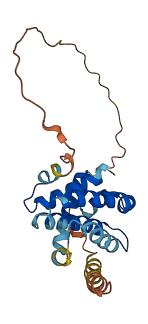
The autoinhibited protein was predicted that may have potential autoinhibitory elements via cis-regPred.
Autoinhibitory domains (AIDs)
Target domain |
|
Relief mechanism |
|
Assay |
cis-regPred |
Accessory elements
No accessory elements
Autoinhibited structure

Activated structure
1 structures for O77737
| Entry ID | Method | Resolution | Chain | Position | Source |
|---|---|---|---|---|---|
| AF-O77737-F1 | Predicted | AlphaFoldDB |
No variants for O77737
| Variant ID(s) | Position | Change | Description | Diseaes Association | Provenance |
|---|---|---|---|---|---|
| No variants for O77737 | |||||
No associated diseases with O77737
6 regional properties for O77737
| Type | Name | Position | InterPro Accession |
|---|---|---|---|
| domain | Apoptosis regulator, Bcl-2 protein, BH4 | 1 - 27 | IPR003093 |
| conserved_site | Apoptosis regulator, Bcl-2, BH1 motif, conserved site | 130 - 148 | IPR020717 |
| conserved_site | Apoptosis regulator, Bcl-2, BH2 motif, conserved site | 181 - 192 | IPR020726 |
| conserved_site | Apoptosis regulator, Bcl-2, BH3 motif, conserved site | 86 - 100 | IPR020728 |
| conserved_site | Apoptosis regulator, Bcl-2, BH4 motif, conserved site | 4 - 24 | IPR020731 |
| domain | Bcl-2, Bcl-2 homology region 1-3 | 90 - 188 | IPR046371 |
Functions
9 GO annotations of cellular component
| Name | Definition |
|---|---|
| anchoring junction | A cell junction that mechanically attaches a cell (and its cytoskeleton) to neighboring cells or to the extracellular matrix. |
| centrosome | A structure comprised of a core structure (in most organisms, a pair of centrioles) and peripheral material from which a microtubule-based structure, such as a spindle apparatus, is organized. Centrosomes occur close to the nucleus during interphase in many eukaryotic cells, though in animal cells it changes continually during the cell-division cycle. |
| cytoplasm | The contents of a cell excluding the plasma membrane and nucleus, but including other subcellular structures. |
| cytosol | The part of the cytoplasm that does not contain organelles but which does contain other particulate matter, such as protein complexes. |
| integral component of membrane | The component of a membrane consisting of the gene products and protein complexes having at least some part of their peptide sequence embedded in the hydrophobic region of the membrane. |
| mitochondrial matrix | The gel-like material, with considerable fine structure, that lies in the matrix space, or lumen, of a mitochondrion. It contains the enzymes of the tricarboxylic acid cycle and, in some organisms, the enzymes concerned with fatty acid oxidation. |
| mitochondrial outer membrane | The outer, i.e. cytoplasm-facing, lipid bilayer of the mitochondrial envelope. |
| nuclear membrane | Either of the lipid bilayers that surround the nucleus and form the nuclear envelope; excludes the intermembrane space. |
| synaptic vesicle membrane | The lipid bilayer surrounding a synaptic vesicle. |
2 GO annotations of molecular function
| Name | Definition |
|---|---|
| protein heterodimerization activity | Binding to a nonidentical protein to form a heterodimer. |
| protein homodimerization activity | Binding to an identical protein to form a homodimer. |
7 GO annotations of biological process
| Name | Definition |
|---|---|
| endocytosis | A vesicle-mediated transport process in which cells take up external materials or membrane constituents by the invagination of a small region of the plasma membrane to form a new membrane-bounded vesicle. |
| extrinsic apoptotic signaling pathway in absence of ligand | The series of molecular signals in which a signal is conveyed from the cell surface to trigger the apoptotic death of a cell. The pathway starts with withdrawal of a ligand from a cell surface receptor, and ends when the execution phase of apoptosis is triggered. |
| intrinsic apoptotic signaling pathway in response to DNA damage | The series of molecular signals in which an intracellular signal is conveyed to trigger the apoptotic death of a cell. The pathway is induced by the detection of DNA damage, and ends when the execution phase of apoptosis is triggered. |
| negative regulation of endoplasmic reticulum stress-induced intrinsic apoptotic signaling pathway | Any process that stops, prevents or reduces the frequency, rate or extent of an endoplasmic reticulum stress-induced intrinsic apoptotic signaling pathway. |
| negative regulation of execution phase of apoptosis | Any process that stops, prevents or reduces the frequency, rate or extent of execution phase of apoptosis. |
| negative regulation of intrinsic apoptotic signaling pathway | Any process that stops, prevents or reduces the frequency, rate or extent of intrinsic apoptotic signaling pathway. |
| regulation of cytokinesis | Any process that modulates the frequency, rate or extent of the division of the cytoplasm of a cell and its separation into two daughter cells. |
4 homologous proteins in AiPD
| 10 | 20 | 30 | 40 | 50 | 60 |
| MSQSNRELVV | DFLSYKLSQK | GYSWSQFTDV | EENRTEAPEG | TESEAETPSA | INGNPSWHLA |
| 70 | 80 | 90 | 100 | 110 | 120 |
| DSPAVNGATG | HSSSLDAREV | IPMAAVKQAL | REAGDEFELR | YRRAFSDLTS | QLHITPGTAY |
| 130 | 140 | 150 | 160 | 170 | 180 |
| QSFEQVLNEL | FRDGVNWGRI | VAFFSFGGAL | CVESVDKEMQ | VLVSRIATWM | ATYLNDHLEP |
| 190 | 200 | 210 | 220 | 230 | |
| WIQENGGWDT | FVELYGNNAA | AESRKGQERF | NRWFLTGMTL | AGVVLLGSLF | SRK |