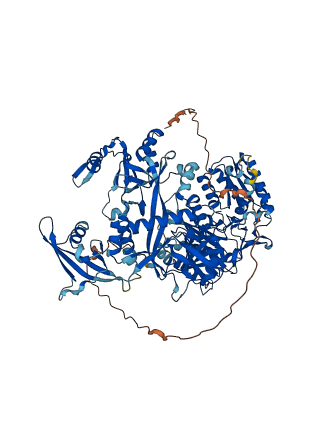
| defense response to Gram-negative bacterium |
Reactions triggered in response to the presence of a Gram-negative bacterium that act to protect the cell or organism. |
| dorsal appendage formation |
Establishment of the dorsal filaments, elaborate specializations of the chorion that protrude from the anterior end of the egg and facilitate embryonic respiration. |
| gene silencing by RNA |
A process in which an RNA molecule reduces expression of target genes. This can occur pre-transcriptionally by assembly of heterochromatin and prevention of transcription or co- or post-transcriptionally by targeting RNAs for degradation or by interfering with splicing or translation. This process starts once the inhibitory RNA molecule has been transcribed, and includes processing of the RNA such as cleavage, modifications, transport from the nucleus to the cytoplasm, loading onto the RISC complex, and the effect on transcription or translation. |
| global gene silencing by mRNA cleavage |
A posttranscriptional gene silencing pathway that involves the cleavage of mRNAs in a non-gene-specific manner. |
| heterochromatin assembly |
An epigenetic gene silencing mechanism in which chromatin is compacted into heterochromatin, resulting in a chromatin conformation refractory to transcription. This process starts with heterochromatin nucleation, its spreading, and ends with heterochromatin boundary formation. |
| maintenance of pole plasm mRNA location |
The process of maintaining mRNA in a specific location in the oocyte pole plasm. An example of this process is found in Drosophila melanogaster. |
| mitotic chromosome condensation |
The cell cycle process in which chromatin structure is compacted prior to and during mitosis in eukaryotic cells. |
| mRNA splicing, via spliceosome |
The joining together of exons from one or more primary transcripts of messenger RNA (mRNA) and the excision of intron sequences, via a spliceosomal mechanism, so that mRNA consisting only of the joined exons is produced. |
| negative regulation of transposition |
Any process that decreases the frequency, rate or extent of transposition. Transposition results in the movement of discrete segments of DNA between nonhomologous sites. |
| oocyte karyosome formation |
The chromosome organization process in which meiotic chromosomes in the oocyte nucleus cluster together to form a compact spherical structure called the karyosome. |
| oocyte maturation |
A developmental process, independent of morphogenetic (shape) change, that is required for an oocyte to attain its fully functional state. Oocyte maturation commences after reinitiation of meiosis commonly starting with germinal vesicle breakdown, and continues up to the second meiotic arrest prior to fertilization. |
| oogenesis |
The complete process of formation and maturation of an ovum or female gamete from a primordial female germ cell. Examples of this process are found in Mus musculus and Drosophila melanogaster. |
| P granule assembly |
The aggregation, arrangement and bonding together of a set of components to form a P granule. |
| piRNA biosynthetic process |
The chemical reactions and pathways resulting in the formation of piRNAs, Piwi-associated RNAs, a class of 24- to 30-nucleotide RNA derived from repeat or complex DNA sequence elements and processed by a Dicer-independent mechanism. |
| pole cell development |
The process whose specific outcome is the progression of the pole cell over time, from its formation to the mature structure. |
| pole cell formation |
Formation of a small group of cells (pole cells) at the posterior pole of the insect blastula. They are the first cells to cellularize after the arrival of nuclei at the end of the syncytial blastula stage and are the precursors to the insect germ cells. |
| pole plasm protein localization |
Any process in which a protein is transported to, or maintained in, the oocyte pole plasm. An example of this is found in Drosophila melanogaster. |
| positive regulation of innate immune response |
Any process that activates or increases the frequency, rate or extent of the innate immune response, the organism's first line of defense against infection. |
| positive regulation of nuclear-transcribed mRNA poly(A) tail shortening |
Any process that increases the frequency, rate or extent of poly(A) tail shortening of a nuclear-transcribed mRNA. Poly(A) tail shortening is the decrease in length of the poly(A) tail of an mRNA from full length to an oligo(A) length. |
| positive regulation of oskar mRNA translation |
Any process that activates or increases the frequency, rate or extent of oskar mRNA translation. |
| positive regulation of post-transcriptional gene silencing by RNA |
Any process that activates or increases the frequency, rate or extent of post-transcriptional gene silencing by RNA. |
| post-transcriptional gene silencing by RNA |
A posttranscriptional gene silencing pathway in which regulatory RNAs elicit silencing of specific target genes, either by mRNA destabilization or inhibition of translation. |
| regulation of oskar mRNA translation |
Any process that modulates the frequency, rate or extent of oskar mRNA translation. To ensure the localization of Oskar protein at the posterior pole of the oocyte, translation of oskar mRNA is repressed during its transport to the posterior pole and activated upon localization of the mRNA at the posterior cortex. |
| regulation of pole plasm oskar mRNA localization |
Any process that modulates the frequency, rate or extent of the process in which oskar mRNA is transported to, or maintained in, the oocyte pole plasm. |
| segmentation |
The regionalization process that divides an organism or part of an organism into a series of semi-repetitive parts, or segments, often arranged along a longitudinal axis. |