O62729
Gene name |
NPY5R (NPY5) |
Protein name |
Neuropeptide Y receptor type 5 |
Names |
NPY5-R, NPY-Y5 receptor, NPYY5-R, Y5 receptor |
Species |
Canis lupus familiaris (Dog) (Canis familiaris) |
KEGG Pathway |
cfa:403712 |
EC number |
|
Protein Class |
|
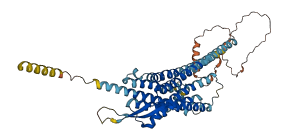
Descriptions
The autoinhibited protein was predicted that may have potential autoinhibitory elements via cis-regPred.
Autoinhibitory domains (AIDs)
Target domain |
|
Relief mechanism |
|
Assay |
cis-regPred |
Accessory elements
No accessory elements
Autoinhibited structure

Activated structure
1 structures for O62729
| Entry ID | Method | Resolution | Chain | Position | Source |
|---|---|---|---|---|---|
| AF-O62729-F1 | Predicted | AlphaFoldDB |
1 variants for O62729
| Variant ID(s) | Position | Change | Description | Diseaes Association | Provenance |
|---|---|---|---|---|---|
| rs852092872 | 111 | K>R | No | EVA |
No associated diseases with O62729
No regional properties for O62729
| Type | Name | Position | InterPro Accession |
|---|---|---|---|
| No domain, repeats, and functional sites for O62729 | |||
4 GO annotations of cellular component
| Name | Definition |
|---|---|
| integral component of membrane | The component of a membrane consisting of the gene products and protein complexes having at least some part of their peptide sequence embedded in the hydrophobic region of the membrane. |
| neuron projection | A prolongation or process extending from a nerve cell, e.g. an axon or dendrite. |
| plasma membrane | The membrane surrounding a cell that separates the cell from its external environment. It consists of a phospholipid bilayer and associated proteins. |
| synapse | The junction between an axon of one neuron and a dendrite of another neuron, a muscle fiber or a glial cell. As the axon approaches the synapse it enlarges into a specialized structure, the presynaptic terminal bouton, which contains mitochondria and synaptic vesicles. At the tip of the terminal bouton is the presynaptic membrane; facing it, and separated from it by a minute cleft (the synaptic cleft) is a specialized area of membrane on the receiving cell, known as the postsynaptic membrane. In response to the arrival of nerve impulses, the presynaptic terminal bouton secretes molecules of neurotransmitters into the synaptic cleft. These diffuse across the cleft and transmit the signal to the postsynaptic membrane. |
4 GO annotations of molecular function
| Name | Definition |
|---|---|
| neuropeptide binding | Interacting selectively and non-covalently and stoichiometrically with neuropeptides, peptides with direct synaptic effects (peptide neurotransmitters) or indirect modulatory effects on the nervous system (peptide neuromodulators). |
| neuropeptide receptor activity | Combining with a neuropeptide to initiate a change in cell activity. |
| pancreatic polypeptide receptor activity | Combining with pancreatic polypeptide PP to initiate a change in cell activity. |
| peptide YY receptor activity | Combining with gut peptide YY to initiate a change in cell activity. |
4 GO annotations of biological process
| Name | Definition |
|---|---|
| cardiac left ventricle morphogenesis | The process in which the left cardiac ventricle is generated and organized. |
| chemical synaptic transmission | The vesicular release of classical neurotransmitter molecules from a presynapse, across a chemical synapse, the subsequent activation of neurotransmitter receptors at the postsynapse of a target cell (neuron, muscle, or secretory cell) and the effects of this activation on the postsynaptic membrane potential and ionic composition of the postsynaptic cytosol. This process encompasses both spontaneous and evoked release of neurotransmitter and all parts of synaptic vesicle exocytosis. Evoked transmission starts with the arrival of an action potential at the presynapse. |
| G protein-coupled receptor signaling pathway | The series of molecular signals initiated by a ligand binding to its receptor, in which the activated receptor promotes the exchange of GDP for GTP on the alpha-subunit of an associated heterotrimeric G-protein complex. The GTP-bound activated alpha-G-protein then dissociates from the beta- and gamma-subunits to further transmit the signal within the cell. The pathway begins with receptor-ligand interaction, and ends with regulation of a downstream cellular process. The pathway can start from the plasma membrane, Golgi or nuclear membrane. |
| outflow tract morphogenesis | The process in which the anatomical structures of the outflow tract are generated and organized. The outflow tract is the portion of the heart through which blood flows into the arteries. |
| 10 | 20 | 30 | 40 | 50 | 60 |
| MDLELQDFYN | KTLATENNTA | ATRNSDFPVW | DDYKSSVDDL | QYFLIGLYTF | VSLLGFMGNL |
| 70 | 80 | 90 | 100 | 110 | 120 |
| LILMALMRKR | NQKTMVNFLI | GNLAFSDILV | VLFCSPFTLT | SVLLDQWMFG | KVMCHIMPFL |
| 130 | 140 | 150 | 160 | 170 | 180 |
| QCVSVLVSTL | ILISIAIVRY | HMIKHPISNN | LTANHGYFLI | ATVWTLGFAI | CSPLPVFHSL |
| 190 | 200 | 210 | 220 | 230 | 240 |
| VELQETFDSA | LLSSRYLCVE | SWPSDSYRIA | FTISLLLVQY | ILPLVCLTVS | HTSVCRSISC |
| 250 | 260 | 270 | 280 | 290 | 300 |
| GLSNKENKLE | ENEMINLTLQ | PFKKSGPQVK | LSSSHKWSYS | FIRKHRRRYS | KKTACVLPAP |
| 310 | 320 | 330 | 340 | 350 | 360 |
| ARPPQENHSR | MLPENFGSVR | SQHSSSSKFI | PGVPTCFEVK | PEENSDVHDM | RVNRSIMRIK |
| 370 | 380 | 390 | 400 | 410 | 420 |
| KRSRSVFYRL | TILILVFAVS | WMPLHLFHVV | TDFNDNLISN | RHFKLVYCIC | HLLGMMSCCL |
| 430 | 440 | ||||
| NPILYGFLNN | GIKADLISLI | QCLHMS |