O54825
Gene name |
Bysl |
Protein name |
Bystin |
Names |
|
Species |
Mus musculus (Mouse) |
KEGG Pathway |
mmu:53414 |
EC number |
|
Protein Class |
|
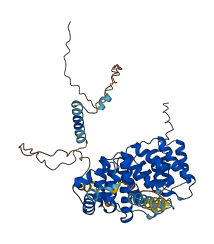
Descriptions
The autoinhibited protein was predicted that may have potential autoinhibitory elements via cis-regPred.
Autoinhibitory domains (AIDs)
Target domain |
|
Relief mechanism |
|
Assay |
cis-regPred |
Accessory elements
No accessory elements
Autoinhibited structure

Activated structure
1 structures for O54825
| Entry ID | Method | Resolution | Chain | Position | Source |
|---|---|---|---|---|---|
| AF-O54825-F1 | Predicted | AlphaFoldDB |
15 variants for O54825
| Variant ID(s) | Position | Change | Description | Diseaes Association | Provenance |
|---|---|---|---|---|---|
| rs3389470198 | 31 | A>E | No | EVA | |
| rs3389471987 | 60 | Q>L | No | EVA | |
| rs239747318 | 74 | A>V | No | EVA | |
| rs3389463609 | 115 | G>R | No | EVA | |
| rs3389470130 | 118 | H>N | No | EVA | |
| rs3389427120 | 137 | N>Y | No | EVA | |
| rs3389469931 | 250 | N>I | No | EVA | |
| rs1132214355 | 252 | V>I | No | EVA | |
| rs1132880922 | 256 | R>G | No | EVA | |
| rs1132294558 | 259 | D>G | No | EVA | |
| rs3389468103 | 309 | S>N | No | EVA | |
| rs3389460584 | 327 | K>* | No | EVA | |
| rs3389381484 | 350 | A>G | No | EVA | |
| rs3389476423 | 404 | L>I | No | EVA | |
| rs221024538 | 421 | Q>H | No | EVA |
No associated diseases with O54825
No regional properties for O54825
| Type | Name | Position | InterPro Accession |
|---|---|---|---|
| No domain, repeats, and functional sites for O54825 | |||
10 GO annotations of cellular component
| Name | Definition |
|---|---|
| apical part of cell | The region of a polarized cell that forms a tip or is distal to a base. For example, in a polarized epithelial cell, the apical region has an exposed surface and lies opposite to the basal lamina that separates the epithelium from other tissue. |
| cell projection | A prolongation or process extending from a cell, e.g. a flagellum or axon. |
| chromosome | A structure composed of a very long molecule of DNA and associated proteins (e.g. histones) that carries hereditary information. |
| cytoplasm | The contents of a cell excluding the plasma membrane and nucleus, but including other subcellular structures. |
| cytoplasmic microtubule | Any microtubule in the cytoplasm of a cell. |
| intracellular membrane-bounded organelle | Organized structure of distinctive morphology and function, bounded by a single or double lipid bilayer membrane and occurring within the cell. Includes the nucleus, mitochondria, plastids, vacuoles, and vesicles. Excludes the plasma membrane. |
| nucleolus | A small, dense body one or more of which are present in the nucleus of eukaryotic cells. It is rich in RNA and protein, is not bounded by a limiting membrane, and is not seen during mitosis. Its prime function is the transcription of the nucleolar DNA into 45S ribosomal-precursor RNA, the processing of this RNA into 5.8S, 18S, and 28S components of ribosomal RNA, and the association of these components with 5S RNA and proteins synthesized outside the nucleolus. This association results in the formation of ribonucleoprotein precursors; these pass into the cytoplasm and mature into the 40S and 60S subunits of the ribosome. |
| nucleoplasm | That part of the nuclear content other than the chromosomes or the nucleolus. |
| perinuclear region of cytoplasm | Cytoplasm situated near, or occurring around, the nucleus. |
| preribosome, small subunit precursor | A preribosomal complex consisting of 20S pre-rRNA, ribosomal proteins including late-associating small subunit proteins, and associated proteins; a precursor of the eukaryotic cytoplasmic small ribosomal subunit. |
1 GO annotations of molecular function
| Name | Definition |
|---|---|
| snoRNA binding | Binding to a small nucleolar RNA. |
6 GO annotations of biological process
| Name | Definition |
|---|---|
| blastocyst formation | The initial formation of a blastocyst from a solid ball of cells known as a morula. |
| in utero embryonic development | The process whose specific outcome is the progression of the embryo in the uterus over time, from formation of the zygote in the oviduct, to birth. An example of this process is found in Mus musculus. |
| maturation of SSU-rRNA from tricistronic rRNA transcript (SSU-rRNA, 5.8S rRNA, LSU-rRNA) | Any process involved in the maturation of a precursor Small SubUnit (SSU) ribosomal RNA (rRNA) molecule into a mature SSU-rRNA molecule from the pre-rRNA molecule originally produced as a tricistronic rRNA transcript that contains the Small Subunit (SSU) rRNA, 5.8S rRNA, and the Large Subunit (LSU) in that order from 5' to 3' along the primary transcript. |
| rRNA processing | Any process involved in the conversion of a primary ribosomal RNA (rRNA) transcript into one or more mature rRNA molecules. |
| stem cell proliferation | The multiplication or reproduction of stem cells, resulting in the expansion of a stem cell population. A stem cell is a cell that retains the ability to divide and proliferate throughout life to provide progenitor cells that can differentiate into specialized cells. |
| trophectodermal cell differentiation | The process in which a relatively unspecialized cell acquires the specialized features of a trophectoderm cell. |
1 homologous proteins in AiPD
| UniProt AC | Gene Name | Protein Name | Species | Evidence Code |
|---|---|---|---|---|
| P38333 | ENP1 | Essential nuclear protein 1 | Saccharomyces cerevisiae (strain ATCC 204508 / S288c) (Baker's yeast) | PR |
| 10 | 20 | 30 | 40 | 50 | 60 |
| MPKFKVTRGA | SNREKHAPLA | EQILAGNAVR | AGTREKRRGR | EVEEEEEYVG | PRLSRRILQQ |
| 70 | 80 | 90 | 100 | 110 | 120 |
| ARQQQEELET | DHGAGDRSAP | PRERATRLGP | GLPQDGSDEE | DEEWPTLEKA | AKMAGVDHQA |
| 130 | 140 | 150 | 160 | 170 | 180 |
| EVIVDPEDER | AIEMFMNKNP | PVRRTLADII | MEKLTEKQTE | VETVMSEVSG | FPMPQLDPRV |
| 190 | 200 | 210 | 220 | 230 | 240 |
| LEVYRGVREV | LCKYRSGKLP | KAFKVIPALS | NWEQILYVTE | PEAWTAAAMY | QATRIFASNL |
| 250 | 260 | 270 | 280 | 290 | 300 |
| KERMAQRFYN | LVLLPRVRDD | IAEYKRLNFH | LYMALKKALF | KPGAWFKGIL | IPLCESGTCT |
| 310 | 320 | 330 | 340 | 350 | 360 |
| LREAIIVGSI | ITKCSIPVLH | SSAAMLKIAE | MEYSGANSIF | LRLLLDKKYA | LPYRVLDALV |
| 370 | 380 | 390 | 400 | 410 | 420 |
| FHFLAFRTEK | RQLPVLWHQC | LLTLAQRYKA | DLATEQKEAL | LELLRLQPHP | QLSPEIRREL |
| 430 | |||||
| QSAVPRDVED | GGVTME |