O35386
Gene name |
Phyh (Ln1, Lnap1, Pahx) |
Protein name |
Phytanoyl-CoA dioxygenase, peroxisomal |
Names |
Lupus nephritis-associated peptide 1, Phytanic acid oxidase, Phytanoyl-CoA alpha-hydroxylase, PhyH |
Species |
Mus musculus (Mouse) |
KEGG Pathway |
mmu:16922 |
EC number |
1.14.11.18: With 2-oxoglutarate as one donor, and incorporation of one atom each of oxygen into both donors |
Protein Class |
|
Descriptions
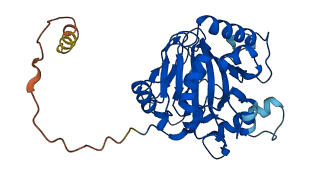
The autoinhibited protein was predicted that may have potential autoinhibitory elements via cis-regPred.
Autoinhibitory domains (AIDs)
Target domain |
|
Relief mechanism |
|
Assay |
cis-regPred |
Accessory elements
No accessory elements
Autoinhibited structure

Activated structure
1 structures for O35386
| Entry ID | Method | Resolution | Chain | Position | Source |
|---|---|---|---|---|---|
| AF-O35386-F1 | Predicted | AlphaFoldDB |
15 variants for O35386
| Variant ID(s) | Position | Change | Description | Diseaes Association | Provenance |
|---|---|---|---|---|---|
| rs27063458 | 2 | N>K | No | EVA | |
| rs3388521942 | 23 | P>S | No | EVA | |
| rs251281257 | 27 | A>S | No | EVA | |
| rs3388523889 | 46 | Y>F | No | EVA | |
| rs3388527323 | 68 | V>D | No | EVA | |
| rs3391225828 | 92 | E>V | No | EVA | |
| rs3388528368 | 93 | V>L | No | EVA | |
| rs3413151097 | 115 | D>E | No | EVA | |
| rs3388529230 | 137 | P>L | No | EVA | |
| rs3411548084 | 189 | I>F | No | EVA | |
| rs3388523766 | 216 | T>I | No | EVA | |
| rs3388530495 | 217 | L>M | No | EVA | |
| rs3388521923 | 218 | K>M | No | EVA | |
| rs3388530517 | 243 | S>I | No | EVA | |
| rs3411652419 | 243 | S>R | No | EVA |
1 associated diseases with O35386
Without disease ID
No regional properties for O35386
| Type | Name | Position | InterPro Accession |
|---|---|---|---|
| No domain, repeats, and functional sites for O35386 | |||
Functions
| Description | ||
|---|---|---|
| EC Number | 1.14.11.18 | With 2-oxoglutarate as one donor, and incorporation of one atom each of oxygen into both donors |
| Subcellular Localization |
|
|
| PANTHER Family | ||
| PANTHER Subfamily | ||
| PANTHER Protein Class | ||
| PANTHER Pathway Category | No pathway information available | |
4 GO annotations of cellular component
| Name | Definition |
|---|---|
| 9+0 non-motile cilium | A non-motile cilium where the axoneme has a ring of nine outer microtubule doublets but no central microtubules (and is therefore called a 9+0 axoneme). |
| mitochondrion | A semiautonomous, self replicating organelle that occurs in varying numbers, shapes, and sizes in the cytoplasm of virtually all eukaryotic cells. It is notably the site of tissue respiration. |
| peroxisomal matrix | The volume contained within the membranes of a peroxisome; in many cells the matrix contains a crystalloid core largely composed of urate oxidase. |
| peroxisome | A small organelle enclosed by a single membrane, and found in most eukaryotic cells. Contains peroxidases and other enzymes involved in a variety of metabolic processes including free radical detoxification, lipid catabolism and biosynthesis, and hydrogen peroxide metabolism. |
5 GO annotations of molecular function
| Name | Definition |
|---|---|
| carboxylic acid binding | Binding to a carboxylic acid, an organic acid containing one or more carboxyl (COOH) groups or anions (COO-). |
| catalytic activity | Catalysis of a biochemical reaction at physiological temperatures. In biologically catalyzed reactions, the reactants are known as substrates, and the catalysts are naturally occurring macromolecular substances known as enzymes. Enzymes possess specific binding sites for substrates, and are usually composed wholly or largely of protein, but RNA that has catalytic activity (ribozyme) is often also regarded as enzymatic. |
| ferrous iron binding | Binding to a ferrous iron ion, Fe(II). |
| L-ascorbic acid binding | Binding to L-ascorbic acid, (2R)-2-[(1S)-1,2-dihydroxyethyl]-4-hydroxy-5-oxo-2,5-dihydrofuran-3-olate; L-ascorbic acid is vitamin C and has co-factor and anti-oxidant activities in many species. |
| phytanoyl-CoA dioxygenase activity | Catalysis of the reaction: 2-oxoglutarate + O(2) + phytanoyl-CoA = 2-hydroxyphytanoyl-CoA + CO(2) + succinate. |
5 GO annotations of biological process
| Name | Definition |
|---|---|
| 2-oxobutyrate catabolic process | The chemical reactions and pathways resulting in the breakdown of 2-oxobutyrate, the anion of the organic acid 2-oxobutyric acid, which contains a ketone group on carbon 2. |
| 2-oxoglutarate metabolic process | The chemical reactions and pathways involving oxoglutarate, the dianion of 2-oxoglutaric acid. It is a key constituent of the TCA cycle and a key intermediate in amino-acid metabolism. |
| fatty acid alpha-oxidation | A metabolic pathway by which 3-methyl branched fatty acids are degraded. These compounds are not degraded by the normal peroxisomal beta-oxidation pathway, because the 3-methyl blocks the dehydrogenation of the hydroxyl group by hydroxyacyl-CoA dehydrogenase. The 3-methyl branched fatty acid is converted in several steps to pristenic acid, which can then feed into the beta-oxidative pathway. |
| isoprenoid metabolic process | The chemical reactions and pathways involving isoprenoid compounds, isoprene (2-methylbuta-1,3-diene) or compounds containing or derived from linked isoprene (3-methyl-2-butenylene) residues. |
| methyl-branched fatty acid metabolic process | The chemical reactions and pathways involving methyl-branched fatty acids, aliphatic monocarboxylic acids with methyl branches on the main chain. |
| 10 | 20 | 30 | 40 | 50 | 60 |
| MNLTRAGARL | QVLLGHLGRP | SAPTIVAQPV | SGLASPASFQ | PEQFQYTLDN | NVLTLEQRKF |
| 70 | 80 | 90 | 100 | 110 | 120 |
| YEENGFLVIK | NLVSDDDIQR | FRAEFERICR | EEVKPPGIVI | MRDVALAKQD | YMPSDRMVSK |
| 130 | 140 | 150 | 160 | 170 | 180 |
| IQDFQEDEEL | FRYCLLPEIL | KYVECFTGPN | IMALHGMLIN | KPPDVGKKTS | RHPLHQDLHY |
| 190 | 200 | 210 | 220 | 230 | 240 |
| FPFRPSNLIV | CAWTAMEHID | RNNGCLVVLP | GTHKGTLKPH | DYPKWEGGVN | KMYHGIQDYD |
| 250 | 260 | 270 | 280 | 290 | 300 |
| PNSPRVHLVM | EKGDTVFFHP | LLIHGSGRNK | TQGFRKAISC | HFGSSDCQCI | DVSGTSQENI |
| 310 | 320 | 330 | |||
| AREVVEMAEK | KYGFQGVMDF | KDTWIFRSRL | VKGERINI |