O35276
Gene name |
Nrp2 |
Protein name |
Neuropilin-2 |
Names |
Vascular endothelial cell growth factor 165 receptor 2 |
Species |
Rattus norvegicus (Rat) |
KEGG Pathway |
rno:81527 |
EC number |
|
Protein Class |
|
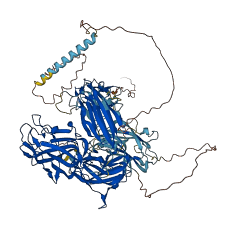
Descriptions
The autoinhibited protein was predicted that may have potential autoinhibitory elements via cis-regPred.
Autoinhibitory domains (AIDs)
Target domain |
|
Relief mechanism |
|
Assay |
cis-regPred |
Accessory elements
No accessory elements
Autoinhibited structure

Activated structure
1 structures for O35276
| Entry ID | Method | Resolution | Chain | Position | Source |
|---|---|---|---|---|---|
| AF-O35276-F1 | Predicted | AlphaFoldDB |
No variants for O35276
| Variant ID(s) | Position | Change | Description | Diseaes Association | Provenance |
|---|---|---|---|---|---|
| No variants for O35276 | |||||
1 associated diseases with O35276
[MIM: 116300]: Cataract 30, multiple types (CTRCT30)
An opacification of the crystalline lens of the eye that frequently results in visual impairment or blindness. Opacities vary in morphology, are often confined to a portion of the lens, and may be static or progressive. In general, the more posteriorly located and dense an opacity, the greater the impact on visual function. {ECO:0000269|PubMed:19126778, ECO:0000269|PubMed:26694549, ECO:0000269|PubMed:28450710}. Note=The disease is caused by variants affecting the gene represented in this entry.
Without disease ID
- An opacification of the crystalline lens of the eye that frequently results in visual impairment or blindness. Opacities vary in morphology, are often confined to a portion of the lens, and may be static or progressive. In general, the more posteriorly located and dense an opacity, the greater the impact on visual function. {ECO:0000269|PubMed:19126778, ECO:0000269|PubMed:26694549, ECO:0000269|PubMed:28450710}. Note=The disease is caused by variants affecting the gene represented in this entry.
7 regional properties for O35276
| Type | Name | Position | InterPro Accession |
|---|---|---|---|
| domain | C2 domain | 89 - 211 | IPR000008-1 |
| domain | C2 domain | 251 - 384 | IPR000008-2 |
| domain | Synaptotagmin | 255 - 270 | IPR001565-1 |
| domain | Synaptotagmin | 270 - 283 | IPR001565-2 |
| domain | Synaptotagmin | 327 - 342 | IPR001565-3 |
| domain | Synaptotagmin | 347 - 357 | IPR001565-4 |
| domain | Rabphilin/Doc2, first C2 domain | 90 - 213 | IPR047022 |
4 GO annotations of cellular component
| Name | Definition |
|---|---|
| axon | The long process of a neuron that conducts nerve impulses, usually away from the cell body to the terminals and varicosities, which are sites of storage and release of neurotransmitter. |
| glutamatergic synapse | A synapse that uses glutamate as a neurotransmitter. |
| integral component of plasma membrane | The component of the plasma membrane consisting of the gene products and protein complexes having at least some part of their peptide sequence embedded in the hydrophobic region of the membrane. |
| integral component of postsynaptic membrane | The component of the postsynaptic membrane consisting of the gene products and protein complexes having at least some part of their peptide sequence embedded in the hydrophobic region of the membrane. |
5 GO annotations of molecular function
| Name | Definition |
|---|---|
| heparin binding | Binding to heparin, a member of a group of glycosaminoglycans found mainly as an intracellular component of mast cells and which consist predominantly of alternating alpha-(1->4)-linked D-galactose and N-acetyl-D-glucosamine-6-sulfate residues. |
| metal ion binding | Binding to a metal ion. |
| semaphorin receptor activity | Combining with a semaphorin, and transmitting the signal from one side of the membrane to the other to initiate a change in cell activity. |
| signaling receptor activity | Receiving a signal and transmitting it in the cell to initiate a change in cell activity. A signal is a physical entity or change in state that is used to transfer information in order to trigger a response. |
| vascular endothelial growth factor receptor activity | Combining with a vascular endothelial growth factor (VEGF) receptor ligand and transmitting the signal across the plasma membrane to initiate a change in cell activity. |
25 GO annotations of biological process
| Name | Definition |
|---|---|
| angiogenesis | Blood vessel formation when new vessels emerge from the proliferation of pre-existing blood vessels. |
| axon extension involved in axon guidance | The long distance growth of a single cell process, that is involved in the migration of an axon growth cone, where the migration is directed to a specific target site by a combination of attractive and repulsive cues. |
| axon guidance | The chemotaxis process that directs the migration of an axon growth cone to a specific target site in response to a combination of attractive and repulsive cues. |
| cellular response to leukemia inhibitory factor | Any process that results in a change in state or activity of a cell (in terms of movement, secretion, enzyme production, gene expression, etc.) as a result of a leukemia inhibitory factor stimulus. |
| dorsal root ganglion morphogenesis | The developmental process by which a dorsal root ganglion is generated and organized. |
| facial nerve structural organization | The process that contributes to the act of creating the structural organization of the facial nerve. This process pertains to the physical shaping of a rudimentary structure. This sensory and motor nerve supplies the muscles of facial expression and the expression and taste at the anterior two-thirds of the tongue. The principal branches are the superficial opthalmic, buccal, palatine and hyomandibular. The main trunk synapses within pterygopalatine ganglion in the parotid gland and this ganglion then gives of nerve branches which supply the lacrimal gland and the mucous secreting glands of the nasal and oral cavities. |
| facioacoustic ganglion development | The process whose specific outcome is the progression of an acoustico-facial VII-VIII ganglion complex over time, from its formation to the mature structure. |
| gonadotrophin-releasing hormone neuronal migration to the hypothalamus | The directional movement of a gonadotrophin-releasing hormone producing neuron from the nasal placode to the hypothalamus. |
| heart development | The process whose specific outcome is the progression of the heart over time, from its formation to the mature structure. The heart is a hollow, muscular organ, which, by contracting rhythmically, keeps up the circulation of the blood. |
| negative chemotaxis | The directed movement of a motile cell or organism towards a lower concentration of a chemical. |
| nerve development | The process whose specific outcome is the progression of a nerve over time, from its formation to the mature structure. |
| neural crest cell migration | The characteristic movement of cells from the dorsal ridge of the neural tube to a variety of locations in a vertebrate embryo. |
| neural crest cell migration involved in autonomic nervous system development | Any neural crest cell migration that is involved in autonomic nervous system development. |
| neuron migration | The characteristic movement of an immature neuron from germinal zones to specific positions where they will reside as they mature. |
| outflow tract septum morphogenesis | The process in which the anatomical structures of the outflow tract septum are generated and organized. The outflow tract septum is a partition in the outflow tract. |
| regulation of postsynapse organization | Any process that modulates the physical form of a postsynapse. |
| semaphorin-plexin signaling pathway involved in neuron projection guidance | Any semaphorin-plexin signaling pathway that is involved in neuron projection guidance. |
| sensory neuron axon guidance | The process in which the migration of an axon growth cone of a sensory neuron is directed to a specific target site in response to a combination of attractive and repulsive cues. A sensory neuron is an afferent neuron conveying sensory impulses. |
| sympathetic ganglion development | The process whose specific outcome is the progression of a sympathetic ganglion over time, from its formation to the mature structure. |
| sympathetic neuron projection extension | Long distance growth of a single sympathetic neuron projection involved in cellular development. A neuron projection is a prolongation or process extending from a nerve cell, e.g. an axon or dendrite. |
| sympathetic neuron projection guidance | The process in which the migration of a sympathetic neuron projection is directed to a specific target site in response to a combination of attractive and repulsive cues. |
| trigeminal ganglion development | The process whose specific outcome is the progression of a trigeminal ganglion over time, from its formation to the mature structure. |
| trunk neural crest cell migration | The characteristic movement of trunk neural crest cells from the neural tube to other locations in the vertebrate embryo. |
| ventral trunk neural crest cell migration | The movement of trunk neural crest cells from the neural tube, travelling ventrally through the anterior half of each sclerotome. Trunk neural crest cells that remain in the sclerotome form the dorsal root ganglia containing the sensory neurons. Trunk neural crest cells that continue more ventrally form the sympathetic ganglia, the adrenal medulla, and the nerve clusters surrounding the aorta. |
| vestibulocochlear nerve structural organization | The process that contributes to the act of creating the structural organization of the vestibulocochlear nerve. This process pertains to the physical shaping of a rudimentary structure. This sensory nerve innervates the membranous labyrinth of the inner ear. The vestibular branch innervates the vestibular apparatus that senses head position changes relative to gravity. The auditory branch innervates the cochlear duct, which is connected to the three bony ossicles which transduce sound waves into fluid movement in the cochlea. |
| 10 | 20 | 30 | 40 | 50 | 60 |
| MDMFPLTWIF | LALYFSGHKV | RSQQDPPCGG | RLNSKDAGYI | TSPGYPQDYP | SHQNCEWVVY |
| 70 | 80 | 90 | 100 | 110 | 120 |
| APEPNQKIVL | NFNPHFEIEK | HDCKYDFIEI | RDGDSESADL | LGKHCGNIAP | PTIISSGSVL |
| 130 | 140 | 150 | 160 | 170 | 180 |
| YIKFTSDYAR | QGAGFSLRYE | IFKTGSEDCS | KNFTSPNGTI | ESPGFPEKYP | HNLDCTFTIL |
| 190 | 200 | 210 | 220 | 230 | 240 |
| AKPRMEIILQ | FLTFDLEHDP | LQVGEGDCKY | DWLDIWDGIP | HVGPLIGKYC | GTKTPSKLRS |
| 250 | 260 | 270 | 280 | 290 | 300 |
| STGILSLTFH | TDMAVAKDGF | SARYYLVHQE | PPENFQCNAP | LGMESGRIAN | EQISASSTFS |
| 310 | 320 | 330 | 340 | 350 | 360 |
| DGRWTPQQSR | LHGDDNGWTP | NVDSNKEYLQ | VDLRFLTMLT | AIATQGAISR | ETQKGYYVKS |
| 370 | 380 | 390 | 400 | 410 | 420 |
| YKLEVSTNGE | DWMVYRHGKN | HKVFQANNDA | TELVLNKLHT | PLLTRFIRIR | PQTWHLGIAL |
| 430 | 440 | 450 | 460 | 470 | 480 |
| RLELFGCRVT | DAPCSNMLGM | LSGLIADTQI | SASSTREYLW | SPSAARLVSS | RSGWFPRNPQ |
| 490 | 500 | 510 | 520 | 530 | 540 |
| AQPGEEWLQV | DLGTPKTVKG | VIIQGARGGD | SITAMEARAF | VRKFKVSYSL | NGKDWEYIQD |
| 550 | 560 | 570 | 580 | 590 | 600 |
| PRTQQPKLFE | GNMHYDTPDI | RRFEPVPAQY | VRVYPERWSP | AGIGMRLEVL | GCDWTDSKPT |
| 610 | 620 | 630 | 640 | 650 | 660 |
| VETLGPTVKS | EETTTPYPMD | EDATECGENC | SFEDDKDLQL | PSGFNCNFDF | PEETCGWMYD |
| 670 | 680 | 690 | 700 | 710 | 720 |
| RAKWLQSTWI | SSANPNDRTF | PDDKNFLKLQ | SDGGREGQFG | RLISPPVHLP | RSPVCMEFQY |
| 730 | 740 | 750 | 760 | 770 | 780 |
| QAMGGHGVAL | QVVREARQES | KLLWVIREDQ | GSEWKHGRII | LPSYDMEYQI | VFEGVIGKGR |
| 790 | 800 | 810 | 820 | 830 | 840 |
| SGEISIDDIR | ISTDVPLENC | MEPISAFAVD | IPEIHGGEGY | EDEIDDDYEG | DWNNSSSTSG |
| 850 | 860 | 870 | 880 | 890 | 900 |
| AGSPSSGKEK | SWLYTLDPIL | ITIIAMSSLG | VLLGATCAGL | LLYCTCSYSG | LSSRSCTTLE |
| 910 | 920 | ||||
| NYNFELYDGL | KHKVKINHQK | CCSEA |