O17071
Gene name |
rpt-4 (F23F1.8) |
Protein name |
Probable 26S proteasome regulatory subunit 10B |
Names |
26S proteasome AAA-ATPase subunit rpt-4, Proteasome regulatory particle ATPase-like protein 4 |
Species |
Caenorhabditis elegans |
KEGG Pathway |
cel:CELE_F23F1.8 |
EC number |
|
Protein Class |
|
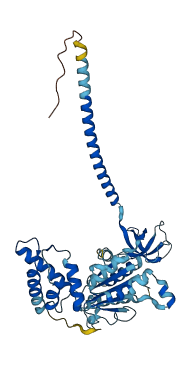
Descriptions
The autoinhibited protein was predicted that may have potential autoinhibitory elements via cis-regPred.
Autoinhibitory domains (AIDs)
Target domain |
|
Relief mechanism |
|
Assay |
cis-regPred |
Accessory elements
No accessory elements
Autoinhibited structure

Activated structure
1 structures for O17071
| Entry ID | Method | Resolution | Chain | Position | Source |
|---|---|---|---|---|---|
| AF-O17071-F1 | Predicted | AlphaFoldDB |
No variants for O17071
| Variant ID(s) | Position | Change | Description | Diseaes Association | Provenance |
|---|---|---|---|---|---|
| No variants for O17071 | |||||
No associated diseases with O17071
5 regional properties for O17071
| Type | Name | Position | InterPro Accession |
|---|---|---|---|
| domain | AAA+ ATPase domain | 183 - 322 | IPR003593 |
| domain | ATPase, AAA-type, core | 188 - 319 | IPR003959 |
| conserved_site | ATPase, AAA-type, conserved site | 290 - 308 | IPR003960 |
| domain | Proteasomal ATPase OB C-terminal domain | 74 - 129 | IPR032501 |
| domain | AAA ATPase, AAA+ lid domain | 343 - 385 | IPR041569 |
3 GO annotations of cellular component
| Name | Definition |
|---|---|
| cytosolic proteasome complex | A proteasome complex found in the cytosol of a cell. |
| nucleus | A membrane-bounded organelle of eukaryotic cells in which chromosomes are housed and replicated. In most cells, the nucleus contains all of the cell's chromosomes except the organellar chromosomes, and is the site of RNA synthesis and processing. In some species, or in specialized cell types, RNA metabolism or DNA replication may be absent. |
| proteasome regulatory particle, base subcomplex | The subcomplex of the proteasome regulatory particle that directly associates with the proteasome core complex. |
4 GO annotations of molecular function
| Name | Definition |
|---|---|
| ATP binding | Binding to ATP, adenosine 5'-triphosphate, a universally important coenzyme and enzyme regulator. |
| ATP hydrolysis activity | Catalysis of the reaction: ATP + H2O = ADP + H+ phosphate. ATP hydrolysis is used in some reactions as an energy source, for example to catalyze a reaction or drive transport against a concentration gradient. |
| identical protein binding | Binding to an identical protein or proteins. |
| proteasome-activating activity | Catalysis of the reaction: ATP + H2O = ADP + phosphate, which promotes unfolding of protein substrates, and channel opening of the core proteasome. |
4 GO annotations of biological process
| Name | Definition |
|---|---|
| positive regulation of RNA polymerase II transcription preinitiation complex assembly | Any process that activates or increases the frequency, rate or extent of RNA polymerase II transcriptional preinitiation complex assembly. |
| proteasome-mediated ubiquitin-dependent protein catabolic process | The chemical reactions and pathways resulting in the breakdown of a protein or peptide by hydrolysis of its peptide bonds, initiated by the covalent attachment of ubiquitin, and mediated by the proteasome. |
| regulation of protein stability | Any process that affects the structure and integrity of a protein, altering the likelihood of its degradation or aggregation. |
| ubiquitin-dependent ERAD pathway | The series of steps necessary to target endoplasmic reticulum (ER)-resident proteins for degradation by the cytoplasmic proteasome. Begins with recognition of the ER-resident protein, includes retrotranslocation (dislocation) of the protein from the ER to the cytosol, protein ubiquitination necessary for correct substrate transfer, transport of the protein to the proteasome, and ends with degradation of the protein by the cytoplasmic proteasome. |
1 homologous proteins in AiPD
| UniProt AC | Gene Name | Protein Name | Species | Evidence Code |
|---|---|---|---|---|
| P62333 | PSMC6 | 26S proteasome regulatory subunit 10B | Homo sapiens (Human) | PR |
| 10 | 20 | 30 | 40 | 50 | 60 |
| MLLLQFSNMV | EPTGPAIVED | ERTKALNSYR | RKLAECRDIE | QKLKDLRKKE | SEMTKQFDKS |
| 70 | 80 | 90 | 100 | 110 | 120 |
| ENDIKSLQSV | GQIVGEVLKQ | LSEEKFIVKA | TNGPRYVVGC | RRSINKEELK | QGTRVSLDMT |
| 130 | 140 | 150 | 160 | 170 | 180 |
| TLTIMRQLPR | EVDPLVYKMS | HEDPGNISYS | DVGGLAEQIR | ELREVVELPL | INPELFKRVG |
| 190 | 200 | 210 | 220 | 230 | 240 |
| ITPPKGCLLF | GPPGTGKTLL | ARAVASQLDC | NFLKVVSSAI | VDKYIGESAR | MIREMFNYAR |
| 250 | 260 | 270 | 280 | 290 | 300 |
| DHQPCIVFMD | EIDAIGGRRF | SEGTSADREI | QRTLMELLNQ | LDGFDSLGKV | KVIMATNRPD |
| 310 | 320 | 330 | 340 | 350 | 360 |
| TLDPALLRPG | RLDRKIEIGL | PNEQSRLEIL | KIHSNKITKH | GEIDFEAVVK | LSDGFSAADL |
| 370 | 380 | 390 | 400 | ||
| RNVCTEAGMF | AIRAEREFVI | DEDFMKAVRK | VGDAKRLETK | LDYKPV |