O08609
Gene name |
Mlx (Tcfl4) |
Protein name |
Max-like protein X |
Names |
Max-like bHLHZip protein, Protein BigMax, Transcription factor-like protein 4 |
Species |
Mus musculus (Mouse) |
KEGG Pathway |
mmu:21428 |
EC number |
|
Protein Class |
|
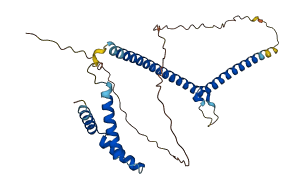
Descriptions
The autoinhibited protein was predicted that may have potential autoinhibitory elements via cis-regPred.
Autoinhibitory domains (AIDs)
Target domain |
|
Relief mechanism |
|
Assay |
cis-regPred |
Accessory elements
No accessory elements
Autoinhibited structure

Activated structure
1 structures for O08609
| Entry ID | Method | Resolution | Chain | Position | Source |
|---|---|---|---|---|---|
| AF-O08609-F1 | Predicted | AlphaFoldDB |
No variants for O08609
| Variant ID(s) | Position | Change | Description | Diseaes Association | Provenance |
|---|---|---|---|---|---|
| No variants for O08609 | |||||
No associated diseases with O08609
1 regional properties for O08609
| Type | Name | Position | InterPro Accession |
|---|---|---|---|
| domain | Myc-type, basic helix-loop-helix (bHLH) domain | 129 - 193 | IPR011598 |
5 GO annotations of cellular component
| Name | Definition |
|---|---|
| cytoplasm | The contents of a cell excluding the plasma membrane and nucleus, but including other subcellular structures. |
| cytosol | The part of the cytoplasm that does not contain organelles but which does contain other particulate matter, such as protein complexes. |
| nuclear membrane | Either of the lipid bilayers that surround the nucleus and form the nuclear envelope; excludes the intermembrane space. |
| nucleoplasm | That part of the nuclear content other than the chromosomes or the nucleolus. |
| nucleus | A membrane-bounded organelle of eukaryotic cells in which chromosomes are housed and replicated. In most cells, the nucleus contains all of the cell's chromosomes except the organellar chromosomes, and is the site of RNA synthesis and processing. In some species, or in specialized cell types, RNA metabolism or DNA replication may be absent. |
9 GO annotations of molecular function
| Name | Definition |
|---|---|
| DNA binding | Any molecular function by which a gene product interacts selectively and non-covalently with DNA (deoxyribonucleic acid). |
| DNA-binding transcription factor activity, RNA polymerase II-specific | A DNA-binding transcription factor activity that modulates the transcription of specific gene sets transcribed by RNA polymerase II. |
| DNA-binding transcription repressor activity, RNA polymerase II-specific | A DNA-binding transcription factor activity that represses or decreases the transcription of specific gene sets transcribed by RNA polymerase II. |
| protein heterodimerization activity | Binding to a nonidentical protein to form a heterodimer. |
| protein homodimerization activity | Binding to an identical protein to form a homodimer. |
| RNA polymerase II cis-regulatory region sequence-specific DNA binding | Binding to a specific upstream regulatory DNA sequence (transcription factor recognition sequence or binding site) located in cis relative to the transcription start site (i.e., on the same strand of DNA) of a gene transcribed by RNA polymerase II. |
| RNA polymerase II transcription regulatory region sequence-specific DNA binding | Binding to a specific sequence of DNA that is part of a regulatory region that controls the transcription of a gene or cistron by RNA polymerase II. |
| RNA polymerase II-specific DNA-binding transcription factor binding | Binding to a sequence-specific DNA binding RNA polymerase II transcription factor, any of the factors that interact selectively and non-covalently with a specific DNA sequence in order to modulate transcription. |
| sequence-specific double-stranded DNA binding | Binding to double-stranded DNA of a specific nucleotide composition, e.g. GC-rich DNA binding, or with a specific sequence motif or type of DNA, e.g. promotor binding or rDNA binding. |
5 GO annotations of biological process
| Name | Definition |
|---|---|
| negative regulation of DNA-templated transcription | Any process that stops, prevents, or reduces the frequency, rate or extent of cellular DNA-templated transcription. |
| negative regulation of transcription by RNA polymerase II | Any process that stops, prevents, or reduces the frequency, rate or extent of transcription mediated by RNA polymerase II. |
| nucleocytoplasmic transport | The directed movement of molecules between the nucleus and the cytoplasm. |
| positive regulation of transcription by RNA polymerase II | Any process that activates or increases the frequency, rate or extent of transcription from an RNA polymerase II promoter. |
| regulation of transcription by RNA polymerase II | Any process that modulates the frequency, rate or extent of transcription mediated by RNA polymerase II. |
1 homologous proteins in AiPD
| UniProt AC | Gene Name | Protein Name | Species | Evidence Code |
|---|---|---|---|---|
| Q9UH92 | MLX | Max-like protein X | Homo sapiens (Human) | PR |
| 10 | 20 | 30 | 40 | 50 | 60 |
| MTEPGASPED | PWVKASFADA | HAGEGRAGRA | RARRGSGRRG | APQLSPESPL | LSGARGCRED |
| 70 | 80 | 90 | 100 | 110 | 120 |
| SSHPACAKVE | YAYSDNSLDP | GLFVESTHKG | SVVSRANSIG | STSASSVPNT | DDEDSDYQQE |
| 130 | 140 | 150 | 160 | 170 | 180 |
| AYKESYKDRR | RRAHTQAEQK | RRDAIKRGYD | DLQTIVPTCQ | QQDFSIGSQK | LSKAIVLQKT |
| 190 | 200 | 210 | 220 | 230 | 240 |
| IDYIQFLHKE | KKKQEEEVST | LRKDVTALKI | MKVNYEQIVK | AHQDNPHEGE | DQVSDQVKFN |
| 250 | 260 | 270 | 280 | 290 | |
| VFQGIMDSLF | QSFNASISVA | SFQELSACVF | SWIEEHCEPQ | TLREIVIGVL | HQLKNQLY |