G3X9C2
Gene name |
Nccrp1 (Fbxo50) |
Protein name |
F-box only protein 50 |
Names |
NCC receptor protein 1, NCCRP-1, Non-specific cytotoxic cell receptor protein 1 homolog |
Species |
Mus musculus (Mouse) |
KEGG Pathway |
mmu:233038 |
EC number |
|
Protein Class |
|
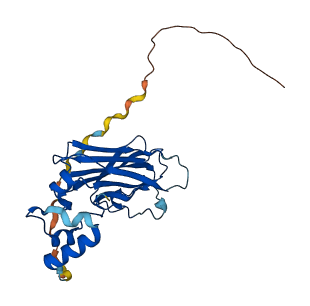
Descriptions
The autoinhibited protein was predicted that may have potential autoinhibitory elements via cis-regPred.
Autoinhibitory domains (AIDs)
Target domain |
|
Relief mechanism |
|
Assay |
cis-regPred |
Accessory elements
No accessory elements
Autoinhibited structure

Activated structure
1 structures for G3X9C2
| Entry ID | Method | Resolution | Chain | Position | Source |
|---|---|---|---|---|---|
| AF-G3X9C2-F1 | Predicted | AlphaFoldDB |
21 variants for G3X9C2
| Variant ID(s) | Position | Change | Description | Diseaes Association | Provenance |
|---|---|---|---|---|---|
| rs248488400 | 9 | T>A | No | EVA | |
| rs3388873830 | 22 | S>L | No | EVA | |
| rs3388885634 | 30 | Q>H | No | EVA | |
| rs3388887638 | 37 | S>Y | No | EVA | |
| rs3388893022 | 78 | P>L | No | EVA | |
| rs3388867424 | 79 | P>Q | No | EVA | |
| rs246634168 | 113 | P>H | No | EVA | |
| rs246634168 | 113 | P>R | No | EVA | |
| rs3388867483 | 115 | G>D | No | EVA | |
| rs3388885678 | 191 | L>M | No | EVA | |
| rs3388890450 | 193 | A>T | No | EVA | |
| rs3388898918 | 196 | R>H | No | EVA | |
| rs3413155304 | 198 | T>M | No | EVA | |
| rs3388867434 | 222 | S>P | No | EVA | |
| rs222446508 | 236 | Y>H | No | EVA | |
| rs3388885636 | 238 | Q>E | No | EVA | |
| rs3388885686 | 249 | G>E | No | EVA | |
| rs3388896358 | 249 | G>V | No | EVA | |
| rs3388896760 | 250 | L>V | No | EVA | |
| rs3388873890 | 251 | R>W | No | EVA | |
| rs3388867479 | 253 | T>A | No | EVA |
No associated diseases with G3X9C2
1 regional properties for G3X9C2
| Type | Name | Position | InterPro Accession |
|---|---|---|---|
| domain | F-box associated (FBA) domain | 83 - 264 | IPR007397 |
2 GO annotations of cellular component
| Name | Definition |
|---|---|
| cytoplasm | The contents of a cell excluding the plasma membrane and nucleus, but including other subcellular structures. |
| SCF ubiquitin ligase complex | A ubiquitin ligase complex in which a cullin from the Cul1 subfamily and a RING domain protein form the catalytic core; substrate specificity is conferred by a Skp1 adaptor and an F-box protein. SCF complexes are involved in targeting proteins for degradation by the proteasome. The best characterized complexes are those from yeast and mammals (with core subunits named Cdc53/Cul1, Rbx1/Hrt1/Roc1). |
No GO annotations of molecular function
| Name | Definition |
|---|---|
| No GO annotations for molecular function |
5 GO annotations of biological process
| Name | Definition |
|---|---|
| glycoprotein catabolic process | The chemical reactions and pathways resulting in the breakdown of a glycoprotein, a protein that contains covalently bound glycose (i.e. monosaccharide) residues; the glycose occurs most commonly as oligosaccharide or fairly small polysaccharide but occasionally as monosaccharide. |
| positive regulation of cell population proliferation | Any process that activates or increases the rate or extent of cell proliferation. |
| protein ubiquitination | The process in which one or more ubiquitin groups are added to a protein. |
| SCF-dependent proteasomal ubiquitin-dependent protein catabolic process | The chemical reactions and pathways resulting in the breakdown of a protein or peptide by hydrolysis of its peptide bonds, initiated by the covalent attachment of ubiquitin, with ubiquitin-protein ligation catalyzed by an SCF (Skp1/Cul1/F-box protein) complex, and mediated by the proteasome. |
| ubiquitin-dependent ERAD pathway | The series of steps necessary to target endoplasmic reticulum (ER)-resident proteins for degradation by the cytoplasmic proteasome. Begins with recognition of the ER-resident protein, includes retrotranslocation (dislocation) of the protein from the ER to the cytosol, protein ubiquitination necessary for correct substrate transfer, transport of the protein to the proteasome, and ends with degradation of the protein by the cytoplasmic proteasome. |
| 10 | 20 | 30 | 40 | 50 | 60 |
| MEKTQDRDTL | SGRMEAEGSL | NSEELPPHPQ | SPPPPPSPRS | PTSPVTPELP | QPNAPTEVEA |
| 70 | 80 | 90 | 100 | 110 | 120 |
| RQLLVEEWGP | LSGKLELPPR | ISWQLLFLER | PLYRNLLSSP | NPEGINIYQP | APPTGPTRKP |
| 130 | 140 | 150 | 160 | 170 | 180 |
| LKELGNFRGW | YITTQNLQGP | LSWTVKEQCV | NLLAKKLWEE | LLDDEQPDIT | IMDWFEDSRL |
| 190 | 200 | 210 | 220 | 230 | 240 |
| DQCVYELHVW | LLAADRRTVI | AQHHVAPRTN | GRGPPGRWIQ | VSHVFRQYGP | GVRFVYFQHK |
| 250 | 260 | ||||
| AKNRMEPGGL | RRTRVTDSSV | SVQLRE |