F7BWT7
Gene name |
Tspan15 |
Protein name |
Tetraspanin-15 |
Names |
Tspan-15, Transmembrane 4 superfamily member 15 |
Species |
Mus musculus (Mouse) |
KEGG Pathway |
mmu:70423 |
EC number |
|
Protein Class |
|
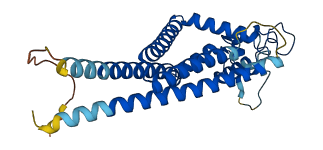
Descriptions
The autoinhibited protein was predicted that may have potential autoinhibitory elements via cis-regPred.
Autoinhibitory domains (AIDs)
Target domain |
|
Relief mechanism |
|
Assay |
cis-regPred |
Accessory elements
No accessory elements
Autoinhibited structure

Activated structure
1 structures for F7BWT7
| Entry ID | Method | Resolution | Chain | Position | Source |
|---|---|---|---|---|---|
| AF-F7BWT7-F1 | Predicted | AlphaFoldDB |
19 variants for F7BWT7
| Variant ID(s) | Position | Change | Description | Diseaes Association | Provenance |
|---|---|---|---|---|---|
| rs3400605627 | 17 | Y>C | No | EVA | |
| rs3401118219 | 52 | Y>C | No | EVA | |
| rs3401233313 | 54 | T>A | No | EVA | |
| rs3389112600 | 88 | N>D | No | EVA | |
| rs3389069864 | 95 | F>S | No | EVA | |
| rs3389113242 | 97 | Y>* | No | EVA | |
| rs3389102375 | 97 | Y>G* | No | EVA | |
| rs3389076147 | 116 | F>S | No | EVA | |
| rs3389076087 | 133 | E>* | No | EVA | |
| rs3389102384 | 180 | G>R | No | EVA | |
| rs3389104442 | 189 | N>K | No | EVA | |
| rs253096310 | 236 | G>A | No | EVA | |
| rs3389104389 | 241 | I>F | No | EVA | |
| rs3389098815 | 259 | V>M | No | EVA | |
| rs50077290 | 280 | R>S | No | EVA | |
| rs228142559 | 283 | T>S | No | EVA | |
| rs259600066 | 284 | A>V | No | EVA | |
| rs3389104401 | 290 | L>P | No | EVA | |
| rs3389113187 | 294 | D>V | No | EVA |
No associated diseases with F7BWT7
No regional properties for F7BWT7
| Type | Name | Position | InterPro Accession |
|---|---|---|---|
| No domain, repeats, and functional sites for F7BWT7 | |||
9 GO annotations of cellular component
| Name | Definition |
|---|---|
| cell junction | A cellular component that forms a specialized region of connection between two or more cells, or between a cell and the extracellular matrix, or between two membrane-bound components of a cell, such as flagella. |
| cell surface | The external part of the cell wall and/or plasma membrane. |
| cytosol | The part of the cytoplasm that does not contain organelles but which does contain other particulate matter, such as protein complexes. |
| integral component of plasma membrane | The component of the plasma membrane consisting of the gene products and protein complexes having at least some part of their peptide sequence embedded in the hydrophobic region of the membrane. |
| intracellular membrane-bounded organelle | Organized structure of distinctive morphology and function, bounded by a single or double lipid bilayer membrane and occurring within the cell. Includes the nucleus, mitochondria, plastids, vacuoles, and vesicles. Excludes the plasma membrane. |
| late endosome membrane | The lipid bilayer surrounding a late endosome. |
| nuclear body | Extra-nucleolar nuclear domains usually visualized by confocal microscopy and fluorescent antibodies to specific proteins. |
| plasma membrane | The membrane surrounding a cell that separates the cell from its external environment. It consists of a phospholipid bilayer and associated proteins. |
| tetraspanin-enriched microdomain | A pre-organized unit composed either of adhesion molecules (mainly integrins and members of the Ig superfamily), signaling receptors and/or enzyme-enriched plasma membrane domains that compartmentalizes cellular processes. Tetraspanin-enriched microdomains might be specially suited for the regulation of avidity of adhesion receptors and the compartmentalization of enzymatic activities. |
1 GO annotations of molecular function
| Name | Definition |
|---|---|
| enzyme binding | Binding to an enzyme, a protein with catalytic activity. |
3 GO annotations of biological process
| Name | Definition |
|---|---|
| negative regulation of Notch signaling pathway | Any process that stops, prevents, or reduces the frequency, rate or extent of the Notch signaling pathway. |
| protein localization to plasma membrane | A process in which a protein is transported to, or maintained in, a specific location in the plasma membrane. |
| protein maturation | Any process leading to the attainment of the full functional capacity of a protein. |
1 homologous proteins in AiPD
| UniProt AC | Gene Name | Protein Name | Species | Evidence Code |
|---|---|---|---|---|
| O42281 | PRPH2 | Peripherin-2 | Gallus gallus (Chicken) | PR |
| 10 | 20 | 30 | 40 | 50 | 60 |
| MPRGDSEQVR | YCARFSYLWL | KFSLIIYSTV | FWLIGGLVLS | VGIYAEAERQ | KYKTLESAFL |
| 70 | 80 | 90 | 100 | 110 | 120 |
| APAIILILLG | VVMFIVSFIG | VLASLRDNLC | LLQSFMYILG | ICLVMELIGG | IVALIFRNQT |
| 130 | 140 | 150 | 160 | 170 | 180 |
| IDFLNDNIRR | GIENYYDDLD | FKNIMDFVQK | KFKCCGGEDY | RDWSKNQYHD | CSAPGPLACG |
| 190 | 200 | 210 | 220 | 230 | 240 |
| VPYTCCIRNT | TDVVNTMCGY | KTIDKERLNA | QNIIHVRGCT | NAVLIWFMDN | YTIMAGLLLG |
| 250 | 260 | 270 | 280 | 290 | |
| ILLPQFLGVL | LTLLYITRVE | DIILEHSVTD | GLLGPGAKSR | TDTAGTGCCL | CYPD |