A2BD05
Gene name |
NEK6 |
Protein name |
Serine/threonine-protein kinase Nek6 |
Names |
Never in mitosis A-related kinase 6, NimA-related protein kinase 6 |
Species |
Mus musculus (Mouse) |
KEGG Pathway |
ssc:100514624 |
EC number |
2.7.11.1: Protein-serine/threonine kinases |
Protein Class |
|
Descriptions
Autoinhibitory domains (AIDs)
Target domain |
31-41 (N-terminal extension of kinase domain) |
Relief mechanism |
Partner binding |
Assay |
|
Accessory elements
189-212 (Activation loop from InterPro)
Target domain |
45-310 (Protein kinase domain) |
Relief mechanism |
|
Assay |
|
Autoinhibited structure

Activated structure
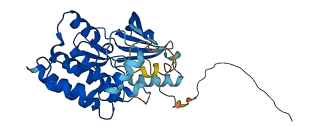
1 structures for A2BD05
| Entry ID | Method | Resolution | Chain | Position | Source |
|---|---|---|---|---|---|
| AF-A2BD05-F1 | Predicted | AlphaFoldDB |
2 variants for A2BD05
| Variant ID(s) | Position | Change | Description | Diseaes Association | Provenance |
|---|---|---|---|---|---|
| rs709730499 | 90 | C>F | No | Ensembl | |
| rs699445173 | 301 | Q>H | No | Ensembl |
No associated diseases with A2BD05
6 regional properties for A2BD05
| Type | Name | Position | InterPro Accession |
|---|---|---|---|
| domain | Protein kinase domain | 56 - 307 | IPR000719 |
| domain | Kinase associated domain 1 (KA1) | 704 - 753 | IPR001772 |
| active_site | Serine/threonine-protein kinase, active site | 174 - 186 | IPR008271 |
| domain | Ubiquitin-associated domain | 326 - 365 | IPR015940 |
| binding_site | Protein kinase, ATP binding site | 62 - 85 | IPR017441 |
| domain | Serine/threonine-protein kinase MARK 1-4, catalytic domain | 55 - 307 | IPR049508 |
Functions
| Description | ||
|---|---|---|
| EC Number | 2.7.11.1 | Protein-serine/threonine kinases |
| Subcellular Localization |
|
|
| PANTHER Family | ||
| PANTHER Subfamily | ||
| PANTHER Protein Class | ||
| PANTHER Pathway Category | No pathway information available | |
4 GO annotations of cellular component
| Name | Definition |
|---|---|
| cytoplasm | The contents of a cell excluding the plasma membrane and nucleus, but including other subcellular structures. |
| microtubule organizing center | An intracellular structure that can catalyze gamma-tubulin-dependent microtubule nucleation and that can anchor microtubules by interacting with their minus ends, plus ends or sides. |
| nuclear speck | A discrete extra-nucleolar subnuclear domain, 20-50 in number, in which splicing factors are seen to be localized by immunofluorescence microscopy. |
| spindle pole | Either of the ends of a spindle, where spindle microtubules are organized; usually contains a microtubule organizing center and accessory molecules, spindle microtubules and astral microtubules. |
6 GO annotations of molecular function
| Name | Definition |
|---|---|
| ATP binding | Binding to ATP, adenosine 5'-triphosphate, a universally important coenzyme and enzyme regulator. |
| metal ion binding | Binding to a metal ion. |
| protein kinase binding | Binding to a protein kinase, any enzyme that catalyzes the transfer of a phosphate group, usually from ATP, to a protein substrate. |
| protein serine kinase activity | Catalysis of the reactions: ATP + protein serine = ADP + protein serine phosphate. |
| protein serine/threonine kinase activity | Catalysis of the reactions: ATP + protein serine = ADP + protein serine phosphate, and ATP + protein threonine = ADP + protein threonine phosphate. |
| protein serine/threonine/tyrosine kinase activity | Catalysis of the reactions: ATP + a protein serine = ADP + protein serine phosphate; ATP + a protein threonine = ADP + protein threonine phosphate; and ATP + a protein tyrosine = ADP + protein tyrosine phosphate. |
6 GO annotations of biological process
| Name | Definition |
|---|---|
| apoptotic process | A programmed cell death process which begins when a cell receives an internal (e.g. DNA damage) or external signal (e.g. an extracellular death ligand), and proceeds through a series of biochemical events (signaling pathway phase) which trigger an execution phase. The execution phase is the last step of an apoptotic process, and is typically characterized by rounding-up of the cell, retraction of pseudopodes, reduction of cellular volume (pyknosis), chromatin condensation, nuclear fragmentation (karyorrhexis), plasma membrane blebbing and fragmentation of the cell into apoptotic bodies. When the execution phase is completed, the cell has died. |
| cell cycle | The progression of biochemical and morphological phases and events that occur in a cell during successive cell replication or nuclear replication events. Canonically, the cell cycle comprises the replication and segregation of genetic material followed by the division of the cell, but in endocycles or syncytial cells nuclear replication or nuclear division may not be followed by cell division. |
| cell division | The process resulting in division and partitioning of components of a cell to form more cells; may or may not be accompanied by the physical separation of a cell into distinct, individually membrane-bounded daughter cells. |
| chromosome segregation | The process in which genetic material, in the form of chromosomes, is organized into specific structures and then physically separated and apportioned to two or more sets. In eukaryotes, chromosome segregation begins with the condensation of chromosomes, includes chromosome separation, and ends when chromosomes have completed movement to the spindle poles. |
| protein autophosphorylation | The phosphorylation by a protein of one or more of its own amino acid residues (cis-autophosphorylation), or residues on an identical protein (trans-autophosphorylation). |
| protein phosphorylation | The process of introducing a phosphate group on to a protein. |
7 homologous proteins in AiPD
| UniProt AC | Gene Name | Protein Name | Species | Evidence Code |
|---|---|---|---|---|
| Q8TDX7 | NEK7 | Serine/threonine-protein kinase Nek7 | Homo sapiens (Human) | EV |
| Q9HC98 | NEK6 | Serine/threonine-protein kinase Nek6 | Homo sapiens (Human) | EV |
| Q9ES74 | Nek7 | Serine/threonine-protein kinase Nek7 | Mus musculus (Mouse) | SS |
| Q9ES70 | Nek6 | Serine/threonine-protein kinase Nek6 | Mus musculus (Mouse) | SS |
| D3ZBE5 | Nek7 | Serine/threonine-protein kinase Nek7 | Rattus norvegicus (Rat) | SS |
| P59895 | Nek6 | Serine/threonine-protein kinase Nek6 | Rattus norvegicus (Rat) | SS |
| G5EFM9 | nekl-3 | Serine/threonine-protein kinase nekl-3 | Caenorhabditis elegans | PR |
| 10 | 20 | 30 | 40 | 50 | 60 |
| MSTRTPLPTV | NERDTENHIS | HGDGRQEVTS | RTGRSGARCR | NSIASCADEQ | PHIGNYRLLK |
| 70 | 80 | 90 | 100 | 110 | 120 |
| TIGKGNFAKV | KLARHILTGR | EVAIKIIDKT | QLNPTSLQKL | FREVRIMKIL | NHPNIVKLFE |
| 130 | 140 | 150 | 160 | 170 | 180 |
| VIETEKTLYL | IMEYASGGEV | FDYLVAHGRM | KEKEARAKFR | QIVSAVQYCH | QKRIVHRDLK |
| 190 | 200 | 210 | 220 | 230 | 240 |
| AENLLLDADM | NIKIADFGFS | NEFTVGSKLD | TFCGSPPYAA | PELFQGKKYD | GPEVDVWSLG |
| 250 | 260 | 270 | 280 | 290 | 300 |
| VILYTLVSGS | LPFDGQNLKE | LRERVLRGKY | RIPFYMSTDC | ENLLKRFLVL | NPVKRGTLEQ |
| 310 | 320 | 330 | 340 | 350 | 360 |
| IMKDRWINAG | HEEDELKPFV | EPELDISDQK | RIDIMVGMGY | SQEEIQESLS | KMKYDEITAT |
| 370 | 380 | 390 | 400 | 410 | 420 |
| YLLLGRKSAE | LDASDSSSSS | NLSLAKVRPN | SDLSNSTGQS | PHHKGQRSVS | SSQKQRRYSD |
| 430 | 440 | 450 | 460 | 470 | 480 |
| HAGPAIPSVV | AYPKRSQTST | ADSDLKEDGI | PSRKSSSSAV | GGKGIAPASP | MLGNAGNPNK |
| 490 | 500 | 510 | 520 | 530 | 540 |
| ADIPERKKSP | AVPSSNTASG | GMTRRNTYVC | SERCAADRHS | VIQNGKENSA | IPDERTPVAS |
| 550 | 560 | 570 | 580 | 590 | 600 |
| THSISSATTP | DRIRFPRGTA | SRSTFHGQPR | ERRTATYNGP | PASPSLSHEA | TPLSQTRSRG |
| 610 | 620 | 630 | 640 | 650 | 660 |
| STNLFSKLTS | KLTRRNMSFR | FIKRLPTEYE | RNGRYEGSSR | NVSSEQKDEN | REAKPRSLRF |
| 670 | 680 | 690 | 700 | 710 | 720 |
| TWSMKTTSSM | DPSDMMREIR | KVLDANNCDY | EQRERFLLFC | VHGDGHAENL | VQWEMEVCKL |
| 730 | 740 | 750 | |||
| PRLSLNGVRF | KRISGTSIAF | KNIASKIANE | LKL |