A2A9F4
Gene name |
Kdf1 |
Protein name |
Keratinocyte differentiation factor 1 |
Names |
|
Species |
Mus musculus (Mouse) |
KEGG Pathway |
mmu:69073 |
EC number |
|
Protein Class |
|
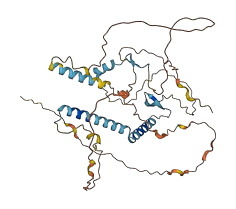
Descriptions
The autoinhibited protein was predicted that may have potential autoinhibitory elements via cis-regPred.
Autoinhibitory domains (AIDs)
Target domain |
|
Relief mechanism |
|
Assay |
cis-regPred |
Accessory elements
No accessory elements
Autoinhibited structure

Activated structure
1 structures for A2A9F4
| Entry ID | Method | Resolution | Chain | Position | Source |
|---|---|---|---|---|---|
| AF-A2A9F4-F1 | Predicted | AlphaFoldDB |
18 variants for A2A9F4
| Variant ID(s) | Position | Change | Description | Diseaes Association | Provenance |
|---|---|---|---|---|---|
| rs228460121 | 37 | P>L | No | EVA | |
| rs27575517 | 44 | R>K | No | EVA | |
| rs3388720558 | 81 | W>* | No | EVA | |
| rs3388722424 | 95 | C>Y | No | EVA | |
| rs3394899252 | 97 | D>E | No | EVA | |
| rs3395015871 | 97 | D>H | No | EVA | |
| rs3388696016 | 98 | C>R | No | EVA | |
| rs3394876021 | 98 | C>S | No | EVA | |
| rs243187704 | 115 | A>T | No | EVA | |
| rs234263484 | 140 | R>G | No | EVA | |
| rs3388722474 | 154 | S>C | No | EVA | |
| rs3388712874 | 157 | S>N | No | EVA | |
| rs3388715279 | 163 | D>H | No | EVA | |
| rs3388704514 | 242 | L>P | No | EVA | |
| rs3388719624 | 265 | D>Y | No | EVA | |
| rs3395015885 | 302 | I>F | No | EVA | |
| rs3394349249 | 305 | S>N | No | EVA | |
| rs3388712807 | 369 | A>D | No | EVA |
No associated diseases with A2A9F4
5 regional properties for A2A9F4
| Type | Name | Position | InterPro Accession |
|---|---|---|---|
| domain | BTB/POZ domain | 19 - 119 | IPR000210 |
| repeat | WD40 repeat | 277 - 313 | IPR001680-1 |
| repeat | WD40 repeat | 419 - 457 | IPR001680-2 |
| repeat | WD40 repeat | 527 - 577 | IPR001680-3 |
| domain | Potassium channel tetramerisation-type BTB domain | 21 - 106 | IPR003131 |
Functions
5 GO annotations of cellular component
| Name | Definition |
|---|---|
| anchoring junction | A cell junction that mechanically attaches a cell (and its cytoskeleton) to neighboring cells or to the extracellular matrix. |
| cell cortex | The region of a cell that lies just beneath the plasma membrane and often, but not always, contains a network of actin filaments and associated proteins. |
| cell junction | A cellular component that forms a specialized region of connection between two or more cells, or between a cell and the extracellular matrix, or between two membrane-bound components of a cell, such as flagella. |
| cell leading edge | The area of a motile cell closest to the direction of movement. |
| cytoplasm | The contents of a cell excluding the plasma membrane and nucleus, but including other subcellular structures. |
No GO annotations of molecular function
| Name | Definition |
|---|---|
| No GO annotations for molecular function |
11 GO annotations of biological process
| Name | Definition |
|---|---|
| developmental growth | The increase in size or mass of an entire organism, a part of an organism or a cell, where the increase in size or mass has the specific outcome of the progression of the organism over time from one condition to another. |
| establishment of skin barrier | Establishment of the epithelial barrier, the functional barrier in the skin that limits its permeability. |
| keratinocyte development | The process whose specific outcome is the progression of a keratinocyte over time, from its formation to the mature structure. |
| keratinocyte proliferation | The multiplication or reproduction of keratinocytes, resulting in the expansion of a cell population. Keratinocytes are epidermal cells which synthesize keratin and undergo a characteristic change as they move upward from the basal layers of the epidermis to the cornified (horny) layer of the skin. |
| limb epidermis development | The process whose specific outcome is the progression of the epidermis of the limb over time, from its formation to the mature structure. The limb epidermis is the outer epithelial layer of the limb, it is a complex stratified squamous epithelium. |
| morphogenesis of embryonic epithelium | The process in which the anatomical structures of embryonic epithelia are generated and organized. |
| negative regulation of keratinocyte proliferation | Any process that decreases the rate, frequency or extent of keratinocyte proliferation. Keratinocyte proliferation is the multiplication or reproduction of keratinocytes, resulting in the expansion of a cell population. |
| negative regulation of stem cell proliferation | Any process that stops, prevents or reduces the frequency, rate or extent of stem cell proliferation. |
| positive regulation of epidermal cell differentiation | Any process that activates or increases the frequency, rate or extent of epidermal cell differentiation. |
| regulation of epidermal cell division | Any process that modulates the frequency, rate or extent of the physical partitioning and separation of an epidermal cell into daughter cells. An epidermal cell is any of the cells that make up the epidermis. |
| stem cell proliferation | The multiplication or reproduction of stem cells, resulting in the expansion of a stem cell population. A stem cell is a cell that retains the ability to divide and proliferate throughout life to provide progenitor cells that can differentiate into specialized cells. |
| 10 | 20 | 30 | 40 | 50 | 60 |
| MPRPGQPRPS | SGPPRLGPWE | RPSELCLETN | DERSQPPPGR | RTRRPDPKDP | GHHGPESITF |
| 70 | 80 | 90 | 100 | 110 | 120 |
| ISGSAEPANE | PPTCCLLWRP | WGWDWCRAAF | CFRRCRDCLQ | RCGACVRGCS | PCLSAGDPIE |
| 130 | 140 | 150 | 160 | 170 | 180 |
| GSAEAAWAKE | HNGVPPSPDR | APPSRRDGQR | LKTSMGSSFS | YPDVKLKGIP | VYPYRHATSP |
| 190 | 200 | 210 | 220 | 230 | 240 |
| VPDVDSCCKE | PLAEPPPTRH | SLPSTFTNSP | RGSEEYYSFH | ESDLDLPEMG | SGSMSSREID |
| 250 | 260 | 270 | 280 | 290 | 300 |
| VLIFKKLTEL | FSVHQIDELA | KCTSDTVFLE | KTSKISDLIS | SITQDYHLDE | QDAEGRLVRG |
| 310 | 320 | 330 | 340 | 350 | 360 |
| IIRISTRKSR | SRPQTSEGRS | ARSTAPAAAP | DSGHETMLGS | GLSQDELTVQ | ISQETTADAI |
| 370 | 380 | 390 | |||
| ARKLRPYGAP | GYPASQDSSF | QGTDTDSSGA | PLLQVYC |