Q9Z2K0
Gene name |
Dedd (Deft) |
Protein name |
Death effector domain-containing protein |
Names |
Death effector domain-containing testicular molecule |
Species |
Rattus norvegicus (Rat) |
KEGG Pathway |
rno:83631 |
EC number |
|
Protein Class |
|
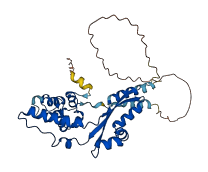
Descriptions
The autoinhibited protein was predicted that may have potential autoinhibitory elements via cis-regPred.
Autoinhibitory domains (AIDs)
Target domain |
|
Relief mechanism |
|
Assay |
cis-regPred |
Accessory elements
No accessory elements
Autoinhibited structure

Activated structure
1 structures for Q9Z2K0
| Entry ID | Method | Resolution | Chain | Position | Source |
|---|---|---|---|---|---|
| AF-Q9Z2K0-F1 | Predicted | AlphaFoldDB |
2 variants for Q9Z2K0
| Variant ID(s) | Position | Change | Description | Diseaes Association | Provenance |
|---|---|---|---|---|---|
| rs197891341 | 213 | N>T | No | EVA | |
| rs198648683 | 237 | K>E | No | EVA |
No associated diseases with Q9Z2K0
1 regional properties for Q9Z2K0
| Type | Name | Position | InterPro Accession |
|---|---|---|---|
| domain | Death effector domain | 24 - 107 | IPR001875 |
Functions
2 GO annotations of cellular component
| Name | Definition |
|---|---|
| cytoplasm | The contents of a cell excluding the plasma membrane and nucleus, but including other subcellular structures. |
| nucleolus | A small, dense body one or more of which are present in the nucleus of eukaryotic cells. It is rich in RNA and protein, is not bounded by a limiting membrane, and is not seen during mitosis. Its prime function is the transcription of the nucleolar DNA into 45S ribosomal-precursor RNA, the processing of this RNA into 5.8S, 18S, and 28S components of ribosomal RNA, and the association of these components with 5S RNA and proteins synthesized outside the nucleolus. This association results in the formation of ribonucleoprotein precursors; these pass into the cytoplasm and mature into the 40S and 60S subunits of the ribosome. |
1 GO annotations of molecular function
| Name | Definition |
|---|---|
| DNA binding | Any molecular function by which a gene product interacts selectively and non-covalently with DNA (deoxyribonucleic acid). |
7 GO annotations of biological process
| Name | Definition |
|---|---|
| apoptotic process | A programmed cell death process which begins when a cell receives an internal (e.g. DNA damage) or external signal (e.g. an extracellular death ligand), and proceeds through a series of biochemical events (signaling pathway phase) which trigger an execution phase. The execution phase is the last step of an apoptotic process, and is typically characterized by rounding-up of the cell, retraction of pseudopodes, reduction of cellular volume (pyknosis), chromatin condensation, nuclear fragmentation (karyorrhexis), plasma membrane blebbing and fragmentation of the cell into apoptotic bodies. When the execution phase is completed, the cell has died. |
| decidualization | The cellular and vascular changes occurring in the endometrium of the pregnant uterus just after the onset of blastocyst implantation. This process involves the proliferation and differentiation of the fibroblast-like endometrial stromal cells into large, polyploid decidual cells that eventually form the maternal component of the placenta. |
| extrinsic apoptotic signaling pathway via death domain receptors | The series of molecular signals in which a signal is conveyed from the cell surface to trigger the apoptotic death of a cell. The pathway starts with a ligand binding to a death domain receptor on the cell surface, and ends when the execution phase of apoptosis is triggered. |
| negative regulation of protein catabolic process | Any process that stops, prevents or reduces the frequency, rate or extent of protein catabolic process. |
| negative regulation of transcription of nucleolar large rRNA by RNA polymerase I | Any process that stops, prevents or reduces the frequency, rate or extent of transcription of nuclear large rRNA transcript mediated by RNA polymerase I. |
| regulation of apoptotic process | Any process that modulates the occurrence or rate of cell death by apoptotic process. |
| spermatogenesis | The developmental process by which male germ line stem cells self renew or give rise to successive cell types resulting in the development of a spermatozoa. |
3 homologous proteins in AiPD
| UniProt AC | Gene Name | Protein Name | Species | Evidence Code |
|---|---|---|---|---|
| Q8WXF8 | DEDD2 | DNA-binding death effector domain-containing protein 2 | Homo sapiens (Human) | PR |
| O75618 | DEDD | Death effector domain-containing protein | Homo sapiens (Human) | PR |
| Q9Z1L3 | Dedd | Death effector domain-containing protein | Mus musculus (Mouse) | PR |
| 10 | 20 | 30 | 40 | 50 | 60 |
| MAGLKRRASQ | VWPEERVEQE | HGLYSLHRMF | DIVGTHLTHR | DVRVLSFLFV | DVIDDHERGL |
| 70 | 80 | 90 | 100 | 110 | 120 |
| IRNGRDFLLA | LERQGRCDES | NFRQVLQLLR | IITRHDLLPY | VTLKKRRAVC | PDLVDKYLEE |
| 130 | 140 | 150 | 160 | 170 | 180 |
| TSIRYVTPRA | LSDPEPRPPQ | PSKTVPPHYP | VVCCPTSGSQ | MCSKRPARGR | TTLGSQRKRR |
| 190 | 200 | 210 | 220 | 230 | 240 |
| KSVTPDPKEK | QTCDIRLRVR | AEYCQHETAL | QGNVFSNKQD | PLERQFERFN | QANTILKSRD |
| 250 | 260 | 270 | 280 | 290 | 300 |
| LGSIICDIKF | SELTYLDAFW | RDYINGSLLE | ALKGVFITDS | LKQAVGHEAI | KLLVNVDEED |
| 310 | |||||
| YELGRQKLLR | NLMLQALP |