Q9Z2D7
Gene name |
Mbd4 |
Protein name |
Methyl-CpG-binding domain protein 4 |
Names |
Methyl-CpG-binding protein MBD4, Mismatch-specific DNA N-glycosylase |
Species |
Mus musculus (Mouse) |
KEGG Pathway |
mmu:17193 |
EC number |
|
Protein Class |
|
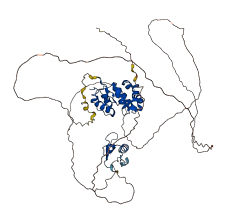
Descriptions
The autoinhibited protein was predicted that may have potential autoinhibitory elements via cis-regPred.
Autoinhibitory domains (AIDs)
Target domain |
|
Relief mechanism |
|
Assay |
cis-regPred |
Accessory elements
No accessory elements
Autoinhibited structure

Activated structure
9 structures for Q9Z2D7
| Entry ID | Method | Resolution | Chain | Position | Source |
|---|---|---|---|---|---|
| 1NGN | X-ray | 210 A | A | 400-554 | PDB |
| 3VXV | X-ray | 200 A | A | 69-136 | PDB |
| 3VXX | X-ray | 220 A | A | 69-136 | PDB |
| 3VYB | X-ray | 240 A | A | 69-136 | PDB |
| 3VYQ | X-ray | 252 A | A/D | 63-136 | PDB |
| 4EVV | X-ray | 239 A | A | 411-554 | PDB |
| 4EW0 | X-ray | 239 A | A | 411-554 | PDB |
| 4EW4 | X-ray | 279 A | A | 411-554 | PDB |
| AF-Q9Z2D7-F1 | Predicted | AlphaFoldDB |
No variants for Q9Z2D7
| Variant ID(s) | Position | Change | Description | Diseaes Association | Provenance |
|---|---|---|---|---|---|
| No variants for Q9Z2D7 | |||||
No associated diseases with Q9Z2D7
1 regional properties for Q9Z2D7
| Type | Name | Position | InterPro Accession |
|---|---|---|---|
| domain | Methyl-CpG DNA binding | 63 - 140 | IPR001739 |
4 GO annotations of cellular component
| Name | Definition |
|---|---|
| chromatin | The ordered and organized complex of DNA, protein, and sometimes RNA, that forms the chromosome. |
| cytoplasm | The contents of a cell excluding the plasma membrane and nucleus, but including other subcellular structures. |
| nuclear speck | A discrete extra-nucleolar subnuclear domain, 20-50 in number, in which splicing factors are seen to be localized by immunofluorescence microscopy. |
| nucleus | A membrane-bounded organelle of eukaryotic cells in which chromosomes are housed and replicated. In most cells, the nucleus contains all of the cell's chromosomes except the organellar chromosomes, and is the site of RNA synthesis and processing. In some species, or in specialized cell types, RNA metabolism or DNA replication may be absent. |
2 GO annotations of molecular function
| Name | Definition |
|---|---|
| DNA binding | Any molecular function by which a gene product interacts selectively and non-covalently with DNA (deoxyribonucleic acid). |
| pyrimidine-specific mismatch base pair DNA N-glycosylase activity | Catalysis of the removal of mismatched pyrimidine bases in DNA. Enzymes with this activity recognize and remove pyrimidines present in mismatches by cleaving the N-C1' glycosidic bond between the target damaged DNA base and the deoxyribose sugar. The reaction releases a free base and leaves an apyrimidinic (AP) site. |
6 GO annotations of biological process
| Name | Definition |
|---|---|
| cellular response to DNA damage stimulus | Any process that results in a change in state or activity of a cell (in terms of movement, secretion, enzyme production, gene expression, etc.) as a result of a stimulus indicating damage to its DNA from environmental insults or errors during metabolism. |
| DNA methylation | The covalent transfer of a methyl group to either N-6 of adenine or C-5 or N-4 of cytosine. |
| DNA repair | The process of restoring DNA after damage. Genomes are subject to damage by chemical and physical agents in the environment (e.g. UV and ionizing radiations, chemical mutagens, fungal and bacterial toxins, etc.) and by free radicals or alkylating agents endogenously generated in metabolism. DNA is also damaged because of errors during its replication. A variety of different DNA repair pathways have been reported that include direct reversal, base excision repair, nucleotide excision repair, photoreactivation, bypass, double-strand break repair pathway, and mismatch repair pathway. |
| intrinsic apoptotic signaling pathway in response to DNA damage | The series of molecular signals in which an intracellular signal is conveyed to trigger the apoptotic death of a cell. The pathway is induced by the detection of DNA damage, and ends when the execution phase of apoptosis is triggered. |
| mitotic G2 DNA damage checkpoint signaling | A mitotic cell cycle checkpoint that detects and negatively regulates progression through the G2/M transition of the cell cycle in response to DNA damage. |
| response to radiation | Any process that results in a change in state or activity of a cell or an organism (in terms of movement, secretion, enzyme production, gene expression, etc.) as a result of an electromagnetic radiation stimulus. Electromagnetic radiation is a propagating wave in space with electric and magnetic components. These components oscillate at right angles to each other and to the direction of propagation. |
1 homologous proteins in AiPD
| UniProt AC | Gene Name | Protein Name | Species | Evidence Code |
|---|---|---|---|---|
| O95983 | MBD3 | Methyl-CpG-binding domain protein 3 | Homo sapiens (Human) | PR |
| 10 | 20 | 30 | 40 | 50 | 60 |
| MESPNLGDNR | VRGESLVPDP | PWDRCKEDIA | VGLGGVGEDG | KDLVISSERS | SLLQEPTAST |
| 70 | 80 | 90 | 100 | 110 | 120 |
| LSSTTATEGH | KPVPCGWERV | VKQRLSGKTA | GKFDVYFISP | QGLKFRSKRS | LANYLLKNGE |
| 130 | 140 | 150 | 160 | 170 | 180 |
| TFLKPEDFNF | TVLPKGSINP | GYKHQSLAAL | TSLQPNETDV | SKQNLKTRSK | WKTDVLPLPS |
| 190 | 200 | 210 | 220 | 230 | 240 |
| GTSESPESSG | LSNSNSACLL | LREHRDIQDV | DSEKRRKSKR | KVTVLKGTAS | QKTKQKCRKS |
| 250 | 260 | 270 | 280 | 290 | 300 |
| LLESTQRNRK | RASVVQKVGA | DRELVPQESQ | LNRTLCPADA | CARETVGLAG | EEKSPSPGLD |
| 310 | 320 | 330 | 340 | 350 | 360 |
| LCFIQVTSGT | TNKFHSTEAA | GEANREQTFL | ESEEIRSKGD | RKGEAHLHTG | VLQDGSEMPS |
| 370 | 380 | 390 | 400 | 410 | 420 |
| CSQAKKHFTS | ETFQEDSIPR | TQVEKRKTSL | YFSSKYNKEA | LSPPRRKSFK | KWTPPRSPFN |
| 430 | 440 | 450 | 460 | 470 | 480 |
| LVQEILFHDP | WKLLIATIFL | NRTSGKMAIP | VLWEFLEKYP | SAEVARAADW | RDVSELLKPL |
| 490 | 500 | 510 | 520 | 530 | 540 |
| GLYDLRAKTI | IKFSDEYLTK | QWRYPIELHG | IGKYGNDSYR | IFCVNEWKQV | HPEDHKLNKY |
| 550 | |||||
| HDWLWENHEK | LSLS |