Q9Z286
Gene name |
Adcy10 (Sac) |
Protein name |
Adenylate cyclase type 10 |
Names |
Germ cell soluble adenylyl cyclase, sAC, Testicular soluble adenylyl cyclase |
Species |
Rattus norvegicus (Rat) |
KEGG Pathway |
rno:59320 |
EC number |
4.6.1.1: Phosphorus-oxygen lyases |
Protein Class |
|
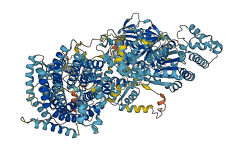
Descriptions
The autoinhibited protein was predicted that may have potential autoinhibitory elements via cis-regPred.
Autoinhibitory domains (AIDs)
Target domain |
|
Relief mechanism |
|
Assay |
cis-regPred |
Accessory elements
No accessory elements
Autoinhibited structure

Activated structure
1 structures for Q9Z286
| Entry ID | Method | Resolution | Chain | Position | Source |
|---|---|---|---|---|---|
| AF-Q9Z286-F1 | Predicted | AlphaFoldDB |
No variants for Q9Z286
| Variant ID(s) | Position | Change | Description | Diseaes Association | Provenance |
|---|---|---|---|---|---|
| No variants for Q9Z286 | |||||
No associated diseases with Q9Z286
Functions
| Description | ||
|---|---|---|
| EC Number | 4.6.1.1 | Phosphorus-oxygen lyases |
| Subcellular Localization |
|
|
| PANTHER Family | ||
| PANTHER Subfamily | ||
| PANTHER Protein Class | ||
| PANTHER Pathway Category | No pathway information available | |
16 GO annotations of cellular component
| Name | Definition |
|---|---|
| apical part of cell | The region of a polarized cell that forms a tip or is distal to a base. For example, in a polarized epithelial cell, the apical region has an exposed surface and lies opposite to the basal lamina that separates the epithelium from other tissue. |
| apical plasma membrane | The region of the plasma membrane located at the apical end of the cell. |
| axon | The long process of a neuron that conducts nerve impulses, usually away from the cell body to the terminals and varicosities, which are sites of storage and release of neurotransmitter. |
| basal part of cell | The region of a cell situated near the base. For example, in a polarized epithelial cell, the basal surface rests on the basal lamina that separates the epithelium from other tissue. |
| cytoplasm | The contents of a cell excluding the plasma membrane and nucleus, but including other subcellular structures. |
| cytosol | The part of the cytoplasm that does not contain organelles but which does contain other particulate matter, such as protein complexes. |
| dendrite | A neuron projection that has a short, tapering, morphology. Dendrites receive and integrate signals from other neurons or from sensory stimuli, and conduct nerve impulses towards the axon or the cell body. In most neurons, the impulse is conveyed from dendrites to axon via the cell body, but in some types of unipolar neuron, the impulse does not travel via the cell body. |
| extracellular region | The space external to the outermost structure of a cell. For cells without external protective or external encapsulating structures this refers to space outside of the plasma membrane. This term covers the host cell environment outside an intracellular parasite. |
| growth cone | The migrating motile tip of a growing neuron projection, where actin accumulates, and the actin cytoskeleton is the most dynamic. |
| membrane | A lipid bilayer along with all the proteins and protein complexes embedded in it an attached to it. |
| microtubule cytoskeleton | The part of the cytoskeleton (the internal framework of a cell) composed of microtubules and associated proteins. |
| mitochondrion | A semiautonomous, self replicating organelle that occurs in varying numbers, shapes, and sizes in the cytoplasm of virtually all eukaryotic cells. It is notably the site of tissue respiration. |
| motile cilium | A cilium which may have a variable arrangement of axonemal microtubules and also contains molecular motors. It may beat with a whip-like pattern that promotes cell motility or transport of fluids and other cells across a cell surface, such as on epithelial cells that line the lumenal ducts of various tissues; or they may display a distinct twirling motion that directs fluid flow asymmetrically across the cellular surface to affect asymmetric body plan organization. Motile cilia can be found in single as well as multiple copies per cell. |
| neuronal cell body | The portion of a neuron that includes the nucleus, but excludes cell projections such as axons and dendrites. |
| nucleus | A membrane-bounded organelle of eukaryotic cells in which chromosomes are housed and replicated. In most cells, the nucleus contains all of the cell's chromosomes except the organellar chromosomes, and is the site of RNA synthesis and processing. In some species, or in specialized cell types, RNA metabolism or DNA replication may be absent. |
| perinuclear region of cytoplasm | Cytoplasm situated near, or occurring around, the nucleus. |
6 GO annotations of molecular function
| Name | Definition |
|---|---|
| adenylate cyclase activity | Catalysis of the reaction: ATP = 3',5'-cyclic AMP + diphosphate. |
| ATP binding | Binding to ATP, adenosine 5'-triphosphate, a universally important coenzyme and enzyme regulator. |
| ATPase binding | Binding to an ATPase, any enzyme that catalyzes the hydrolysis of ATP. |
| bicarbonate binding | Binding to bicarbonate ions (CHO3-). |
| magnesium ion binding | Binding to a magnesium (Mg) ion. |
| manganese ion binding | Binding to a manganese ion (Mn). |
6 GO annotations of biological process
| Name | Definition |
|---|---|
| cAMP biosynthetic process | The chemical reactions and pathways resulting in the formation of the nucleotide cAMP (cyclic AMP, adenosine 3',5'-cyclophosphate). |
| cellular response to inorganic substance | Any process that results in a change in state or activity of a cell (in terms of movement, secretion, enzyme production, gene expression, etc.) as a result of an inorganic substance stimulus. |
| epithelial cilium movement involved in extracellular fluid movement | The directed, self-propelled movement of cilia of epithelial cells. Depending on the type of cell, there may be one or many cilia per cell. This movement is usually coordinated between many epithelial cells, and serves to move extracellular fluid. |
| intracellular signal transduction | The process in which a signal is passed on to downstream components within the cell, which become activated themselves to further propagate the signal and finally trigger a change in the function or state of the cell. |
| positive regulation of apoptotic process | Any process that activates or increases the frequency, rate or extent of cell death by apoptotic process. |
| spermatogenesis | The developmental process by which male germ line stem cells self renew or give rise to successive cell types resulting in the development of a spermatozoa. |
No homologous proteins in AiPD
| UniProt AC | Gene Name | Protein Name | Species | Evidence Code |
|---|---|---|---|---|
| No homologous proteins | ||||
| 10 | 20 | 30 | 40 | 50 | 60 |
| MSARRQELQD | RAIVKIAAHL | PDLIVYGDFS | PERPSVKCFD | GVLMFVDISG | FTAMTEKFST |
| 70 | 80 | 90 | 100 | 110 | 120 |
| AMYMDRGAEQ | LVEILNYYIS | AIVEKVLIFG | GDILKFAGDA | LLALWKVERK | QLKNIITVVI |
| 130 | 140 | 150 | 160 | 170 | 180 |
| KCSLEIHGLF | EAKEVEEGLD | IRVKIGLAAG | HITMLVFGDE | TRNYFLVIGQ | AVDDVRLAQN |
| 190 | 200 | 210 | 220 | 230 | 240 |
| MAQMNDVILS | PNCWQLCDRS | MIEIERIPDQ | RAVKVSFLKP | PPTFNFDEFF | AKCMAFMDYY |
| 250 | 260 | 270 | 280 | 290 | 300 |
| PSGDHKNFLR | LACMLESDPE | LELSLQKYVM | EIILKQIDDK | QLRGYLSELR | PVTIVFVNLM |
| 310 | 320 | 330 | 340 | 350 | 360 |
| FKEQDKAEVI | GSAIQAACVH | ITSVLKVFRG | QINKVFMFDK | GCSFLCVFGF | PGEKAPDEIT |
| 370 | 380 | 390 | 400 | 410 | 420 |
| HALESAVDIF | DFCSQVHKIR | TVSIGVASGI | VFCGIVGHTV | RHEYTVIGQK | VNIAARMMMY |
| 430 | 440 | 450 | 460 | 470 | 480 |
| YPGIVTCDSV | TYDGSNLPAY | FFKELPKKVM | KGVADPGPVY | QCLGLNEKVM | FGMAYLICNR |
| 490 | 500 | 510 | 520 | 530 | 540 |
| YEGYPLLGRV | REIDYFMSTM | KDFLMTNCSR | VLMYEGLPGY | GKSQVLMEIE | YLASQHENHR |
| 550 | 560 | 570 | 580 | 590 | 600 |
| AVAIALTKIS | FHQNFYTIQI | LMANVLGLDT | CKHYKERQTN | LQNRVKTLLD | DKYHCLLNDI |
| 610 | 620 | 630 | 640 | 650 | 660 |
| FHVQFPVSRE | MSRMSKIRKQ | KQLEALFMKI | LEQTVREERI | IFIIDEAQFV | DVASWAFIEK |
| 670 | 680 | 690 | 700 | 710 | 720 |
| LIRSMPIFIV | MSLCPFPETP | CAAANAIMKN | RNTTYITLGT | MQPQEIRDKV | CVDLSVSSIP |
| 730 | 740 | 750 | 760 | 770 | 780 |
| RELDSYLVEG | SCGIPYYCEE | LLKNLDHHRI | LIFQQAEAEE | KTNVTWNNLF | KYSVKPTEDM |
| 790 | 800 | 810 | 820 | 830 | 840 |
| YLYTSIAAGQ | KEACYLTSGV | RLKNLSPPAS | LKEISLVQLD | SMSLSHQMLV | RCAAIIGLTF |
| 850 | 860 | 870 | 880 | 890 | 900 |
| TTELLFEILP | CWNMKMMIKA | LATLVESNVF | DCFRSSKDLQ | LALKQNVTTF | EVHYRSLSLK |
| 910 | 920 | 930 | 940 | 950 | 960 |
| SKEGLAYSEE | EQLREMEGEV | IECRILRFCR | PIMQKTAYEL | WLKDQKKVLH | LKCARFLEES |
| 970 | 980 | 990 | 1000 | 1010 | 1020 |
| AHRCNHCRNR | DFIPYHHFIA | DIRLNTLDMD | TVKKMVKSHG | FKTEDEVIFS | KSEIPRKFKF |
| 1030 | 1040 | 1050 | 1060 | 1070 | 1080 |
| PENISITETR | EKILHFFDNV | IIKMRTSQDD | VIPLESCHCE | ELLQIVILPL | AQHFVALEEN |
| 1090 | 1100 | 1110 | 1120 | 1130 | 1140 |
| NKALYYFLEL | ASAYLILGDN | YNAYMYLGEG | ERLLKSLTNE | DSWSQTFEYA | TFYSLKGEIC |
| 1150 | 1160 | 1170 | 1180 | 1190 | 1200 |
| FNMGQMVLAK | KMLRKALKLL | NRMFPCNLLS | LTFQMHIEKN | RLSHFMNQHT | QEGSLPGKKL |
| 1210 | 1220 | 1230 | 1240 | 1250 | 1260 |
| AQLFLQSSCF | SLLWKIYSLN | FFFHYKYYGR | LAAIMQMNTS | LETQNNFQII | KAFLDFSLYR |
| 1270 | 1280 | 1290 | 1300 | 1310 | 1320 |
| HLAGYEGVWF | KYEILVMEQL | LNLPLKGEAF | EIMAYAADAL | GHIKFLTGHL | DLAIELGSRA |
| 1330 | 1340 | 1350 | 1360 | 1370 | 1380 |
| HKMWSLLRNP | NKYHMVLCRL | SKPLFLKSRY | KHLVQVLGWL | WDLSVTEEHI | FSKAFFYFVC |
| 1390 | 1400 | 1410 | 1420 | 1430 | 1440 |
| LDIMLYSGFI | YRTFEECLEF | IHHNEDNRIL | KFQSGLLLGL | YSCIAVWYAR | LQEWDNFYKF |
| 1450 | 1460 | 1470 | 1480 | 1490 | 1500 |
| SNRAKTLVTR | RTPTVLYYEG | ISRYMEGQVL | HLQKQIEEQA | ENAQDSGVEL | LKALETLVAQ |
| 1510 | 1520 | 1530 | 1540 | 1550 | 1560 |
| NTTGPVFYPR | LYHLMAYVCI | LMGDGHSCDF | FLNTALELSE | TQGNLLEKCW | LSMSKEWWYS |
| 1570 | 1580 | 1590 | 1600 | ||
| APELTGDQWL | QTVLSLPSWD | KIVSGNVTLQ | DVQKNKFLMR | VNILDNPF |