Q9Z1M9
Gene name |
Smc1a (Smc1, Smc1l1) |
Protein name |
Structural maintenance of chromosomes protein 1A |
Names |
SMC protein 1A, SMC-1A |
Species |
Rattus norvegicus (Rat) |
KEGG Pathway |
rno:63996 |
EC number |
|
Protein Class |
|
Descriptions
The autoinhibited protein was predicted that may have potential autoinhibitory elements via cis-regPred.
Autoinhibitory domains (AIDs)
Target domain |
|
Relief mechanism |
|
Assay |
cis-regPred |
Accessory elements
No accessory elements
Autoinhibited structure

Activated structure
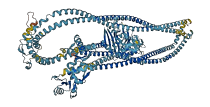
1 structures for Q9Z1M9
| Entry ID | Method | Resolution | Chain | Position | Source |
|---|---|---|---|---|---|
| AF-Q9Z1M9-F1 | Predicted | AlphaFoldDB |
No variants for Q9Z1M9
| Variant ID(s) | Position | Change | Description | Diseaes Association | Provenance |
|---|---|---|---|---|---|
| No variants for Q9Z1M9 | |||||
No associated diseases with Q9Z1M9
4 regional properties for Q9Z1M9
| Type | Name | Position | InterPro Accession |
|---|---|---|---|
| domain | RecF/RecN/SMC, N-terminal | 3 - 1208 | IPR003395 |
| domain | SMCs flexible hinge | 513 - 629 | IPR010935 |
| domain | Smc1, ATP-binding cassette domain | 4 - 148 | IPR028468-1 |
| domain | Smc1, ATP-binding cassette domain | 1117 - 1220 | IPR028468-2 |
Functions
6 GO annotations of cellular component
| Name | Definition |
|---|---|
| cohesin complex | A protein complex that is required for sister chromatid cohesion in eukaryotes. The cohesin complex forms a molecular ring complex, and is composed of structural maintenance of chromosomes (SMC) and kleisin proteins. For example, in yeast, the complex is composed of the SMC proteins Smc1p and Smc3p, and the kleisin protein Scc1p. In vertebrates, the complex is composed of the SMC1 (SMC1A or SMC1B) and SMC3 heterodimer attached via their hinge domains to a kleisin (RAD21, REC8 or RAD21L) which links them, and one STAG protein (STAG1, STAG2 or STAG3). |
| kinetochore | A multisubunit complex that is located at the centromeric region of DNA and provides an attachment point for the spindle microtubules. |
| meiotic cohesin complex | A cohesin complex that mediates sister chromatid cohesion during meiosis; has a subunit composition distinct from that of the mitotic cohesin complex. |
| mitotic spindle pole | Either of the ends of a mitotic spindle, a spindle that forms as part of mitosis, where spindle microtubules are organized; usually contains a microtubule organizing center and accessory molecules, spindle microtubules and astral microtubules. |
| nuclear matrix | The dense fibrillar network lying on the inner side of the nuclear membrane. |
| nucleus | A membrane-bounded organelle of eukaryotic cells in which chromosomes are housed and replicated. In most cells, the nucleus contains all of the cell's chromosomes except the organellar chromosomes, and is the site of RNA synthesis and processing. In some species, or in specialized cell types, RNA metabolism or DNA replication may be absent. |
6 GO annotations of molecular function
| Name | Definition |
|---|---|
| ATP binding | Binding to ATP, adenosine 5'-triphosphate, a universally important coenzyme and enzyme regulator. |
| ATP hydrolysis activity | Catalysis of the reaction: ATP + H2O = ADP + H+ phosphate. ATP hydrolysis is used in some reactions as an energy source, for example to catalyze a reaction or drive transport against a concentration gradient. |
| chromatin binding | Binding to chromatin, the network of fibers of DNA, protein, and sometimes RNA, that make up the chromosomes of the eukaryotic nucleus during interphase. |
| DNA binding | Any molecular function by which a gene product interacts selectively and non-covalently with DNA (deoxyribonucleic acid). |
| mediator complex binding | Binding to a mediator complex. The mediator complex is a protein complex that interacts with the carboxy-terminal domain of the largest subunit of RNA polymerase II and plays an active role in transducing the signal from a transcription factor to the transcriptional machinery. The Saccharomyces complex contains several identifiable subcomplexes: a head domain comprising Srb2, -4, and -5, Med6, -8, and -11, and Rox3 proteins; a middle domain comprising Med1, -4, and -7, Nut1 and -2, Cse2, Rgr1, Soh1, and Srb7 proteins; a tail consisting of Gal11p, Med2p, Pgd1p, and Sin4p; and a regulatory subcomplex comprising Ssn2, -3, and -8, and Srb8 proteins. Metazoan mediator complexes have similar modular structures and include homologs of yeast Srb and Med proteins. |
| protein heterodimerization activity | Binding to a nonidentical protein to form a heterodimer. |
10 GO annotations of biological process
| Name | Definition |
|---|---|
| cell division | The process resulting in division and partitioning of components of a cell to form more cells; may or may not be accompanied by the physical separation of a cell into distinct, individually membrane-bounded daughter cells. |
| DNA repair | The process of restoring DNA after damage. Genomes are subject to damage by chemical and physical agents in the environment (e.g. UV and ionizing radiations, chemical mutagens, fungal and bacterial toxins, etc.) and by free radicals or alkylating agents endogenously generated in metabolism. DNA is also damaged because of errors during its replication. A variety of different DNA repair pathways have been reported that include direct reversal, base excision repair, nucleotide excision repair, photoreactivation, bypass, double-strand break repair pathway, and mismatch repair pathway. |
| meiotic cell cycle | Progression through the phases of the meiotic cell cycle, in which canonically a cell replicates to produce four offspring with half the chromosomal content of the progenitor cell via two nuclear divisions. |
| mitotic sister chromatid cohesion | The cell cycle process in which the sister chromatids of a replicated chromosome are joined along the entire length of the chromosome, from their formation in S phase through metaphase during a mitotic cell cycle. This cohesion cycle is critical for high fidelity chromosome transmission. |
| mitotic spindle assembly | Mitotic bipolar spindle assembly begins with spindle microtubule nucleation from the separated spindle pole body, includes spindle elongation during prometaphase, and is complete when all kinetochores are stably attached the spindle, and the spindle assembly checkpoint is satisfied. |
| response to DNA damage checkpoint signaling | A process that occurs in response to signals generated as a result of DNA damage checkpoint signaling. |
| response to radiation | Any process that results in a change in state or activity of a cell or an organism (in terms of movement, secretion, enzyme production, gene expression, etc.) as a result of an electromagnetic radiation stimulus. Electromagnetic radiation is a propagating wave in space with electric and magnetic components. These components oscillate at right angles to each other and to the direction of propagation. |
| sister chromatid cohesion | The cell cycle process in which the sister chromatids of a replicated chromosome become tethered to each other. |
| somatic stem cell population maintenance | Any process by which an organism retains a population of somatic stem cells, undifferentiated cells in the embryo or adult which can undergo unlimited division and give rise to cell types of the body other than those of the germ-line. |
| stem cell population maintenance | The process by which an organism or tissue maintains a population of stem cells of a single type. This can be achieved by a number of mechanisms: stem cell asymmetric division maintains stem cell numbers; stem cell symmetric division increases them; maintenance of a stem cell niche maintains the conditions for commitment to the stem cell fate for some types of stem cell; stem cells may arise de novo from other cell types. |
4 homologous proteins in AiPD
| UniProt AC | Gene Name | Protein Name | Species | Evidence Code |
|---|---|---|---|---|
| P32908 | SMC1 | Structural maintenance of chromosomes protein 1 | Saccharomyces cerevisiae (strain ATCC 204508 / S288c) (Baker's yeast) | PR |
| Q8NDV3 | SMC1B | Structural maintenance of chromosomes protein 1B | Homo sapiens (Human) | PR |
| Q14683 | SMC1A | Structural maintenance of chromosomes protein 1A | Homo sapiens (Human) | PR |
| Q9CU62 | Smc1a | Structural maintenance of chromosomes protein 1A | Mus musculus (Mouse) | PR |
| 10 | 20 | 30 | 40 | 50 | 60 |
| MGFLKLIEIE | NFKSYKGRQI | IGPFQRFTAI | IGPNGSGKSN | LMDAISFVLG | EKTSNLRVKT |
| 70 | 80 | 90 | 100 | 110 | 120 |
| LRDLIHGAPV | GKPAANRAFV | SMVYSEEGAE | DRTFARVIVG | GSSEYKINNK | VVQLHEYSEE |
| 130 | 140 | 150 | 160 | 170 | 180 |
| LEKLGILIKA | RNFLVFQGAV | ESIAMKNPKE | RTALFEEISR | SGELAQEYDK | RKKEMVKAEE |
| 190 | 200 | 210 | 220 | 230 | 240 |
| DTQFNYHRKK | NIAAERKEAK | QEKEEADRYQ | ALKDEVVRAQ | VQLQLFKLYH | NEVEIEKLNK |
| 250 | 260 | 270 | 280 | 290 | 300 |
| ELASKNKEIE | KDKKRMDKVE | DELKEKKKEL | GKMMREQQQI | EKEIKEKDSE | LNQKRPQYIK |
| 310 | 320 | 330 | 340 | 350 | 360 |
| AKENTSHKIK | KLEAAKKSLQ | NRQKHYKKRK | GDMDELEKEM | LSVEKARQEF | EERMEEESQS |
| 370 | 380 | 390 | 400 | 410 | 420 |
| QGRDLTLEEN | QVKKYHRLKE | EASKRAATLA | QELEKFNRDQ | KADQDRLDLE | ERKKVETEAK |
| 430 | 440 | 450 | 460 | 470 | 480 |
| IKQKLREIEE | NQKRIEKLEE | YITTSKQSLE | EQKKLEGELT | EEVEMAKRRI | DEINKELNQV |
| 490 | 500 | 510 | 520 | 530 | 540 |
| MEQLGDARID | RQESSRQQRK | AEIMESIKRL | YPGSVYGRLI | DLCQPTQKKY | QIAVTKVLGK |
| 550 | 560 | 570 | 580 | 590 | 600 |
| NMDAIIVDSE | KTGRDCIQYI | KEQRGEPETF | LPLDYLEVKP | TDEKLRELKG | AKLVIDVIRY |
| 610 | 620 | 630 | 640 | 650 | 660 |
| EPPHIKKALQ | YACGNALVCD | NVEDARRIAF | GGHQRHKTVA | LDGTLFQKSG | VISGGASDLK |
| 670 | 680 | 690 | 700 | 710 | 720 |
| AKARRWDEKA | VDKLKEKKER | LTEELKEQMK | AKRKEAELRQ | VQSQAHGLQM | RLKYSQSDLE |
| 730 | 740 | 750 | 760 | 770 | 780 |
| QTKTRHLALN | LQEKSKLESE | LANFGPRIND | IKRIIQSRER | EMKDLKEKMN | QVEDEVFEEF |
| 790 | 800 | 810 | 820 | 830 | 840 |
| CREIGVRNIR | EFEEEKVKRQ | NEIAKKRLEF | ENQKTRLGIQ | LDFEKNQLKE | DQDKVHMWEQ |
| 850 | 860 | 870 | 880 | 890 | 900 |
| TVKKDENEIE | KLKKEEQRHM | KIIDETMAQL | QDLKNQHLAK | KSEVNDKNHE | MEEIRKKLGG |
| 910 | 920 | 930 | 940 | 950 | 960 |
| ANKEMTHLQK | EVTAIETKLE | QKRSDRHNLL | QACKMQDIKL | PLSKGTMDDI | SQEEGGSQGE |
| 970 | 980 | 990 | 1000 | 1010 | 1020 |
| ESVSGSQRTS | SIYAREALIE | IDYGDLCEDL | KDAQAEEEIK | QEMNTLQQKL | NEQQSVLQRI |
| 1030 | 1040 | 1050 | 1060 | 1070 | 1080 |
| AAPNMKAMEK | LESVRDKFQE | TSDEFEAARK | RAKKAKQAFE | QIKKERFDRF | NACFESVATN |
| 1090 | 1100 | 1110 | 1120 | 1130 | 1140 |
| IDEIYKALSR | NSSAQAFLGP | ENPEEPYLDG | INYNCVAPGK | RFRPMDNLSG | GEKTVAALAL |
| 1150 | 1160 | 1170 | 1180 | 1190 | 1200 |
| LFAIHSYKPA | PFFVLDEIDA | ALDNTNIGKV | ANYIKEQSTC | NFQAIVISLK | EEFYTKAESL |
| 1210 | 1220 | 1230 | |||
| IGVYPEQGDC | VISKVLTFDL | TKYPDANPNP | NEQ |