Q9YHZ6
Gene name |
cdc45 (cdc45l) |
Protein name |
Cell division control protein 45 homolog |
Names |
|
Species |
Xenopus laevis (African clawed frog) |
KEGG Pathway |
xla:398081 |
EC number |
|
Protein Class |
|
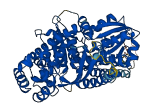
Descriptions
The autoinhibited protein was predicted that may have potential autoinhibitory elements via cis-regPred.
Autoinhibitory domains (AIDs)
Target domain |
|
Relief mechanism |
|
Assay |
cis-regPred |
Accessory elements
No accessory elements
Autoinhibited structure

Activated structure
2 structures for Q9YHZ6
| Entry ID | Method | Resolution | Chain | Position | Source |
|---|---|---|---|---|---|
| 8Q6O | EM | 314 A | J/P | 1-567 | PDB |
| AF-Q9YHZ6-F1 | Predicted | AlphaFoldDB |
No variants for Q9YHZ6
| Variant ID(s) | Position | Change | Description | Diseaes Association | Provenance |
|---|---|---|---|---|---|
| No variants for Q9YHZ6 | |||||
No associated diseases with Q9YHZ6
No regional properties for Q9YHZ6
| Type | Name | Position | InterPro Accession |
|---|---|---|---|
| No domain, repeats, and functional sites for Q9YHZ6 | |||
2 GO annotations of cellular component
| Name | Definition |
|---|---|
| CMG complex | A protein complex that contains the GINS complex, Cdc45p, and the heterohexameric MCM complex, and that is involved in unwinding DNA during replication. |
| nucleoplasm | That part of the nuclear content other than the chromosomes or the nucleolus. |
1 GO annotations of molecular function
| Name | Definition |
|---|---|
| chromatin binding | Binding to chromatin, the network of fibers of DNA, protein, and sometimes RNA, that make up the chromosomes of the eukaryotic nucleus during interphase. |
2 GO annotations of biological process
| Name | Definition |
|---|---|
| cell cycle | The progression of biochemical and morphological phases and events that occur in a cell during successive cell replication or nuclear replication events. Canonically, the cell cycle comprises the replication and segregation of genetic material followed by the division of the cell, but in endocycles or syncytial cells nuclear replication or nuclear division may not be followed by cell division. |
| DNA replication initiation | The process in which DNA-dependent DNA replication is started; this begins with the ATP dependent loading of an initiator complex onto the DNA, this is followed by DNA melting and helicase activity. In bacteria, the gene products that enable the helicase activity are loaded after the initial melting and in archaea and eukaryotes, the gene products that enable the helicase activity are inactive when they are loaded and subsequently activate. |
No homologous proteins in AiPD
| UniProt AC | Gene Name | Protein Name | Species | Evidence Code |
|---|---|---|---|---|
| No homologous proteins | ||||
| 10 | 20 | 30 | 40 | 50 | 60 |
| MFVSDLRKEF | FDVIVTERVL | LLVAPDVDAL | CACKILQALF | QCDHVQYTLV | PVSGWQELET |
| 70 | 80 | 90 | 100 | 110 | 120 |
| LFLEHKEQFR | YFVLINCGAN | IDLLETLQPQ | EEAIFYICDT | HRPIDVVNIY | NDSQVKLLIR |
| 130 | 140 | 150 | 160 | 170 | 180 |
| QDDDLEIPAY | DDIFNDDEED | GEDSGNESDG | AEPSGKRRRF | DEAAVERRIE | RRRQRREWEA |
| 190 | 200 | 210 | 220 | 230 | 240 |
| RRREIIFDYE | QYEYHGTSSA | MMMFELAWIM | SKDSNDMLWW | AIVGLTDQWV | QDRITQMKYV |
| 250 | 260 | 270 | 280 | 290 | 300 |
| TDVGTLQRHV | SRHNHRNEDE | ENSLSIDCMR | IAFEYDLRLS | LYQHWSLYES | ICNSCYTSAT |
| 310 | 320 | 330 | 340 | 350 | 360 |
| LKLWSLQGQK | KLQEFLADMG | MPLKQVKQKF | NSMDISLKEN | LREMLEESAN | KFGMKDVRVQ |
| 370 | 380 | 390 | 400 | 410 | 420 |
| TFSVQFGFKN | KFLASDIVFA | VLSLLENTER | DEKGTDNFIK | ALDSLSRSNL | DKLHTGLEMG |
| 430 | 440 | 450 | 460 | 470 | 480 |
| KKLLCAIQQT | VASCICTNLI | LSQGPFLYCY | LMEGTPDVKM | FSNPISLCLL | CKYLLKSFVC |
| 490 | 500 | 510 | 520 | 530 | 540 |
| STKNKRCKLL | PLVLAAPLDA | EKGTVIMVGI | PPEAESSDKK | NFFGRAFEKA | AESTSSRTLH |
| 550 | 560 | ||||
| NHFDMSIIEL | RTEDRSKFLD | ALISLLS |