Q9YGW0
Gene name |
mknk1 (mnk1) |
Protein name |
MAP kinase-interacting serine/threonine-protein kinase 1 |
Names |
MAP kinase signal-integrating kinase 1, MAPK signal-integrating kinase 1, Mnk1 |
Species |
Xenopus laevis (African clawed frog) |
KEGG Pathway |
xla:387327 |
EC number |
2.7.11.1: Protein-serine/threonine kinases |
Protein Class |
|
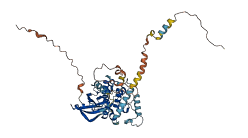
Descriptions
The autoinhibited protein was predicted that may have potential autoinhibitory elements via cis-regPred.
Autoinhibitory domains (AIDs)
Target domain |
|
Relief mechanism |
|
Assay |
cis-regPred |
Accessory elements
178-208 (Activation loop from InterPro)
Target domain |
37-321 (Protein kinase domain) |
Relief mechanism |
|
Assay |
|
Autoinhibited structure

Activated structure
1 structures for Q9YGW0
| Entry ID | Method | Resolution | Chain | Position | Source |
|---|---|---|---|---|---|
| AF-Q9YGW0-F1 | Predicted | AlphaFoldDB |
No variants for Q9YGW0
| Variant ID(s) | Position | Change | Description | Diseaes Association | Provenance |
|---|---|---|---|---|---|
| No variants for Q9YGW0 | |||||
No associated diseases with Q9YGW0
5 regional properties for Q9YGW0
| Type | Name | Position | InterPro Accession |
|---|---|---|---|
| domain | GMP synthase, C-terminal | 212 - 525 | IPR001674 |
| domain | GMP synthase, glutamine amidotransferase | 10 - 205 | IPR004739 |
| domain | Glutamine amidotransferase | 12 - 198 | IPR017926 |
| domain | NAD/GMP synthase | 215 - 289 | IPR022310 |
| domain | GMP synthetase ATP pyrophosphatase domain | 208 - 400 | IPR025777 |
Functions
| Description | ||
|---|---|---|
| EC Number | 2.7.11.1 | Protein-serine/threonine kinases |
| Subcellular Localization |
|
|
| PANTHER Family | ||
| PANTHER Subfamily | ||
| PANTHER Protein Class | ||
| PANTHER Pathway Category | No pathway information available | |
No GO annotations of cellular component
| Name | Definition |
|---|---|
| No GO annotations for cellular component |
4 GO annotations of molecular function
| Name | Definition |
|---|---|
| ATP binding | Binding to ATP, adenosine 5'-triphosphate, a universally important coenzyme and enzyme regulator. |
| metal ion binding | Binding to a metal ion. |
| protein serine kinase activity | Catalysis of the reactions: ATP + protein serine = ADP + protein serine phosphate. |
| protein serine/threonine kinase activity | Catalysis of the reactions: ATP + protein serine = ADP + protein serine phosphate, and ATP + protein threonine = ADP + protein threonine phosphate. |
2 GO annotations of biological process
| Name | Definition |
|---|---|
| protein phosphorylation | The process of introducing a phosphate group on to a protein. |
| regulation of translation | Any process that modulates the frequency, rate or extent of the chemical reactions and pathways resulting in the formation of proteins by the translation of mRNA or circRNA. |
No homologous proteins in AiPD
| UniProt AC | Gene Name | Protein Name | Species | Evidence Code |
|---|---|---|---|---|
| No homologous proteins | ||||
| 10 | 20 | 30 | 40 | 50 | 60 |
| MVSSQPVPFD | DGGKRRKKKR | KTRAMESFTG | KFADLYRLTD | ELLGEGAYAK | VQGCVSLQNG |
| 70 | 80 | 90 | 100 | 110 | 120 |
| KDYAVKIVEK | KAGHSRSRVF | REVETLYQCQ | GNKNILELIE | FCEDDARFYL | VFEKLLGGSI |
| 130 | 140 | 150 | 160 | 170 | 180 |
| LSHIQKRKHF | NEREASKVVK | DIASALDFLH | TKGIAHRDLK | PENILCEFKD | KVSPVKICDF |
| 190 | 200 | 210 | 220 | 230 | 240 |
| DLGSGVKLNS | ACTTITTPEL | TTPCGSAEYM | APEVVEVFTE | EATFYDKRCD | LWSLGVILYI |
| 250 | 260 | 270 | 280 | 290 | 300 |
| MLSGYPPFVG | NCGTDCGWDR | GEVCRVCQNK | LFESIQEGKY | EFPEKDWSHI | SISAKDLISK |
| 310 | 320 | 330 | 340 | 350 | 360 |
| LLVRDAKERL | SAFQVLQHPW | LQGDAPERGL | PTPLVLQRNS | STKDLTIFAA | EAIAFNRQLS |
| 370 | 380 | 390 | 400 | 410 | |
| QHDNDLNEED | ESFIHAVCSM | RLSPPSKSRL | AKRRAQAHAR | KGGSHPTHST | VTASQGTP |