Q9Y7K1
Gene name |
SPBC216.04c |
Protein name |
Uncharacterized protein C216.04c |
Names |
|
Species |
Schizosaccharomyces pombe (strain 972 / ATCC 24843) (Fission yeast) |
KEGG Pathway |
spo:SPBC216.04c |
EC number |
|
Protein Class |
|
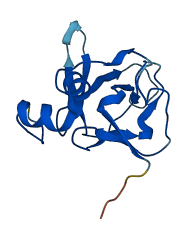
Descriptions
The autoinhibited protein was predicted that may have potential autoinhibitory elements via cis-regPred.
Autoinhibitory domains (AIDs)
Target domain |
|
Relief mechanism |
|
Assay |
cis-regPred |
Accessory elements
No accessory elements
Autoinhibited structure

Activated structure
1 structures for Q9Y7K1
| Entry ID | Method | Resolution | Chain | Position | Source |
|---|---|---|---|---|---|
| AF-Q9Y7K1-F1 | Predicted | AlphaFoldDB |
No variants for Q9Y7K1
| Variant ID(s) | Position | Change | Description | Diseaes Association | Provenance |
|---|---|---|---|---|---|
| No variants for Q9Y7K1 | |||||
No associated diseases with Q9Y7K1
1 regional properties for Q9Y7K1
| Type | Name | Position | InterPro Accession |
|---|---|---|---|
| domain | Peptide methionine sulphoxide reductase MrsB domain | 7 - 134 | IPR002579 |
2 GO annotations of cellular component
| Name | Definition |
|---|---|
| cytosol | The part of the cytoplasm that does not contain organelles but which does contain other particulate matter, such as protein complexes. |
| nucleus | A membrane-bounded organelle of eukaryotic cells in which chromosomes are housed and replicated. In most cells, the nucleus contains all of the cell's chromosomes except the organellar chromosomes, and is the site of RNA synthesis and processing. In some species, or in specialized cell types, RNA metabolism or DNA replication may be absent. |
2 GO annotations of molecular function
| Name | Definition |
|---|---|
| metal ion binding | Binding to a metal ion. |
| peptide-methionine (R)-S-oxide reductase activity | Catalysis of the reaction: peptide-L-methionine + H(2)O + thioredoxin disulfide = peptide-L-methionine (R)-S-oxide + thioredoxin. Can act on oxidized methionine in peptide linkage with specificity for the R enantiomer. Thioredoxin disulfide is the oxidized form of thioredoxin. |
3 GO annotations of biological process
| Name | Definition |
|---|---|
| cellular detoxification | Any process carried out at the cellular level that reduces or removes the toxicity of a toxic substance. These may include transport of the toxic substance away from sensitive areas and to compartments or complexes whose purpose is sequestration of the toxic substance. |
| protein repair | The process of restoring a protein to its original state after damage by such things as oxidation or spontaneous decomposition of residues. |
| response to oxidative stress | Any process that results in a change in state or activity of a cell or an organism (in terms of movement, secretion, enzyme production, gene expression, etc.) as a result of oxidative stress, a state often resulting from exposure to high levels of reactive oxygen species, e.g. superoxide anions, hydrogen peroxide (H2O2), and hydroxyl radicals. |
No homologous proteins in AiPD
| UniProt AC | Gene Name | Protein Name | Species | Evidence Code |
|---|---|---|---|---|
| No homologous proteins | ||||
| 10 | 20 | 30 | 40 | 50 | 60 |
| MGFPLEKSED | EWKKELGPEK | YRIMRQKGTE | HPGAGRFTHQ | FPKQGVFVCA | ACKELLYKAS |
| 70 | 80 | 90 | 100 | 110 | 120 |
| TKFESHCGWP | AFFDNLPGKV | KRIEDNSYGM | HRVEAVCANC | GGHLGHIFKG | EGYSNPTDER |
| 130 | |||||
| HCINSASLEF | HNEATNDN |