Q9Y738
Gene name |
mis12 (SPBC409.04c) |
Protein name |
Centromere protein mis12 |
Names |
NMS complex subunit mis12 |
Species |
Schizosaccharomyces pombe (strain 972 / ATCC 24843) (Fission yeast) |
KEGG Pathway |
spo:SPBC409.04c |
EC number |
|
Protein Class |
|
Descriptions
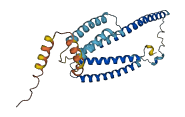
The autoinhibited protein was predicted that may have potential autoinhibitory elements via cis-regPred.
Autoinhibitory domains (AIDs)
Target domain |
|
Relief mechanism |
|
Assay |
cis-regPred |
Accessory elements
No accessory elements
Autoinhibited structure

Activated structure
2 structures for Q9Y738
| Entry ID | Method | Resolution | Chain | Position | Source |
|---|---|---|---|---|---|
| 5WWL | X-ray | 240 A | M | 1-215 | PDB |
| AF-Q9Y738-F1 | Predicted | AlphaFoldDB |
No variants for Q9Y738
| Variant ID(s) | Position | Change | Description | Diseaes Association | Provenance |
|---|---|---|---|---|---|
| No variants for Q9Y738 | |||||
No associated diseases with Q9Y738
5 regional properties for Q9Y738
| Type | Name | Position | InterPro Accession |
|---|---|---|---|
| domain | GMP synthase, C-terminal | 213 - 525 | IPR001674 |
| domain | GMP synthase, glutamine amidotransferase | 10 - 205 | IPR004739 |
| domain | Glutamine amidotransferase | 12 - 200 | IPR017926 |
| domain | NAD/GMP synthase | 223 - 295 | IPR022310 |
| domain | GMP synthetase ATP pyrophosphatase domain | 208 - 400 | IPR025777 |
5 GO annotations of cellular component
| Name | Definition |
|---|---|
| chromosome, centromeric core domain | The innermost portion of the centromeric region of a chromosome, encompassing the core region of a chromosome centromere and the proteins that bind to it. |
| condensed chromosome, centromeric region | The region of a condensed chromosome that includes the centromere and associated proteins, including the kinetochore. In monocentric chromosomes, this region corresponds to a single area of the chromosome, whereas in holocentric chromosomes, it is evenly distributed along the chromosome. |
| inner kinetochore | The region of a kinetochore closest to centromeric DNA; in mammals the CREST antigens (CENP proteins) are found in this layer; this layer may help define underlying centromeric chromatin structure and position of the kinetochore on the chromosome. |
| NMS complex | A supercomplex formed by the association of two subcomplexes (known as MIND and Ndc80 in Schizosaccharomyces) with additional proteins at the kinetochores of condensed nuclear chromosomes. |
| nuclear MIS12/MIND complex | A multiprotein kinetochore subcomplex that binds to centromeric chromatin and forms part of the inner kinetochore of a chromosome in the nucleus. It helps to recruit outer kinetochore subunits that will bind to microtubules. Nuclear localization arises in some organisms because the nuclear envelope is not broken down during mitosis. In S. cerevisiae, it consists of at least four proteins: Mtw1p, Nnf1p, Nsl1p, and Dsn1. |
No GO annotations of molecular function
| Name | Definition |
|---|---|
| No GO annotations for molecular function |
5 GO annotations of biological process
| Name | Definition |
|---|---|
| cell division | The process resulting in division and partitioning of components of a cell to form more cells; may or may not be accompanied by the physical separation of a cell into distinct, individually membrane-bounded daughter cells. |
| kinetochore assembly | The aggregation, arrangement and bonding together of a set of components to form the kinetochore, a multisubunit complex that is located at the centromeric region of DNA and provides an attachment point for the spindle microtubules. |
| mitotic sister chromatid segregation | The cell cycle process in which replicated homologous chromosomes are organized and then physically separated and apportioned to two sets during the mitotic cell cycle. Each replicated chromosome, composed of two sister chromatids, aligns at the cell equator, paired with its homologous partner. One homolog of each morphologic type goes into each of the resulting chromosome sets. |
| monopolar spindle attachment to meiosis I kinetochore | The process in which spindle microtubules become physically associated with the proteins making up the kinetochore complex during meiosis I. During meiosis I sister kinetochores are lying next to each other facing the same spindle pole and monopolar attachment of the chromatid to the spindle occurs. |
| protein localization to kinetochore | Any process in which a protein is transported to, or maintained at, the kinetochore. |
No homologous proteins in AiPD
| UniProt AC | Gene Name | Protein Name | Species | Evidence Code |
|---|---|---|---|---|
| No homologous proteins | ||||
| 10 | 20 | 30 | 40 | 50 | 60 |
| MLVELLEFTP | LSFIDDVINI | TNQLLYKGVN | GVDKAFSQTR | FAKKAPQEIE | EGLHKFEVLF |
| 70 | 80 | 90 | 100 | 110 | 120 |
| ESVVDRYYDG | FEVYTLRNIF | SYPPELKGYM | RTFGKDVDYS | ITTEQDAAMD | QAIQEAAEKL |
| 130 | 140 | 150 | 160 | 170 | 180 |
| VVKMQLRRDL | RMRLSRKREK | KTEIEKHLER | ISFLNKVPEN | WQVTLPETTD | FLLDQLGNLQ |
| 190 | 200 | 210 | 220 | 230 | 240 |
| HAVKRVVEAS | PTVHSREVDE | RITYLEKGYE | RLSNPIDQQK | DFWSHHLSKL | ESTANTETAN |
| 250 | |||||
| NIHKLLLSSE | KDVGHTDEP |