Q9XTA8
Gene name |
OLR1 (LOX1) |
Protein name |
Oxidized low-density lipoprotein receptor 1 |
Names |
Ox-LDL receptor 1, Lectin-like oxidized LDL receptor 1, LOX-1, Lectin-like oxLDL receptor 1, Lectin-type oxidized LDL receptor 1 |
Species |
Oryctolagus cuniculus (Rabbit) |
KEGG Pathway |
ocu:100009322 |
EC number |
|
Protein Class |
|
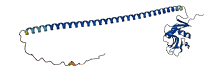
Descriptions
The autoinhibited protein was predicted that may have potential autoinhibitory elements via cis-regPred.
Autoinhibitory domains (AIDs)
Target domain |
|
Relief mechanism |
|
Assay |
cis-regPred |
Accessory elements
No accessory elements
Autoinhibited structure

Activated structure
1 structures for Q9XTA8
| Entry ID | Method | Resolution | Chain | Position | Source |
|---|---|---|---|---|---|
| AF-Q9XTA8-F1 | Predicted | AlphaFoldDB |
No variants for Q9XTA8
| Variant ID(s) | Position | Change | Description | Diseaes Association | Provenance |
|---|---|---|---|---|---|
| No variants for Q9XTA8 | |||||
No associated diseases with Q9XTA8
Functions
4 GO annotations of cellular component
| Name | Definition |
|---|---|
| extracellular region | The space external to the outermost structure of a cell. For cells without external protective or external encapsulating structures this refers to space outside of the plasma membrane. This term covers the host cell environment outside an intracellular parasite. |
| integral component of membrane | The component of a membrane consisting of the gene products and protein complexes having at least some part of their peptide sequence embedded in the hydrophobic region of the membrane. |
| membrane raft | Any of the small (10-200 nm), heterogeneous, highly dynamic, sterol- and sphingolipid-enriched membrane domains that compartmentalize cellular processes. Small rafts can sometimes be stabilized to form larger platforms through protein-protein and protein-lipid interactions. |
| plasma membrane | The membrane surrounding a cell that separates the cell from its external environment. It consists of a phospholipid bilayer and associated proteins. |
1 GO annotations of molecular function
| Name | Definition |
|---|---|
| carbohydrate binding | Binding to a carbohydrate, which includes monosaccharides, oligosaccharides and polysaccharides as well as substances derived from monosaccharides by reduction of the carbonyl group (alditols), by oxidation of one or more hydroxy groups to afford the corresponding aldehydes, ketones, or carboxylic acids, or by replacement of one or more hydroxy group(s) by a hydrogen atom. Cyclitols are generally not regarded as carbohydrates. |
3 GO annotations of biological process
| Name | Definition |
|---|---|
| cell adhesion | The attachment of a cell, either to another cell or to an underlying substrate such as the extracellular matrix, via cell adhesion molecules. |
| immune system process | Any process involved in the development or functioning of the immune system, an organismal system for calibrated responses to potential internal or invasive threats. |
| inflammatory response | The immediate defensive reaction (by vertebrate tissue) to infection or injury caused by chemical or physical agents. The process is characterized by local vasodilation, extravasation of plasma into intercellular spaces and accumulation of white blood cells and macrophages. |
No homologous proteins in AiPD
| UniProt AC | Gene Name | Protein Name | Species | Evidence Code |
|---|---|---|---|---|
| No homologous proteins | ||||
| 10 | 20 | 30 | 40 | 50 | 60 |
| MAVDDLKVKP | MKDQPDQKSN | GKKPKGLRFL | SSPWWCPAAV | ALGVLCLGSL | MTIIMLGMQL |
| 70 | 80 | 90 | 100 | 110 | 120 |
| LQVSDLLKQQ | QANLTLQENI | LEGQVLAQQQ | AEAASQESQR | ELKEMIETLA | KRLDEKSKKQ |
| 130 | 140 | 150 | 160 | 170 | 180 |
| MELNHQYLNL | QEALKRMDNF | SGPCPEDWLW | HGKNCYLFSS | GSFNWESSQE | KCLSLDAQLL |
| 190 | 200 | 210 | 220 | 230 | 240 |
| KINSTEDLGF | IQQATSHSSF | PFWMGLSRRK | PDYSWLWEDG | SPLMPHLFRF | QGAVSQRYPS |
| 250 | 260 | 270 | |||
| GTCAYIQKGN | VFAENCILVA | YSICQKKANL | LRSE |